American Public Opinion About Election 2004
Tuesday, September 14, 2004
by Joseph Carroll
Gallup polling after this year's political conventions finds Americans generally receptive to the conventions and the candidates' acceptance speeches. Roughly 4 in 10 Americans also said they were more likely to vote for Republican incumbent George W. Bush and, in a separate question, for Democratic challenger John Kerry as a result of the conventions.
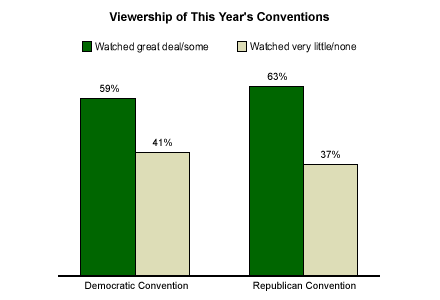
Viewership of This Year's Conventions
After the Democratic and Republican conventions, Gallup asked Americans about how much of each convention they watched on television. Americans were just slightly more likely to report having watched at least some of the Republican convention than to say this about the Democratic convention. The polls show that 63% of Americans said they watched a great deal or some of the GOP convention, compared with 59% who watched the Democratic convention.
Not surprisingly, self-reported convention viewership varied significantly depending on partisanship, with Republicans and Democrats each much more likely to state that they watched their own party's convention. Seventy-four percent of Democrats said they watched at least some of the convention on television. This compares with 56% of independents and 46% of Republicans who watched that amount of the Democratic convention. By comparison, 81% of Republicans said they watched a great deal or some of the GOP convention, compared with 52% of independents and 49% of Democrats.
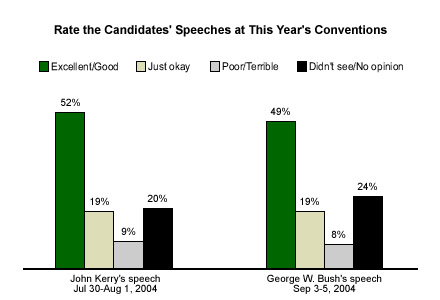
Rating Kerry's and Bush's Convention Speeches
Gallup's convention polling this year finds few differences in the public's overall ratings of Kerry's and Bush's acceptance speeches at their respective parties' conventions. A slight majority of Americans, 52%, rated Kerry's speech at the Democratic convention as excellent (25%) or good (27%), while just about half of all Americans rated Bush's speech at the Republican convention as excellent (22%) or good (27%). About one in five adults nationwide rated both speeches as "just okay," and fewer than 1 in 10 said the speeches were "poor" or "terrible."
Again, partisan viewpoints make a big difference in ratings of the acceptance speeches. Eighty-one percent of Democrats rated Kerry's acceptance speech as excellent or good, compared with 52% of independents and 22% of Republicans. Seventy-seven percent of Republicans rated Bush's speech positively, while 42% of independents and 24% of Democrats shared that point of view.
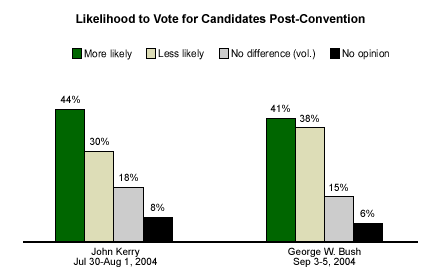
How Did the Conventions Affect Americans' Vote Choice?
When Americans were asked if the conventions made them more likely or less likely to vote for the candidates, Gallup found that Kerry fared slightly better than Bush. After the Democratic convention, 44% of Americans said they were more likely to vote for Kerry, while 30% said they were less likely and 18% voluntarily responded that it didn't make much difference. Polling after the GOP convention found 41% of Americans saying they were more likely to vote for Bush, 38% saying they were less likely, and 18% saying it made no difference.
Following the Democratic convention, 76% of Democrats said they were more likely to vote for Kerry as a result of that convention, compared with 45% of independents and just 11% of Republicans who felt that way. After the Republican convention, the results were essentially the reverse. Seventy-seven percent of Republicans said they were more likely to vote for Bush as a result of the convention, compared with 33% of independents and 8% of Democrats.
Despite these self-reported reactions, of course, Kerry did not gain in Gallup's trial-heat balloting following his convention, while Bush enjoyed a slight uptick in polling after his convention.