Second in a series on religion and voting habits
So much has happened to change America's social and political landscape in the last four years; it will be fascinating to see how those changes are reflected in the dynamics of next year's presidential election. The influence of religion provides a case in point: Three months before the last election in August 2000, when Gallup asked Americans how important religion would be to their vote, 33% said their personal religious beliefs and faith would be "extremely" or "very" important*. This figure is very close to the 36% of Americans who answered the same way in a November 2003 poll, approximately one year before the 2004 presidential election**.
So on the surface, it appears that little has changed. But a closer look at the data reveals some significant changes along political lines.
The New "Party Line"
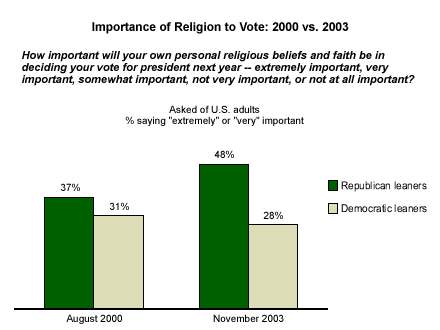
In 2000, the data showed little difference between Republicans and Democrats with regard to the importance of religion to their vote. Thirty-seven percent of Republicans and Republican leaners said that their religious beliefs would be extremely or very important in their decisions, compared to 31% of Democrats and Democratic leaners.
But the 2003 data tell a different story. In the most recent survey, nearly half of Republicans and Republican leaners (48%) say religion will be important to their votes in the 2004 presidential election, as do only 28% of Democrats and Democratic leaners. It is unclear how much a conservative, more overtly religious president in office may be behind the shift of the religious vote, or if it is just a continuation of trend that began earlier.
Religion Galvanizes Support for Bush
In August 2000, registered voters who said that religion would be extremely or very important to their vote were about as likely to support Democratic candidate Al Gore as they were Republican presidential candidate George W. Bush: 46% planned to vote for Bush in the 2000 election, while 46% planned to vote for Gore.
Though next year's Democratic presidential candidate has not been selected yet, a look at hypothetical matchups between George Bush and the current three top candidates for the Democratic nomination suggests that religion will be more strongly related to support for Bush than for any of the top Democrats.
The Nov. 10-12 poll tested several hypothetical head-to-head races between Bush and each prospective Democratic candidate. Among registered voters who say religion is extremely or very important to their vote, 67% would vote for Bush over former Vermont Gov. Howard Dean (the current Democratic front-runner), while 30% would choose Dean. Similarly, 65% of this group of voters would select Bush over Missouri Rep. Richard Gephardt, and 33% would choose Gephardt. Sixty-five percent would choose Bush over retired Army Gen. Wesley Clark, while 33% would choose Clark. Certainly much can change between now and the election next year, but these early data indicate that religious voters may be overwhelmingly casting votes for Bush.
It seems that in the three years since the election, Bush has become the go-to candidate for those who feel that religion is important to their vote for president. Bush's approval ratings are also much higher among those for whom religion is important to their vote. At the time of this survey, Bush's approval rating was 65% among those who said their faith would be extremely or very important in deciding their vote, compared with 44% among those who say religion will have less of an impact on their vote.
Bottom Line
While overall it appears that the importance of religion to voting has not changed since the last election, the political alignment of those who feel that religion is important to their vote has apparently undergone a shift. Under the leadership of a religious Republican president, the Republicans seem to be winning the battle with Democrats for the support of religious voters.
*These results are based on telephone interviews with a randomly selected national sample of 1,019 adults, aged 18 and older, conducted Aug. 24-27, 2000. For results based on this sample, one can say with 95% confidence that the maximum error attributable to sampling and other random effects is ±3 percentage points. In addition to sampling error, question wording and practical difficulties in conducting surveys can introduce error or bias into the findings of public opinion polls.
For results based on a sample of 832 registered voters, one can say with 95% confidence that the maximum error attributable to sampling and other random effects is ±4 percentage points.
**These results are based on telephone interviews with a randomly selected national sample of 1,004 adults, aged 18 and older, conducted Nov. 10-12, 2003. For results based on this sample, one can say with 95% confidence that the maximum error attributable to sampling and other random effects is ±3 percentage points. In addition to sampling error, question wording and practical difficulties in conducting surveys can introduce error or bias into the findings of public opinion polls.
For results based on a sample of 838 registered voters, one can say with 95% confidence that the maximum error attributable to sampling and other random effects is ±4 percentage points.
