"In the history of Iraq, a dark and painful era is over. A hopeful day has arrived."
-- President Bush, in his address upon Saddam Hussein's capture
But what does the future hold?
Over the course of the past year, analysts on both sides of the Atlantic have spent countless hours debating the question: What do Iraqis want for their future? Do they want a democracy? A theocratic state? The ascendance of their own sect or faith at the expense of others? A tolerant and pluralistic society?
To move beyond conjecture, however, one has to put such questions to Iraqis themselves.
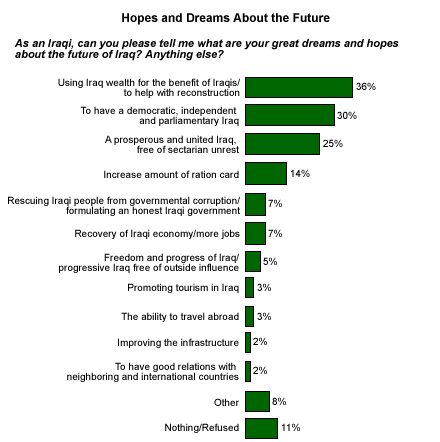
In August and September, Gallup interviewed a scientifically representative sample of 1,178 Baghdad residents in the privacy of their own homes, and asked them to express -- in their own words -- their personal aspirations for their country's future. More than 1,000 verbatim responses were recorded. Among the results:
- More than a third (36%) said they hope their country's wealth will be used for the benefit of the Iraqi people, and to assist in the country's reconstruction.
- Nearly as many (30%) voiced a desire for a democratically governed, independent Iraq. Among those who did, many mentioned a parliamentary system as the means of achieving this objective.
- One Baghdadi in four (25%) expressed the hope for a united and prosperous Iraq, free of sectarian unrest.
- Roughly one in seven (14%) cited a more immediate concern: that the amount of food made available under the ration card system -- still the sole source of sustenance for many unemployed Iraqis -- be increased.
- Smaller proportions said they hope for an honest Iraqi government untainted by corruption (7%), economic recovery and increased job opportunities (7%), and a progressive Iraq free from outside influences (5%).
In Their Own Words
Aggregating the types of replies given to this open-ended question makes it possible to know how broadly held various sentiments are. But the most compelling and poignant insights come from the actual verbatim responses themselves. Here are some of the specific aspirations voiced by the Baghdadis that Gallup interviewed:
- "To have a democratic government, where all Iraqis and people of other nationalities would live fairly. Also, that Iraqis should be respected by all neighboring countries." -- male, early 40s, did not complete intermediate school
- "Complete freedom of the Iraqi people. Putting an end to wars. Improving the security and economic status, so that a high level of prosperity would prevail in Iraq." -- female, late 30s, basic education only
- "I wish that the president of the republic would be just and democratic, and would look after the people instead of himself." -- male, early 30s, did not complete secondary school
- "(That) Iraq's fortunes remain for the Iraqi people only" -- female, late 20s, did not complete secondary school
- "That Iraq would be safe, stable, and good. For Iraqi people to rebuild their country themselves." -- male, early 50s, did not complete intermediate school
- "To get our rights, no stranger should prevent us from our rights. Providing housing for Iraqi families." -- female, early 50s, did not complete intermediate school
- "Stability of security and economy. Improving the relationship with other countries of the world and allowing Iraqis to travel more freely." -- male, early 20s, college education
- "An independent and free country, with no occupation" -- male, early 40s, basic education only
- "To have an integrated, independent national government from south to north, that considers the rights of the Iraqi people of all sects, regardless of their religion or policies" -- male, early 40s, college education
- "Stability. Distributing land and housing to the Iraqi people. Offering job opportunities for the Iraqi people. Distributing oil earnings to the Iraqi people, taking into consideration the fact that Iraq needs to rebuild." -- female, early 40s, no formal education
- "Forming an independent Iraqi government. All Iraqi people enjoy safety and security. Improving the economic and living conditions of the Iraqi people." -- female, late teens, did not complete intermediate school
- "To have Iraq independent and free from hegemony and foreign interference" -- female, early 20s, college education
- "Supporting educated people, especially youth. Allowing easy traveling. Providing housing to Iraqi people. Improving the economic situation." -- female, late 20s, university degree
- "Ensuring security and welfare for Iraq's people and securing the future of their children" -- female, late 30s, completed secondary school
Ordinary Iraqis, emerging from two decades in which the expression of provocative ideas could mean jail or death, have given compelling descriptions of their wishes for their country's future. It would be tragic indeed if the West -- and Iraq's next government -- did not listen to their voices.
