More than two years after the Sept. 11 terrorist attacks, debate continues to swirl around the law born of those times, the USA Patriot Act. Passed almost without dissent on Oct. 26, 2001, the Patriot Act greatly enhanced law enforcement officials' powers to pursue terrorists, both foreign and domestic. Once the crisis atmosphere that the attacks generated began to fade, officials at both the city and state levels (as well as private citizens) began to question whether the law undermines citizens' civil rights under the Constitution.
A Gallup Poll conducted in November 2003* indicates that public familiarity with the Patriot Act is still fairly low, and Americans appear unwilling to have their civil rights violated in the name of defense against terrorism. The data also show that Americans are growing more likely to say that the Bush administration has gone too far in restricting civil liberties in the fight against terrorism.
America's Civil Liberty Awakening
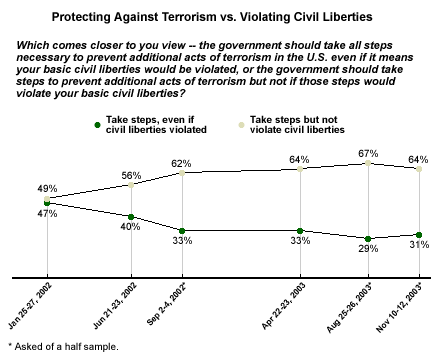
At the outset of 2002, just a few months after the Sept. 11 terrorist attacks, Americans were evenly divided about the steps the government should take to prevent additional acts of terrorism. In January 2002, 47% of Americans said that the government should take "all steps necessary" to prevent future acts of terrorism in the United States, even if it means violating people's basic civil liberties. Forty-nine percent said the government should take steps to prevent additional acts of terrorism, but not if those steps would violate civil liberties. The November 2003 data paint a different picture -- in that survey, just under a third (31%) said that any steps necessary should be taken to prevent terrorism, while 64% said the government should take steps but not violate people's civil liberties. The data have shown a roughly 2-to-1 margin against violating civil liberties since September 2002.
Americans Unfamiliar With Patriot Act
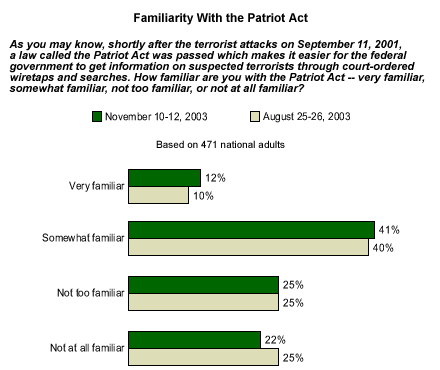
When asked about the Patriot Act by name for the first time in August 2003, almost half of Americans said they weren't familiar with the Patriot Act. Attorney General John Ashcroft's efforts last September to tout the value of the new law, and the media coverage and debate that accompanied his tour did little to change this. In November, 53% of the public said it was either very (12%) or somewhat (41%) familiar with the Patriot Act, while the other half was either not too (25%) or not at all (22%) familiar.
Going Too Far?
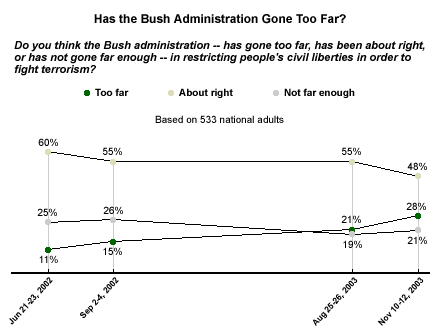
Over the last two years, the public has become increasingly likely to feel that the Bush administration is going too far in restricting civil liberties in order to fight terrorism. Although only about a quarter of the population (28%) said this last November, that percentage had increased steadily from 11% in June 2002. The November poll showed roughly half of Americans saying the Bush administration had been "about right" in its handling of civil liberties and the fight on terrorism, while 21% said the administration had not gone far enough.
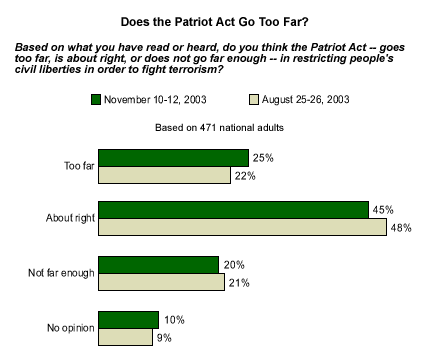
Gallup also asked this same question in reference to the Patriot Act, and found that responses mirror those applied to the Bush administration's security measures. Twenty-five percent of Americans said that the Patriot Act goes too far in restricting civil liberties, 45% said it is about right, and 20% said it does not go far enough.
*Results are based on telephone interviews with 1,004 national adults, aged 18 and older, conducted Nov. 10-12, 2003. All questions reported in this story are based on randomly selected halves of the sample (roughly 500 interviews). For results based on these samples of national adults, one can say with 95% confidence that the maximum margin of sampling error is ±5 percentage points.
