Medicare reform has been among the prominent political topics lately, as Democratic presidential hopefuls have come up with their own plans for how to improve the U.S. healthcare system. Many of these proposed changes are reminiscent of healthcare policy in Canada and Great Britain, where universal care is the standard.
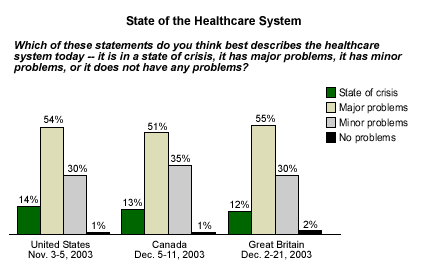
Recent Gallup Polls conducted in the United States, Canada, and Great Britain* asked residents of each country how satisfied they are with their healthcare systems and whether they would like them changed. More than 50% of respondents in each country feel that their respective healthcare system has "major problems." Roughly a third in each country feel that there are minor problems. Relatively small percentages define their systems as "in a state of crisis," but few feel there are no problems at all.
Quality of Healthcare
Given that the ratings of the state of their healthcare systems do not differ by country, one might suppose that Americans, Canadians, and Britons would similarly rate the quality of the healthcare they receive. But there are modest differences here: A somewhat higher percentage of Americans rate the quality of healthcare they receive as "excellent" (33%) than do either Britons (27%) or Canadians (24%). Roughly half of the residents of each country rate the healthcare they receive as "good," but the percentage of people rating their healthcare "only fair" is higher in Canada (19%) and Great Britain (20%) than it is in the United States (13%).
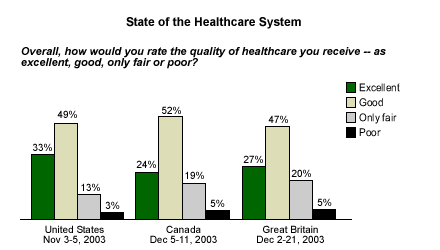
It seems that U.S. policy-makers should pause before looking to Canada and Great Britain for solutions to their country's healthcare issues. Despite highly publicized concerns about medical errors and other healthcare quality issues in the United States, Americans are no less likely than Britons and Canadians to give high marks to their healthcare services.
Changing the Healthcare System
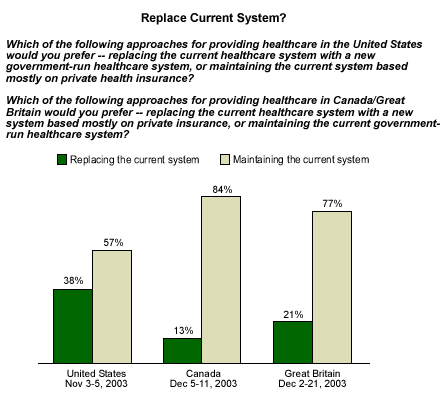
One might suppose that their levels of satisfaction with healthcare received would make Americans as likely as Britons and Canadians to call for changes to the system. However, U.S. residents are actually more likely than Canadians or Britons to feel such change is necessary.
Thirty-eight percent of Americans say they would like to replace the current, private U.S. healthcare system with a government-run system similar to that in Canada and Great Britain. But only 21% of British citizens would like to see the government-run British system replaced with a system based mostly on private insurance. And Canadians are less likely than Britons to want to replace their government-run system, at 13%.
Bottom Line
The majority of people in all three countries want to maintain their current systems. But the key to their differences may not be quality, but cost. Nearly a quarter of Americans (24%) say that they or someone in their family has put off medical treatment because of cost (see "Healthcare Decisions: Penny-Wise, Pound-Foolish?" in Related Items), and roughly 8 in 10 Americans say they are dissatisfied with the cost of healthcare in the United States. This problem is less likely to arise in Canada or Great Britain, because universal healthcare is provided -- quality is an issue, but cost is not.
Furthermore, in America, those who have put off healthcare because of cost aren't alone in thinking that healthcare costs in the United States have gotten out of hand. Even the majority of those who have not delayed healthcare because of cost are still dissatisfied with the healthcare costs in the United States more generally. And healthcare costs are Americans' No. 1-rated most urgent health problem.
Perceived inequality may be a major factor in continued support for replacing the U.S. system with a government-run system. As long as this problem persists, healthcare policy will continue to maintain its high-profile status during presidential election years.
*Results in the United States are based on telephone interviews with 1,007 national adults, aged 18 and older, conducted Nov. 3-5, 2003. For results based on the total sample of national adults, one can say with 95% confidence that the maximum margin of sampling error is ±3 percentage points. The survey was conducted by Gallup USA.
Results in Canada are based telephone interviews with 1,012 national adults, aged 18 and older, conducted Dec. 5-11, 2003. For results based on the total sample of national adults, one can say with 95% confidence that the maximum margin of sampling error is ±3 percentage points. The survey was conducted by Gallup Canada.
Results in Great Britain are based telephone interviews with 1,000 national adults, aged 18 and older, conducted Dec. 2-21, 2003. For results based on the total sample of national adults, one can say with 95% confidence that the maximum margin of sampling error is ±5 percentage points. The survey was conducted by Gallup UK.