WASHINGTON, D.C. -- Turkey's new law that extinguishes smoking in all bars, coffeehouses, and restaurants by mid-2009 potentially could have as many as 36 million Turks smoldering. In a May 2007 Gallup Poll in Turkey, half of Turks said they smoked the day before they were surveyed. This 50% is by far the highest incidence reported in the more than 100 countries where Gallup has asked this question; only Lebanon (41%), Greece (40%), and Cuba (40%) come remotely close.
On Jan. 3, the Turkish parliament passed the new law, which expands the country's decade-old smoking ban on buses, planes, and offices, to include enclosed public spaces and other transportation such as taxis and trains. Turks largely flouted the spottily enforced previous ban, but the new legislation comes packaged with a stern warning label about substantial fines for violators.
EU candidate Turkey's anti-smoking legislation follows a wave of recent similar bans in a number of EU member states; bans in Germany and France went into effect only days before Turkey's parliament passed its bill. However, unlike the EU member states it hopes to join, Turkey faces a much higher incidence of smoking; the regional median for incidence of smoking in the EU is 29%. The country is also among the world's top growers and exporters of tobacco.
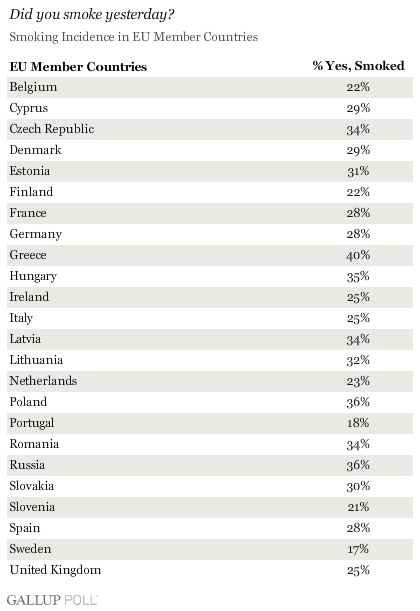
Who Smokes Like Turks?
Smoking occupies a firm place in Turkish culture, especially among males. Two in three Turkish men (66%) said they smoked the previous day, compared with a third of Turkish women (34%). Majorities of Turks across most age groups -- 51% of 15- to 24-year-olds, 58% of 25- to 34-year-olds, and 51% of 35- to 49-year-olds -- said they smoked the previous day. Reported incidence of smoking only drops below a majority among Turks who are 50 and older; 36% of Turks in this age group said they smoked.
Survey Methods
Results are based on face-to-face interviews with 1,001 adults in Turkey, aged 15 and older, conducted in May 2007. For results based on the total sample of national adults, one can say with 95% confidence that the maximum margin of sampling error is ±3 percentage points. In addition to sampling error, question wording and practical difficulties in conducting surveys can introduce error or bias into the findings of public opinion polls.