WASHINGTON, D.C. -- In its recent assessment of Iran's covert nuclear work, the National Intelligence Council determined that the country had "halted its nuclear weapons program." Nevertheless, Washington maintains a tough stance on Tehran. During his recent Mideast tour, President George W. Bush said Iran "seeks to intimidate its neighbors with ballistic missiles and bellicose rhetoric" and urged Arab leaders to engage in a policy of containment. Although some in the region agree that Iran presents a potential threat, Arab leaders also emphasized the need for dialogue and diplomacy, underlining the importance of avoiding a military conflict.
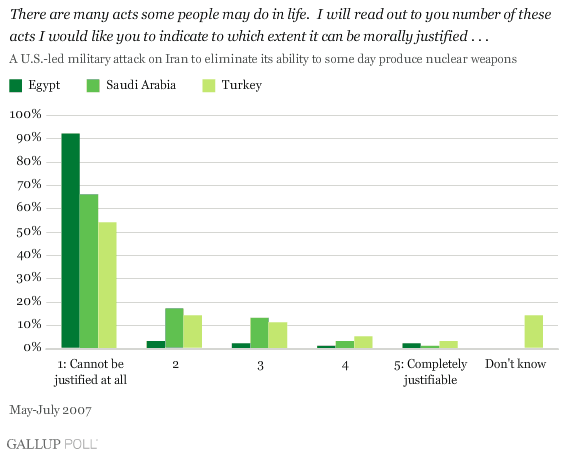
Results from Gallup Polls conducted in Egypt, Saudi Arabia (both nations were on the president's tour), and Turkey in 2007 reveal that few would condone military action against Iran. Respondents were asked to rate the extent to which a U.S.-led military attack on Iran to eliminate its ability to someday produce nuclear weapons can be morally justified on a 5-point scale, where "1" means that it cannot be justified at all and "5" means that it is completely justifiable. Only 2% of Egyptians, 1% of Saudis, and 3% of Turks say such an attack can be completely justifiable. At the other end of the scale, 92% of Egyptians, 66% of Saudis, and 54% of Turks say it cannot be justified at all. Unlike in Egypt and Saudi Arabia, where all respondents selected a specific level of moral justification on the 5-point scale, 14% of Turks say they did not know.
One could argue that few in Egypt, Saudi Arabia, and Turkey, three key U.S. allies in the region, view the use of military force on Iran as morally justifiable because the potential target is a Muslim nation located in the Middle East. However, the poll asked a similar question about the moral justification of an attack on North Korea, which the U.S. administration also considers to be a rogue state (although negotiations have been under way to curb Pyongyang's nuclear weapons program). Similarly, few respondents in the three countries surveyed would condone such a military action. Only 3% of Egyptians and 2% of Saudis and Turks say a U.S.-led military attack on North Korea to eliminate its nuclear capabilities is completely justifiable. Unlike in Egypt and Saudi Arabia, where all respondents selected a specific level of moral justification on the 5-point scale, 16% of Turks say they did not know.
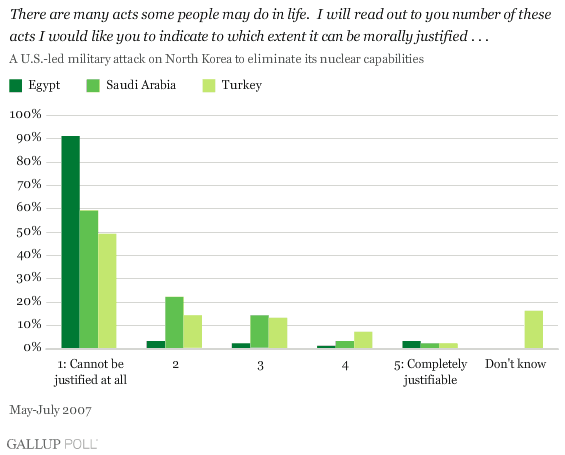
The similarities in public opinion vis-à-vis military action against Iran and North Korea are striking. By asking Muslims to take a moral stand on a potential event that would occur far from their own backyard and affect non-Muslims, the poll results bring Egyptians', Saudis', and Turks' attitudes into sharper focus. The findings reveal that, at least, those surveyed do not condone the United States' use of its military might to police the world. Further, Gallup research in 10 predominantly Muslim countries shows that respondents associate ruthless (68%), aggressive (66%), and conceited (65%) with the United States. Overall, such attitudes suggest that Muslims, at least those surveyed, perceive military action, even to remove a potential nuclear threat, to be unacceptably aggressive foreign policy.
Survey Methods
Results are based on face-to-face interviews with at least 1,000 adults, aged 15 and older, in Egypt, Saudi Arabia, and Turkey conducted from May through July 2007. For results based on the total sample of national adults, one can say with 95% confidence that the maximum margin of sampling error is ±3 percentage points. In addition to sampling error, question wording and practical difficulties in conducting surveys can introduce error or bias into the findings of public opinion polls.