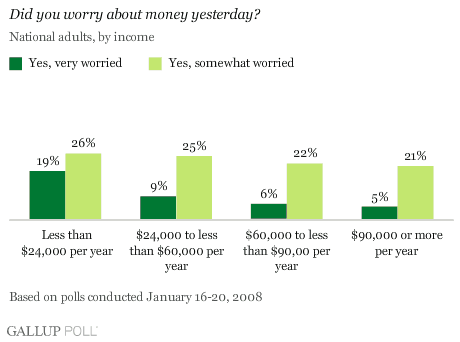
PRINCETON, NJ -- According to a series of Gallup Polls conducted Jan. 17-20, 2008, about one in three Americans (34%) say they worried about money "yesterday," with 10% saying they were "very worried" and 24% saying they were "somewhat worried." Lower-income consumers are more likely to worry about money than their higher income counterparts are, but even among higher income Americans, there are many who say they worry about money.
Forty-five percent of those making less than $24,000 annually report being worried about money recently, while 26% of those making $90,000 or more a year also report having such worries. Thirty-four percent of those making $24,000 but less than $60,000 a year say they worry, and 28% of those making $60,000 but less than $90,000 annually say the same.
Worries About Jobs
About 8% of Americans say they worried yesterday about losing their job. While this may not seem high given the talk of recession and the 5% unemployment rate, people's concerns about losing their jobs tend to lag as the economy slows down and the unemployment rate increases. Thirteen percent of those making less than $24,000 a year say they worry about losing their jobs, compared to just 4% of those making $90,000 or more who say the same. Of those making $24,000 but less than $60,000 a year, 8% say they similarly worry, as do 6% of those making $60,000 but less than $90,000 annually.
Will Emergency Government Action Reduce Money Worries?
In the past, economic slowdowns were often the result of high interest rates reducing the demand for credit and consumer spending. Given such an economic scenario, the Fed's emergency cut in the federal funds rates earlier this week would represent strong anti-recessionary medicine, as would the tax-rebate package the Bush administration and congressional Democrats are now considering.
Survey Methods
Results are based on 5,123 telephone interviews with national adults, aged 18 and older, conducted January 16-20, 2008. For results based on the total sample of national adults, one can say with 95% confidence that the margin of sampling error is ±2 percentage points.