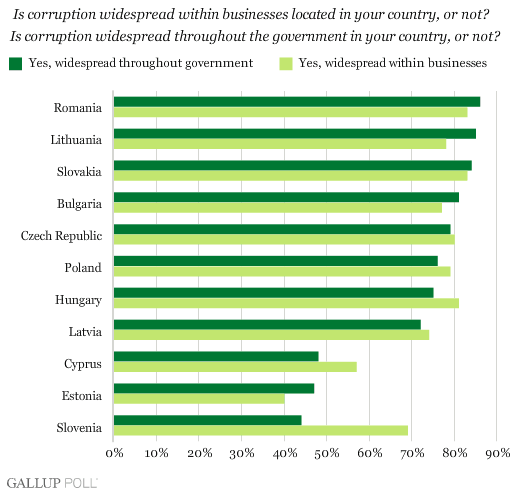
WASHINGTON, D.C. -- The European Commission last week released progress reports that criticized Bulgaria's and Romania's efforts to tackle corruption at high levels. Gallup surveys in these two countries indicate that residents also perceive a problem with corruption in their country: 81% of Bulgarians and 86% of Romanians say corruption is widespread throughout their government. Additionally, 77% of Bulgarians and 83% of Romanians say the same is true about businesses in their country. However, pervasive perceptions of corruption within the European Union are hardly limited to these two newest member countries. In many of the countries that joined the EU in 2004, proportions who say that corruption is widespread throughout the government and within businesses in their own country are similar to those in Bulgaria and Romania.
Corruption Concerns Prevalent
At least 7 in 10 respondents from the Czech Republic (79%), Hungary (75%), Latvia (72%), Lithuania (85%), Poland (76%), and Slovakia (84%) say corruption is widespread throughout the government in their country. In Cyprus, Estonia, and Slovenia at least 4 in 10 respondents agree. Majorities in each newer EU country surveyed, except Estonia, also say corruption is widespread within businesses in their country. Among the 11 newer EU member states surveyed, a median of 76% say government corruption is widespread, and a median of 78% say business corruption is widespread. In the 14 older EU member states where Gallup has polled, a median of 50% say corruption is prevalent throughout the government and within businesses.
Confidence in Judicial Systems Lacking
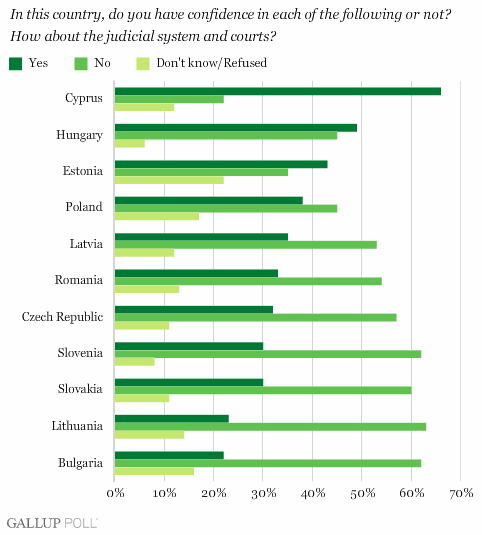
The European Commission's report also examined progress with judicial reform in Bulgaria and Romania. Failure to achieve set benchmarks could make other EU member states hesitant to accept judicial decisions made in these countries. About one in five (22%) Bulgarians and only one-third (33%) of Romanians say they have confidence in the judicial system in their respective country.
Confidence in judicial systems is also low throughout other newer EU member states. Only in Cyprus do a majority of respondents (66%) express confidence in the country's judicial system and courts. The median confidence for these 11 newer countries is 33%, and the median for the 14 older EU countries surveyed is 54%. Along with Lithuanians, Bulgarians are less likely to express confidence in their judicial system than those in any other EU member state where Gallup has polled.
Bottom Line
The European Commission's report clearly illustrates that a great deal of work yet remains for Romania and Bulgaria to address the ongoing problem of corruption in their countries adequately. However, Gallup data reveal that many citizens in other newer EU member states see corruption as a significant problem in their own country as well.
Survey Methods
Results are based on telephone and face-to-face interviews with approximately 1,000 adults in Austria, Belgium, Bulgaria, Cyprus, Czech Republic, Denmark, Estonia, Finland, France, Germany, Greece, Hungary, Iceland, Italy, Latvia, Lithuania, Netherlands, Poland, Portugal, Romania, Slovakia, Slovenia, Spain, Sweden, and the United Kingdom, aged 15 and older, conducted throughout 2006 and 2007. For results based on the total sample of national adults, one can say with 95% confidence that the maximum margin of sampling error is ±3 percentage points. In addition to sampling error, question wording and practical difficulties in conducting surveys can introduce error or bias into the findings of public opinion polls.