When it comes to the multifaceted healthcare system, most Americans hold doctors and nurses in high esteem, but a majority of them rate nursing homes and health insurance companies poorly. Gallup asked Americans to assess the quality of various aspects of healthcare in this country in November 2003, and posed similar questions in Canada and Great Britain a month later*. Given the differences between their healthcare systems and the U.S. system, do healthcare ratings in these two countries follow a similar pattern?
Overall, Americans rate the quality of U.S. healthcare higher than do Britons and Canadians. Sixty percent of Americans rate the quality of healthcare as excellent or good, compared with 54% of Canadians and 49% of Britons. But Gallup this year also asked about specific aspects of the healthcare system to investigate which factors most influence perceptions of quality. How do healthcare recipients in each country feel about the places they go for healthcare treatment? The people who administer care? The companies that provide medicine?
Nurses and Doctors
In each country, respondents rate the quality of the people who provide healthcare most positively. Nurses and physicians receive higher marks than any of the other five healthcare elements included in the survey. More than 80% of Americans, Canadians, and Britons rate the medical services that nurses provide as "excellent" or "good," with no significant differences among the three countries.
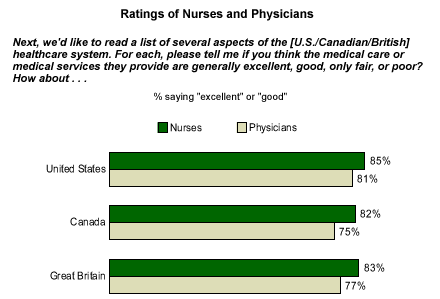
And at least 75% of respondents in each country rate the services that physicians provide as excellent or good. The quality of physician service is slightly more likely to be rated as excellent or good in the United States (81%) than in Canada (75%).
Hospitals and Accident/Emergency Rooms
Despite the bad press that emergency rooms tend to receive in the United States, Americans rate them more positively than negatively, and also more positively than do Canadians and Britons. In the United States and Great Britain, majorities of respondents give positive ratings to accident/emergency rooms (62% in the United States and 54% in Great Britain rate these as excellent or good), while accident rooms in Canada receive lower ratings (40%).
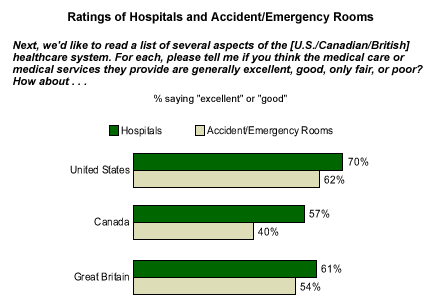
Americans are also more pleased with the quality of their hospitals than either Canadians or Britons are. Seventy percent of Americans rate hospitals positively, compared with 57% of Canadians and 61% of Britons.
Pharmaceutical or Drug Companies
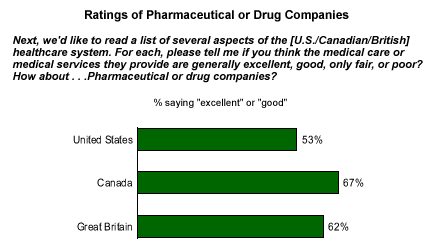
Medicare prescription drug plans and the difference in prescription drug costs in the United States and Canada have received intense publicity in America. The high drug costs in the United States have almost certainly affected ratings of pharmaceutical companies, but the Gallup data show Americans are still more likely to rate them in positive than in negative terms. Fifty-three percent of Americans rate pharmaceutical companies as excellent or good, compared with 67% in Canada and 62% in Great Britain.
Private Healthcare/Health Insurance Companies and Nursing Homes
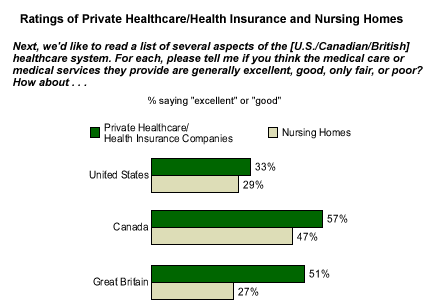
Health insurance companies, referred to by the Canadians and British as private healthcare, are the norm here in the United States, but not in Canada and Great Britain. Only a third of Americans give positive ratings to health insurance companies, while private healthcare is rated positively by 57% of Canadians and 51% of Britons.
Nursing homes receive low scores in all three countries, and in fact are the lowest-rated healthcare institution in each country. However, Canadians’ ratings (47% excellent or good) are significantly more positive than Americans’ (29%) or Britons’ (27%).
These differences highlight the relative weaknesses in private vs. government-administered healthcare systems and pits two healthcare priorities against one another -- quality versus cost/access.
In the United States, quality is rated high, while cost and access are major concerns. The U.S. population seems to support a move toward greater government involvement in the healthcare system (see "Greener on the Other Side? Universal vs. Private Healthcare" in Related Items). In Canada and Great Britain, both private healthcare and the current public system are positively evaluated.
These responses suggest that healthcare consumers in all three countries may be happiest with a mixed system of private and public healthcare, combining elements of the current systems in the United States, Canada, and Great Britain. However, substantial majorities of Britons and Canadians are reluctant to give up their government-run systems for private ones. Given the lower ratings of overall quality of healthcare in those countries, those numbers could change if it was clear the limited privatization might produce substantial gains in quality.
Bottom Line
The overall quality of healthcare receives the most positive ratings in the United States, and these high scores seem to be driven by positive perceptions of doctors, nurses, hospitals, and emergency rooms. But Americans’ concerns regarding health insurance, pharmaceutical companies, and nursing homes -- both in absolute terms and relative to the Canadian and British systems -- persist.
It seems that the U.S. health system could benefit from adapting selected elements from the Canadian and British systems. The question is: How can cost and access be better controlled, without compromising the high quality of U.S. healthcare? This is the question that those seeking to reform the healthcare system must face in the months and years to come.
*Results in the United States are based on telephone interviews with 1,007 national adults, aged 18 and older, conducted Nov. 3-5, 2003. For results based on the total sample of national adults, one can say with 95% confidence that the maximum margin of sampling error is ±3 percentage points. The survey was conducted by Gallup USA.
Results in Canada are based telephone interviews with 1,012 national adults, aged 18 and older, conducted Dec. 5-11, 2003. For results based on the total sample of national adults, one can say with 95% confidence that the maximum margin of sampling error is ±3 percentage points. The survey was conducted by Gallup Canada.
Results in Great Britain are based telephone interviews with 1,000 national adults, aged 18 and older, conducted Dec. 2-21, 2003. For results based on the total sample of national adults, one can say with 95% confidence that the maximum margin of sampling error is ±5 percentage points. The survey was conducted by Gallup UK.