GALLUP NEWS SERVICE
PRINCETON, NJ -- President George W. Bush elevated the issue of same-sex marriage to the constitutional level on Tuesday with his declaration: "Today I call upon the Congress to promptly pass, and to send to the states for ratification, an amendment to our Constitution defining and protecting marriage as a union of a man and woman as husband and wife."
As Bush recognized in his announcement, "An amendment to the Constitution is never to be undertaken lightly," and indeed the Founding Fathers of the United States required that any amendment must be approved by a two-thirds majority in each the House of Representatives and the Senate, and then approved by three-fourths of the states. Although there were no polls in the late 1700s, it is reasonable to assume that the Founders envisioned amendments to the Constitution taking place in situations in which these same types of large majorities of the public were in support, and that such high levels of support would be reflected in the votes of their representatives.
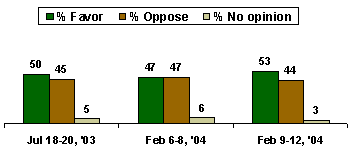
That clearly is not the situation in this case. A special Gallup analysis of more than 2,500 Americans' responses over the last eight months to a question asking about a constitutional amendment that defines marriage shows that such an amendment is supported by a very slim majority of Americans, 51%, with 45% opposed.
|
"Would you favor or oppose a
constitutional amendment that would define marriage as being
between a man and a woman, thus barring marriages between gay and
lesbian couples?" |
||
|
Favor |
Oppose |
Don't know |
|
51% |
45% |
4.5% |
The support for the amendment has remained relatively stable over the period of time covered in these interviews.
| Favor or Oppose a Constitutional
Amendment Defining Marriage as Being Between a Man and a Woman? |
 |
The percentage of Americans favoring a constitutional amendment to define marriage as between a man and a woman is about 12 points lower than the percentage who say that, generally speaking, same-sex marriages should not be recognized as valid.
|
"Do you think marriages between
homosexuals should or should not be recognized by the law as valid,
with the same rights as traditional marriages?" |
||
|
Should be valid |
Should not be valid |
Don't know |
|
33% |
63% |
4% |
In short, there is significantly less support for amending the Constitution to address this issue than there is opposition to legalized same-sex marriage more generally.
Bush's announcement of his support for a marriage amendment in the midst of a presidential election year turned it into even more of a partisan issue than might ordinarily be the case. The data already reflect significant differences in support or opposition to the idea of the amendment by both political party identification and by ideology:
|
"Would you favor or oppose a
constitutional amendment that would define marriage as being
between a man and a woman, thus barring marriages between gay and
lesbian couples?" |
|||
|
Favor Const. |
Oppose Const. |
Don't know |
|
|
% |
% |
% |
|
|
Total |
51 |
45 |
4.5 |
|
Republicans |
66 |
31 |
2 |
|
Independents |
46 |
49 |
4 |
|
Democrats |
41 |
54 |
4 |
|
Conservative |
65 |
32 |
4 |
|
Moderate |
48 |
47 |
5 |
|
Liberal |
29 |
65 |
5 |
The political divisions are clear, but perhaps not as stark as would be imagined:
- Two-thirds of Republicans and conservatives favor a constitutional amendment, as might be expected.
- Four in 10 Americans who identify themselves as Democrats also favor such a constitutional amendment. While this is substantially below the level of support among Republicans, and less than a majority, it is still a not insignificant level of support, and illustrates the caution with which Democratic candidates must deal with this issue in the presidential campaign this year.
- Only 29% of liberals support a marriage amendment, one of the lowest levels of support found in any subgroup looked at in this analysis.
Here is an analysis of support for a constitutional marriage amendment broken out by key demographic groups:
|
"Would you favor or oppose a
constitutional amendment that would define marriage as being
between a man and a woman, thus barring marriages between gay and
lesbian couples?" |
|||
|
Favor Const. |
Oppose Const. |
Don't know |
|
|
% |
% |
% |
|
|
Total |
51 |
45 |
4.5 |
|
Male |
52 |
43 |
5 |
|
Female |
49 |
46 |
5 |
|
18 to 29 |
48 |
49 |
3 |
|
30 to 49 |
50 |
46 |
4 |
|
50 to 64 |
52 |
42 |
6 |
|
65+ |
54 |
42 |
5 |
|
Males 18 to 49 |
52 |
44 |
4 |
|
Males 50+ |
53 |
42 |
5 |
|
Females 18 to49 |
47 |
49 |
3 |
|
Females 50+ |
52 |
42 |
6 |
|
East |
47 |
48 |
5 |
|
Midwest |
51 |
44 |
5 |
|
South |
54 |
42 |
4 |
|
West |
48 |
47 |
5 |
|
HS or less |
55 |
40 |
5 |
|
Some college |
52 |
43 |
5 |
|
College grad |
49 |
48 |
4 |
|
Postgrad |
38 |
58 |
4 |
|
<$20,000 |
50 |
45 |
5 |
|
$20,000-$30,000 |
49 |
47 |
5 |
|
$30,000-$50,000 |
57 |
39 |
4 |
|
$50,000-$75,000 |
49 |
47 |
4 |
|
$75,000 and above |
47 |
49 |
4 |
|
Attend church weekly |
63 |
32 |
5 |
|
Attend church less |
51 |
45 |
4 |
|
Seldom/Never |
42 |
54 |
4 |
|
White |
51 |
45 |
5 |
|
Black |
52 |
42 |
6 |
Support and opposition for a constitutional amendment is perhaps less differentiated by these demographic and geographic subgroups than might have been supposed.
- One of the most significant differences in support for the amendment is found among Americans with varying self-reported levels of church attendance. Sixty-three percent of those who attend church weekly support the amendment, compared with 51% of those who attend less than once a week or monthly, and only 42% of those who say they attend church seldom or never.
- There is also a significant difference in support for the amendment by levels of education. Those with postgraduate degrees are significantly more likely to oppose the amendment than are those with less than a college degree, the majority of whom favor it.
- Men are slightly more likely than women to have net favorable support for the amendment.
- Those living in the South and Midwest are more likely to favor such an amendment than are those living on either coast.
- Americans over age 30 have a net favorable support for the amendment, particularly those who are 65 and older, who favor the amendment by a 12-point margin. Younger Americans between the ages of 18 and 29 essentially break even, with as many opposing the amendment as supporting it.
- There is no significant difference between the attitudes of blacks and whites relating to the amendment.
Survey Methods
These results are based on telephone interviews with randomly selected national samples of adults, aged 18 and older, conducted between July 2003 and February 2004. For results based on the combined samples, one can say with 95% confidence that the maximum error attributable to sampling and other random effects is ±2 percentage points. For any individual sample, the margin of error is ±3 percentage points. In addition to sampling error, question wording and practical difficulties in conducting surveys can introduce error or bias into the findings of public opinion polls.
