WASHINGTON, D.C. -- Earlier this month the World Bank committed $20 million to improve infrastructure in Albania, focusing on secondary and local roads improvement in rural areas. Gallup Polls throughout the Balkan region show that many citizens are dissatisfied with their local roads and highways.
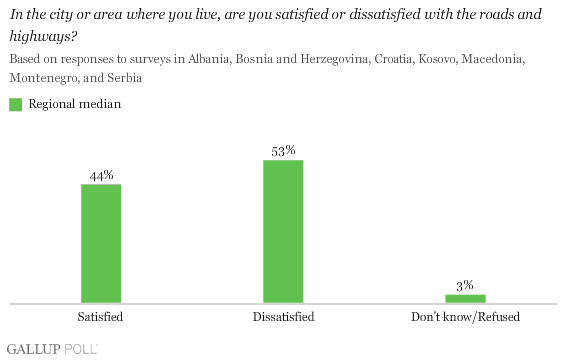
According to a World Bank press release, the roads project in Albania will "improve access to essential services and economic markets, especially in rural areas, by improving the condition, management, and financing of regional and local roads in the country."
Albanians express less dissatisfaction with their roads and highways than do other residents in many countries in the Balkan region. Only Croatians express less dissatisfaction than Albanians do. Respondents from the two poorest areas in the Balkans in terms of GDP per capita, Montenegro and Kosovo, are the most likely in the region to say they are dissatisfied with their roads and highways.
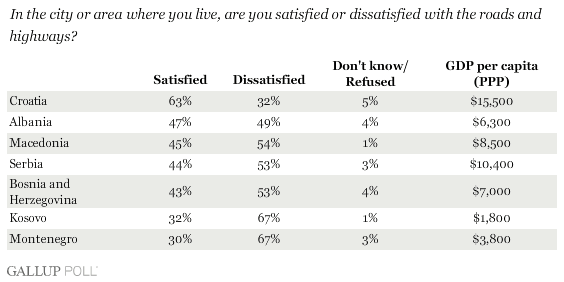
Residents of the Balkans are not alone in their dissatisfaction with their roads and highways; many residents of neighboring Central European countries are dissatisfied as well. In 5 of 11 countries in this region, at least half of respondents say they are dissatisfied with the roads and highways where they live. Notable exceptions in this region are in Switzerland, Austria, and Germany, where fewer than one in five say they are dissatisfied with the roads in their local areas.
Survey Methods
Results are based on face-to-face interviews with 834 adults in Montenegro, aged 15 and older, conducted in December 2006 and January 2007. For results based on the total sample of national adults, one can say with 95% confidence that the maximum margin of sampling error is ±4 percentage points.
Results are based on face-to-face interviews with approximately 1,000 adults in Albania, Austria, Bulgaria, Croatia, Czech Republic, Germany, Greece, Hungary, Kosovo, Latvia, Lithuania, Macedonia, Poland, Slovakia, Slovenia, Switzerland and 1,556 adults in Serbia, aged 15 and older, conducted throughout 2006 and 2007. For results based on the total sample of national adults, one can say with 95% confidence that the maximum margin of sampling error is ±3 percentage points.
Results are based on face-to-face interviews with 2,002 adults in Bosnia and Herzegovina, aged 15 and older, conducted throughout 2006 and 2007. For results based on the total sample of national adults, one can say with 95% confidence that the maximum margin of sampling error is ±2 percentage points.
In addition to sampling error, question wording and practical difficulties in conducting surveys can introduce error or bias into the findings of public opinion polls.