GALLUP NEWS SERVICE
PRINCETON, NJ -- Many Americans soon will bid adieu to their television Friends -- Chandler, Joey, Monica, Phoebe, Rachel, and Ross -- as the popular television series broadcasts its final original episode in May, but a recent Gallup Poll suggests Americans have plenty of real world friends of their own. A substantial majority of Americans are satisfied not only with the overall number of friends they have, but also with the closeness of the relationships they have with their friends. And, when asked how satisfied they are with a variety of things in their personal lives, satisfaction with friendships ranks second behind satisfaction with family.
On Average, Americans Say They Have About Nine "Close Friends"
The poll, conducted Dec. 11-14, finds that, on average, Americans have nine "close friends" (a mean of 8.6), not including their relatives. This includes 45% of Americans who say they have six or more close friends, 39% who have between three and five close friends, and 14% who have one or two close friends. Only 2% of Americans say they have no close friends. The current average represents a slightly lower number of close friends than reported in 1990 and 2001, when Americans said they had an average of 10 friends (means of 9.9 and 9.5, respectively).
Not counting your relatives, about how many close friends would you say you have?
|
2003 Dec 11-14 |
2001 Dec 6-9 |
1990 Jan 18-21 |
|
|
% |
% |
% |
|
|
None |
2 |
2 |
1 |
|
One |
6 |
2 |
5 |
|
Two |
8 |
8 |
10 |
|
Three |
11 |
9 |
11 |
|
Four |
11 |
9 |
8 |
|
Five |
17 |
14 |
16 |
|
Six to nine |
18 |
19 |
14 |
|
Ten or more |
27 |
35 |
33 |
|
No answer |
1 |
1 |
2 |
|
Mean |
8.6 |
9.5 |
9.9 |
|
Median |
5 |
6 |
5 |
Gallup also found that the average number of close friends among respondents in different demographic groups does not differ in many instances. However, there are differences among people in different age groups and income categories.
- Age. Conventional wisdom might suggest that younger Americans would be more likely than older Americans would be to have a greater number of friends, but do they have more close friends? The poll shows that, on average, those aged 65 and older have an average of 13 close friends, compared with an average of 9 friends for those aged 18 to 29 and those aged 50 to 64 and 7 friends for 30- to 49-year-olds.
- Income. Americans earning less than $30,000 a year, on average, say they have about 10 close friends. This compares with an average of 8 close friends for people earning between $30,000 a year and less than $75,000 a year, and 7 close friends for people earning $75,000 or more annually.
|
Mean Number of Friends |
|
|
Total |
8.6 |
|
Age |
|
|
18- to 29-year-olds |
8.9 |
|
30- to 49-year-olds |
7.0 |
|
50- to 64-year-olds |
8.7 |
|
65 years and older |
12.5 |
|
Income |
|
|
$75,000 a year or more |
7.4 |
|
$50,000-$74,999 a year |
8.2 |
|
$30,000-$49,999 a year |
8.0 |
|
Less than $30,000 a year |
9.6 |
Men interviewed in the poll report having an average of 9 close friends, compared with 8 close friends among women. Those who say they are personally very happy average 9 close friends, compared with 8 close friends among those who are fairly happy. Respondents with children under age 18 report having an average of 7 close friends, compared with an average of 9 among those without children under 18. None of these differences are statistically significant, however. And, the results also show that there are no statistical differences between the average number of close friends among Protestants and Catholics, and among Republicans, Democrats, and independents.
|
Mean Number of Friends |
|
|
Total |
8.6 |
|
Gender |
|
|
Men |
9.3 |
|
Women |
7.9 |
|
Personal happiness |
|
|
Very happy |
9.1 |
|
Fairly happy |
7.7 |
|
Partisanship |
|
|
Republicans |
8.6 |
|
Independents |
8.8 |
|
Democrats |
8.4 |
|
Religious preference |
|
|
Protestants |
8.9 |
|
Catholics |
7.5 |
|
Children under 18? |
|
|
Yes |
7.3 |
|
No |
9.4 |
Large Majority Satisfied With State of Friendships Today
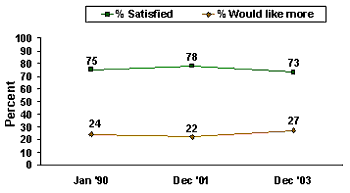
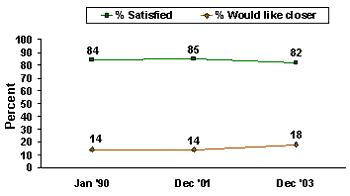
Seventy-three percent of Americans are satisfied with the number of friends they have, and only 27% would like to have more friends. An even larger percentage of Americans are satisfied with the closeness of their relationships with their friends -- 82% are satisfied and just 18% say they would like to have closer relationships. On both measures, Americans are slightly less satisfied this year with the number of friends and the closeness of the friendships than they were in 2001.
| Are You Satisfied With the Number of Friends You Have? |
 |
| Are You Satisfied With the Closeness of Relationships With Friends? |
 |
Interestingly, there are few differences among people in various age groups regarding their satisfaction with their total number of friends, but there are differences on their satisfaction with the closeness of their friendships. Ninety-one percent of adults aged 65 and older are satisfied with the closeness of their friendships, compared with 82% of 18- to 29-year-olds, 80% of 30- to 49-year-olds, and 78% of 50- to 64-year-olds.
Another question in the poll asked Americans to rate their level of satisfaction on a number of different aspects of their own personal lives. The results show that respondents are most highly satisfied with their families (at 62%), but friends (along with religion and the area where respondents live) also rated highly.
|
Americans' Satisfaction With Their Personal Lives |
||
|
2003 Dec 11-14 |
Highly |
Mostly |
|
% |
% |
|
|
Family |
62 |
27 |
|
Friends |
47 |
38 |
|
Where you live |
46 |
33 |
|
Religion or spirituality |
46 |
31 |
|
Romance |
42 |
24 |
|
Health |
40 |
41 |
|
Career (based on employed adults) |
26 |
52 |
|
Personal growth |
26 |
53 |
|
Fun and recreation |
23 |
44 |
|
Money |
14 |
45 |
Survey Methods
These results are based on telephone interviews with a randomly selected national sample of 1,011 adults, aged 18 and older, conducted Dec. 11-14, 2003. For results based on this sample, one can say with 95% confidence that the maximum error attributable to sampling and other random effects is ±3 percentage points. In addition to sampling error, question wording and practical difficulties in conducting surveys can introduce error or bias into the findings of public opinion polls.
