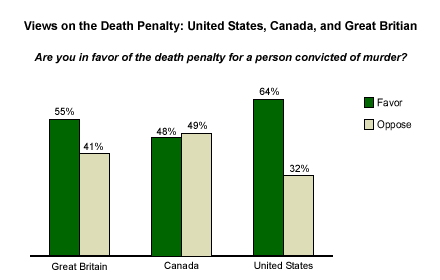
Not everyone believes in the Old Testament notion of "an eye for an eye." Americans may be more likely than those in some other developed nations may be to favor that type of reciprocal justice; according to Gallup Polls conducted late last year in three countries*, 64% of Americans favor the death penalty for a person convicted of murder. Canadians are about evenly split on the subject, with 48% in favor of the death penalty and 49% opposed. In Great Britain, a slim majority supports the death penalty, with 55% in favor and 41% opposed.
The governments of both Great Britain and Canada abolished the death penalty for murder some time ago, in 1965 and in 1976, respectively. The U.S. Supreme Court struck down state death penalty laws in 1972 and did not reinstate the punishment again until 1976. The first execution after the moratorium took place in January 1977, when Gary Gilmore was executed by firing squad in Utah. Currently, capital punishment is legal in 38 U.S. states.
Conflicting Views
The death penalty is a deeply divisive issue, with vocal supporters on both sides. The presumptive Democratic presidential nominee John Kerry and Republican incumbent George W. Bush typify those opposing viewpoints. Kerry is generally opposed to the death penalty, under all circumstances but one. He feels that capital punishment should be an option when dealing with convicted terrorists. Bush, in his political biography, A Charge to Keep, said: "I support the death penalty because I believe that if administered swiftly and justly, capital punishment is a deterrent against future violence and will save innocent lives."
However, polls by Gallup and other organizations show that more Americans believe the death penalty does not act as a deterrent to committing murder than believe it does.
Comparing homicide statistics in the United States, Britain, and Canada casts some doubt on the argument that the death penalty is a deterrent to committing murder. In 2001, there were 554 murders in all of Canada. That was 8 more than the previous year, but 167 fewer than in 1975, the year before the death penalty was abolished. From 1972 and 1976, when the death penalty was not imposed in the United States, there were between 8.8 and 9.8 homicides per 100,000. After the death penalty was reinstated, the number of homicides (according to FBI statistics) reached a peak -- 10.2 per 100,000 -- in 1980. After several fluctuations in the 1980s and early 1990s, the number has been on a downward trend and was 5.6 per 100,000 in 2001.
The homicide statistics in Great Britain are similar to those in Canada. The murder rate has held fairly steady at between 1 and 2 per 100,000 for decades. Abolishing the death penalty seems to have had no effect on the number of reported homicides. However, more than half of Britons favor capital punishment.
Bottom Line
Some states, such as Illinois and Maryland, have issued moratoriums on the death penalty to see if it is administered accurately and fairly. But policy shifts aren't likely to quell vociferous arguments for and against the death penalty in the United States. Indeed, the arguments are still ongoing in Great Britain and Canada, even decades after the abolition of the death penalty in those countries.
*Results in the United States are based on telephone interviews with 1,017 national adults, aged 18 and older, conducted Oct. 6-8, 2003. For results based on the total sample of national adults, one can say with 95% confidence that the maximum margin of sampling error is ±3 percentage points. The survey was conducted by Gallup USA.
Results in Canada are based telephone interviews with 1,012 national adults, aged 18 and older, conducted Dec. 5-11, 2003. For results based on the total sample of national adults, one can say with 95% confidence that the maximum margin of sampling error is ±3 percentage points. The survey was conducted by Gallup Canada.
Results in Great Britain are based telephone interviews with 1,000 national adults, aged 18 and older, conducted Dec. 2-21, 2003. For results based on the total sample of national adults, one can say with 95% confidence that the maximum margin of sampling error is ±5 percentage points. The survey was conducted by Gallup UK.
