Anyone who's ever had outpatient surgery knows that the anesthesiologist is a vital member of the surgical team. Before having an operation, patients want to feel safe, comfortable, and assured that they will not feel pain. According to Gallup's 2002 healthcare database, there is a statistically significant correlation (.47) between satisfaction with anesthesiology services and overall outpatient satisfaction.
What do outpatients expect when it comes to anesthesiology services? The answer is a major key to patient satisfaction.
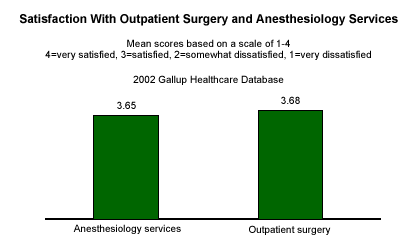
Gallup's database indicates that satisfaction with anesthesiology services is relatively high (a mean score of 3.65 on a scale of 1 to 4), and is only slightly lower than satisfaction with outpatient surgery overall (3.68 on a scale of 1 to 4). In 2002 (the most recent year for which data are currently available), 68% of outpatients reported that they were "very satisfied" with the anesthesiology services they received, and 71% were very satisfied with their overall outpatient experience. The ratings were virtually identical in 2001 -- however, there is room for improvement.
Evaluating Anesthesiology Services
Satisfaction surveys measure patients' perceptions of things that they can see and understand. From a clinical perspective, one might evaluate the type and quantity of anesthesia that the anesthesiologist uses. However, most patients don't have the knowledge base to make such judgments. Beyond the basic question of whether or not they felt much pain (in the vast majority of outpatient procedures they will not), patients tend to base their evaluations on the pre-operative communication between themselves (and their families) and the anesthesiologist.
When evaluating their outpatient experiences, patients' impressions of the anesthesiologist will be largely colored by the pre-operative meeting. Lack of communication before the operation is a potential patient "dissatisfier," not to mention a poor clinical practice.
Assuming a pre-operative meeting does occur, what are the important communication criteria? First, family members should be included. Like the patient, family members are also under stress, even if the surgery is minor. Uncertainty aggravates stress and produces dissatisfaction. If nothing else, family members want to meet the surgical team and be reassured.
Second, the anesthesiologist should not appear rushed when speaking to the patient and his or her family. Most outpatient surgeries are relatively short, and efficient facilities turn cases over quickly. This atmosphere places time constraints on the anesthesiologist. But it is the quality of the time spent with the patient that he or she will remember, not the quantity. Anesthesiologists should enter the patient's room and sit down. They should learn the names of the patient and family members, and use them. The patient and family should feel as if they are the total focus of attention.
Third, anesthesiologists should communicate in simple language. A common criticism of all doctors is that their language is too technical. Patients and their families often have to ask a nurse to explain what their doctor has told them. Use of simple language is especially important if the patient and anesthesiologist are from different countries with different primary languages.
Finally, the last step in every pre-operative meeting should be to solicit questions from the patient and family. Patient education should not be a lecture; listening is also important. The anesthesiologist should allow adequate time for patients and families to raise questions and to address concerns.
Bottom Line
Understanding patient perceptions of anesthesiology services is relatively simple. Although more than two-thirds of patients are currently very satisfied with the anesthesiology services they received, nearly a third are not. The key to changing that is better communication.