On Wednesday, the U.S. Supreme Court will hear oral arguments on the constitutionality of allowing public schools to lead students in reciting the Pledge of Allegiance, which contains the phrase, "one nation under God." A look in Gallup's online public opinion database, the Gallup Brain, shows that this is a new chapter in a national discussion that began more than 50 years ago.
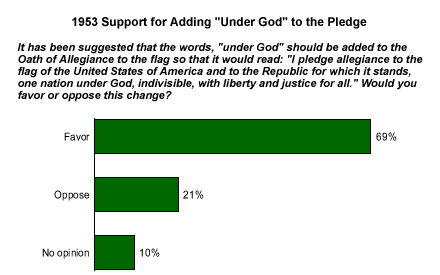
In the 1950s, during the height of the Cold War and the anti-communist sentiment that went with it, politicians suggested that the phrase, "under God," be added to the existing pledge to the flag, to distinguish a religious America from non-religious communist countries. A substantial majority of Americans, 69%, said they supported the addition, according to a 1953 Gallup Poll, while 21% were opposed.
"From this day forward, the millions of our schoolchildren will daily proclaim in every city and town, every village and rural schoolhouse, the dedication of our nation and our people to the Almighty," declared President Dwight D. Eisenhower on Flag Day in 1954, after signing the bill that added "under God" to the Pledge of Allegiance.
Patriotism, Prayer, or Both?
By 2000, the Cold War had become a chapter in history books. That year, Michael A. Newdow, an atheist from Sacramento, Calif., filed a lawsuit arguing that his daughter who attended an area school was injured when she had to "watch and listen as her state-employed teacher in her state-run school leads her classmates in a ritual proclaiming there is a God." A district court judge ultimately dismissed the case. But the Ninth Circuit Court of Appeals -- the largest appellate court in the United States -- reversed the decision and ruled that the inclusion of "under God" in the pledge violates the Establishment Clause in the Constitution.
If the Supreme Court does not reverse this ruling, children in the public schools in the nine states covered under the Ninth Circuit Court of Appeals would no longer be allowed to recite the pledge, and the ban could apply to public schools across the nation.
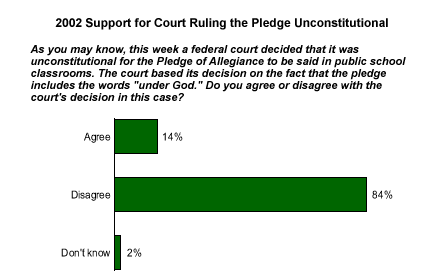
How did the American public feel about all this? In a June 2002 Gallup Poll, Gallup asked respondents if they agreed or disagreed with the federal court's ruling. Eighty-four percent said they disagreed, and 14% agreed.
Religiosity Then and Now
Given the high degree of religiosity among Americans, it's no surprise that support for the phrase, "under God," remains high. Gallup research shows that two of the most indicative markers of religiosity -- belief in God and church attendance -- have changed relatively little over the last 50 years. In 1954, 98% of Americans told Gallup they believed in God, and in 1999, the last time the question was asked, 94% said they believed in either God (86%) or a universal spirit (8%). Forty-six percent of Americans said they had attended church within the last seven days in 1954; 43% said so in 2003.
Bottom Line
Elk Grove Unified School District v. Newdow may be a troubling case, particularly for a court that begins each session with "God save the United States and this honorable court." In addition, the motto, "In God We Trust," appears on U.S. currency and many patriotic songs include references to God ("God Bless America"). Newdow, a non-practicing lawyer, has pledged to continue his attempt to overturn these national expressions of religion, as well as others. The Supreme Court hopes to rule on this issue by June, but the most recent Gallup data suggest that there is a broad public mandate to leave well enough alone.
