Russian President Vladimir Putin was re-elected in a landslide victory on March 14, capturing 71% of the vote and garnering criticism from a host of international sources in the process. During the months and weeks leading up to the election, there was significant concern about the fairness of the election process. According to election observers from the Organization for Security and Cooperation in Europe (OSCE), Putin did not actively campaign or debate his opponents, and the state-controlled television news media demonstrated clear pro-Putin bias. Election observers have also cited incidents of ballot stuffing and coercion of citizens to vote.
"Though generally well managed … this election cannot be seen as a fundamental test of the Russian Democratic system, " the OSCE reported. A retreat from democracy could have serious repercussions for U.S. relations with Russia -- especially if Americans tend to harbor suspicions about their former Cold War foe.
Gallup's annual World Affairs poll, last administered Feb. 9-12, 2004*, asked U.S. adults for their opinions about Russia as part of a battery of questions about various foreign countries. Although the survey was conducted before March 14, the results suggest that Americans were unperturbed about or unaware of the situation in Russia during the weeks leading up to the election.
Most Americans Have Favorable Opinion of Russia
Respondents were read a list of 22 countries and asked if they have a very favorable, mostly favorable, mostly unfavorable, or very unfavorable opinion of each one. Russia scores right in the middle of the pack, with 59% expressing a favorable opinion of it -- 7% "very favorable" and 52% "mostly favorable." Australia, Great Britain, and Canada were the most positively rated (all receiving favorability ratings near 90%) and North Korea was the lowest-rated country at 12% favorable.
Russia's favorability rating has actually increased substantially since it was last measured on March 14-15, 2003, when only 41% of Americans had a "very" or "mostly" favorable opinion of Russia. This low March 2003 rating probably resulted from Russia's opposition to the U.S. invasion of Iraq, though more vocal critics such as France and Germany suffered larger declines in favorable ratings. Just over a month earlier, according to a Feb. 3-6, 2003, poll, 63% of Americans had a favorable opinion of Russia, and the current favorability rating of 59% is little changed from that February 2003 measurement.
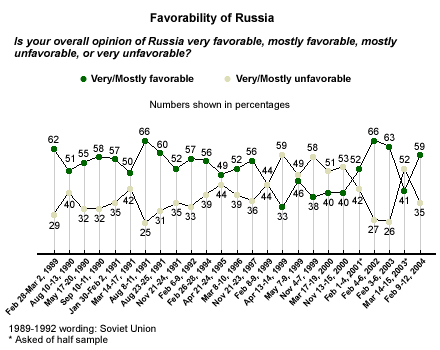
Gallup has been measuring U.S. favorability toward Russia since early 1989, the year that the Berlin Wall fell. Russia has maintained a favorable rating among a majority of Americans during most of that 15-year span, with the exception of a period between early 1999 and late 2000, when favorability reached as low as 33%, and the March 2003 rating. The late 1990s were a time of great turmoil in Russia, when its economy plummeted, crime rates skyrocketed, and embattled President Boris Yeltsin eventually handed power over to Putin on Dec. 31, 1999. Americans' favorability toward Russia rebounded in 2001 and 2002, eventually tying its 15-year high of 66% in February 2002.
Americans Don't See Russian Military as Critical Threat
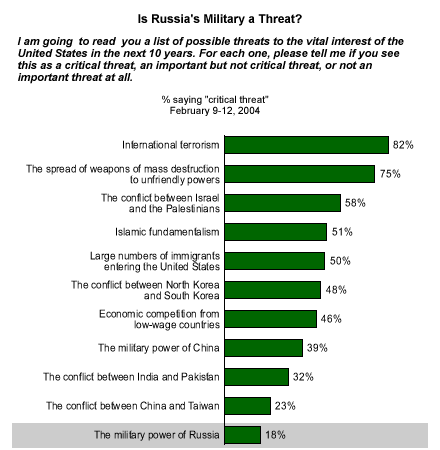
As part of the February 2004 survey, Gallup also asked respondents about the importance of various threats to the United States. Of the 11 items tested, Russia's military is rated as a threat by relatively few Americans -- just 18% view it as a "critical threat" to the vital interests of the United States in the next 10 years. Fifty percent of Americans say Russia's military power represents an important, but not a critical threat, and 29% say it is not an important threat. By comparison, 82% of Americans say international terrorism is a critical threat.
*Results are based on telephone interviews with 1,002 national adults, aged 18 and older, conducted Feb. 9-12, 2004. For results based on the total sample of national adults, one can say with 95% confidence that the margin of sampling error is ±3 percentage points.
