PRINCETON, NJ -- Over two-thirds of Americans -- 71% -- have a great deal or a fair amount of confidence in President Obama to do or recommend the right thing for the economy, a much higher level of confidence than is given to Federal Reserve Chairman Ben Bernanke, Treasury Secretary Tim Geithner, or the Democratic or Republican leaders in Congress.
These results, from a new April 6-9 Gallup Poll, show that President Obama continues to be the individual upon whom Americans are most willing to bestow their confidence when it comes to the economy.
Americans' confidence in Obama on the economy is roughly similar to the confidence rating the public gave to President George W. Bush in April 2001, then in his initial quarter of governing, as is the case now for Obama. Obama gets slightly higher "a great deal of confidence" ratings than did Bush, while Bush received a slightly higher "fair amount" rating. In 2002 and 2003, Bush's ratings were similar to Obama's now. By April of 2008, his last year in office, Bush's overall confidence ratings on the economy had dropped to just 34%. (At that time, however, his overall job approval ratings had also dropped below 30%.)
As previous Gallup research has shown, Obama inspires significantly higher confidence than does Geithner, his Treasury secretary. Federal Reserve Chairman Bernanke has been instrumental in pushing through dramatic economic policies and changes in an effort to stimulate the economy, and Americans accord him about the same level of confidence as they give to Geithner -- but again, lower than the public's confidence in Obama.
Bernanke was sworn in as chairman of the Federal Reserve in early 2006, under the Republican administration of George W. Bush. Bernanke's current confidence ratings are quite similar to where they have been over the last three years, despite the upheaval in the nation's economy in the last year.
It is unlikely that many Americans have a highly sophisticated understanding of the complex economic policies enacted in the last several months by either Bernanke or Geithner. Yet only 17% and 14% of Americans, respectively, are not able or willing to give an opinion on confidence in these two men's actions on the economy.
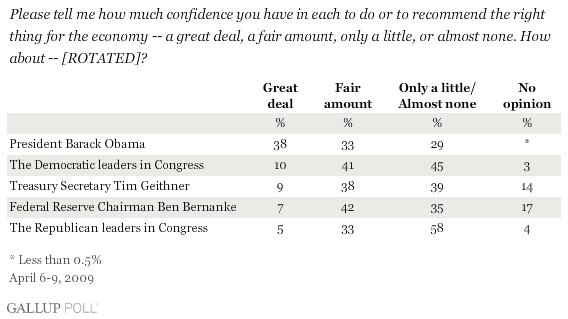
Americans are not overwhelmingly positive about either the Democratic or the Republican leaders in Congress. Still, the Democrats fare better on a comparative basis. Fifty-one percent of Americans have a great deal or a fair amount of confidence in the Democratic leaders, compared to 38% in the Republican leaders.
There are interesting differences in confidence levels in these individuals and leaders by partisan orientation.
-
Obama gets almost universal confidence from Democrats, two-thirds support from independents, and just over one-third confidence from Republicans.
-
Geithner appears to be somewhat more politicized than Bernanke. Geithner's confidence rating ranges from 70% among Democrats to just 24% among Republicans. Bernanke, on the other hand, has a more modest 28-point partisan gap, with a 64% confidence rating among Democrats vs. 36% among Republicans.
-
The partisan ratings of Bernanke have shifted from last year, when he was serving under a Republican president. At that time, the Fed chairman received a 61% confidence rating from Republicans, 43% from independents, and just a 40% rating from Democrats. Apparently, Americans associate the Fed chairman with the particular president he happens to be serving under.
-
Democrats have more faith in their leaders than Republicans do in theirs. Seventy-nine percent of Democrats say they have confidence in the Democratic leaders in Congress on the economy. Although this is lower than the confidence Democrats have in Obama, it is higher than the 57% confidence rating Republicans give the Republican leaders in Congress.
Survey Methods
Results are based on telephone interviews with 1,027 national adults, aged 18 and older, conducted April 6-9, 2009. For results based on the total sample of national adults, one can say with 95% confidence that the maximum margin of sampling error is ±3 percentage points.
Interviews are conducted with respondents on land-line telephones (for respondents with a land-line telephone) and cellular phones (for respondents who are cell-phone-only).
In addition to sampling error, question wording and practical difficulties in conducting surveys can introduce error or bias into the findings of public opinion polls.