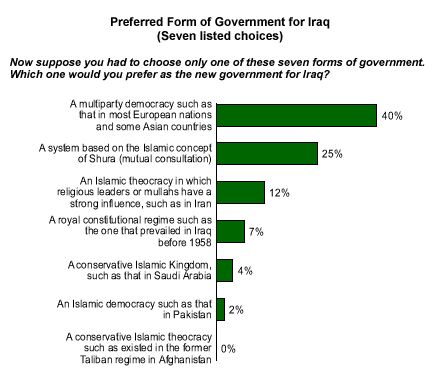
Results from Gallup's recent nationwide poll of Iraq* indicate a clear desire among Iraqis for a government directly accountable to popular will. As reported earlier (see "Iraqis Consider Their Nation's Future" in Related Items), a multiparty parliamentary democracy is the most widely preferred form of government among the seven models tested -- 40% of Iraqis would prefer such a government, while just 12% hope for "an Islamic theocracy in which religious leaders or mullahs have a strong influence, such as in Iran." Furthermore, Iraqis are nearly four times as likely to agree that their country needs "an Iraqi democracy" (84%) as they are to accept the assertion that Iraq needs a government "made up mostly of religious leaders" (22%).
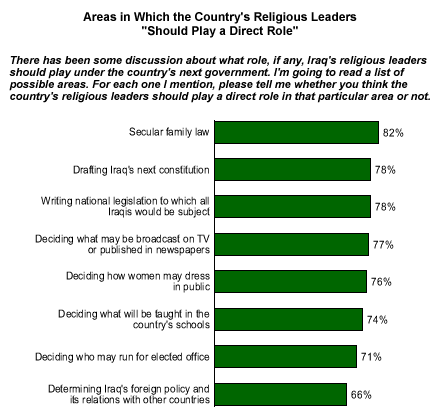
Despite these sentiments, only about a third of Iraqis (31%) say they support the notion of separating religion from government, while 58% oppose the notion. Even more dramatically, a solid majority of Iraqis believe that the country's religious leaders ought to play a direct role -- if not the primary role -- in a wide range of legislative, judicial, and administrative functions. Three-quarters or more of Iraqis told Gallup that religious leaders ought to play a direct role in:
- drafting Iraq's next constitution (78%)
- drafting national legislation -- laws to which all Iraqis would be subject (78%)
- deciding what may be broadcast on television or published in newspapers (77%)
- deciding how women may dress in public (76%)
- determining the country's secular family law (governing such issues as marriage, divorce, and property inheritance) (82%)
- determining what will be taught in the country's schools (74%)
Nearly as many think the country's clerics should play a role in determining Iraq's foreign policy (66%) and deciding who may run for public office (71%).
Should the Clergy's Power Be Limited?
But how much authority do Iraqis really want their country's clerics to be able to exert in each of these areas? Iraqis who said they thought clerics should be involved in a given area were further asked:
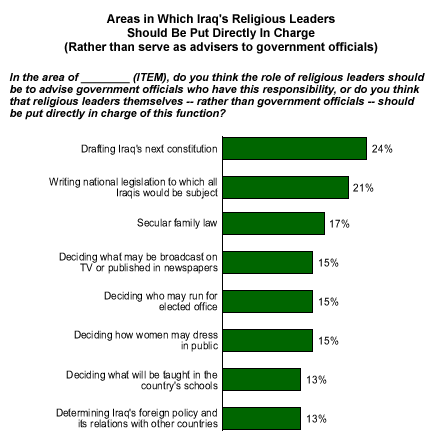
"Do you think the role of religious leaders should be to advise government officials who have this responsibility, or do you think that religious leaders themselves -- rather than government officials -- should be put directly in charge of this function?"
In general, Iraqis' clear preference is for religious leaders to play an advisory role in the seven legal and regulatory areas Gallup tested, rather than to be vested with direct authority. Less than a quarter of Iraqis believe the clergy ought to be put directly in charge of writing national legislation (21%), determining secular family law (17%), deciding television and newspaper content (15%), deciding who may run for office (15%), or how women may dress in public (15%). Only about one in eight Iraqis want religious leaders to determine what may be taught in schools (13%) or what the country's foreign policy will be (13%).
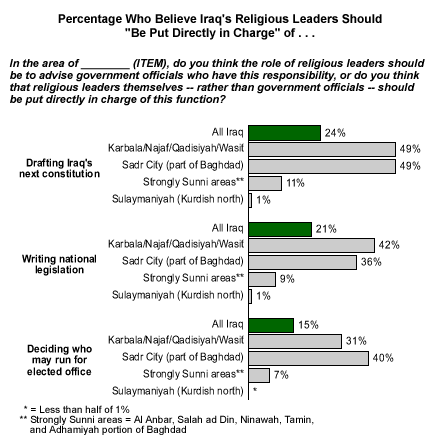
Interestingly, however, nearly a quarter of Iraqis (24%) express the belief that the country's next constitution ought to be directly drafted by religious leaders. This wish was expressed by roughly half (49%) of those interviewed in the conservative, heavily Shiite south central provinces of Karbala, Najaf, al Qadisiyah, and Wasit.
Sharp Regional Differences Over Scope of Clerics' Powers
As is the case with many of the poll's findings, the overall numbers obscure important variations across Iraq's geographic, ethnic, and sectarian "fault lines." For example, while most Iraqis reject the separation of mosque and state, nearly three-quarters (73%) of those in the heavily Kurdish northeastern province of Sulaymaniyah support this notion. Less than 1% of residents in the Kurdish north believe that Iraq needs a government made up primarily of religious leaders -- an assertion with which one in five Iraqis nationwide (22%) agree.
The preference for establishing an Islamic theocracy along Iranian lines is a minority sentiment everywhere, but support for this option is significantly higher in the south central provinces of Karbala, Najaf, al Qadisiyah, and Wasit (25%) than it is in the heavily Sunni parts of the country (3%).
There is also evidence of rising support for theocratic rule in Sadr City (formerly Saddam City) -- home to roughly a fifth of the total population of Baghdad. Nearly a third (31%) of Sadr City's residents would prefer that the country establish an Islamic theocracy, this is up from just 20% when Gallup first asked this question late last summer. Similarly, support for separation of mosque and state among Sadr City's residents has fallen from nearly a third (31%) in August 2003 to just 12% in the current poll.
Other indications of Sadr City's current attitudinal climate -- some of which may reflect the support that some Sadr City residents have provided to radical cleric Muqtada al-Sadr -- include:
- 49% of Sadr City residents believe that the clergy should be in charge of drafting Iraq's next constitution.
- 49% think clerics should determine how women may dress in public.
- 42% believe clerics should determine Iraq's foreign policy.
- 40% think the clergy should determine who may run for public office.