This is the second article in a two-part series. The first article discusses the level of support among Iraqis for an independent Kurdish state (see Related Items).
Assuming Iraq's final constitution allows the Kurdish northeast a measure of autonomy sufficient to quell any separatist impulse, can this region -- a self-governing, secular society for more than a dozen years -- be reintegrated successfully with the rest of Iraq?
The findings from Gallup's recent nationwide poll of Iraq show some areas of Kurdish convergence with broader Iraqi sentiment, as well as many areas in which attitudes, and even core values, are significantly different from those of Iraqi society as a whole.
To cite a few particularly striking examples:
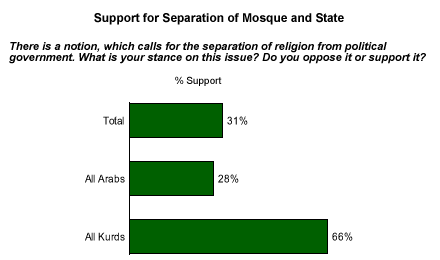
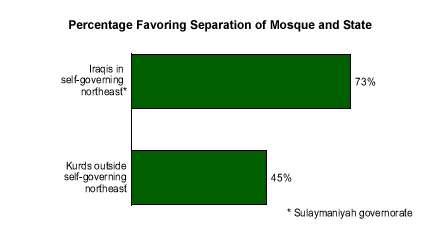
- Fifty-eight percent of all Iraqis, and 65% of Arab Iraqis, oppose the principle of separation of mosque and state. But only 18% of those living in the northeastern governorate of Sulaymaniyah oppose such a separation, while 73% endorse it.
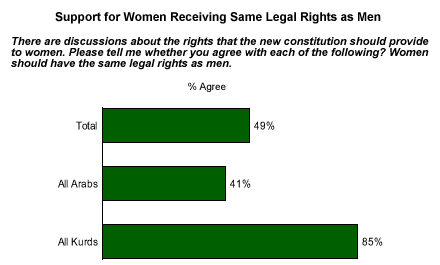
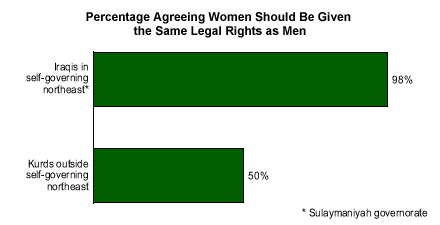
- Iraqis, as a whole, are nearly evenly split on whether women should or should not have the same legal rights as men (49% think they should, 47% think they shouldn't). Iraq's ethnic Arabs lean toward the latter position (41% feel women should have equal rights, 55% feel they shouldn't). Among residents of Sulaymaniyah, however, 98% believe women should hold the same legal rights as their male counterparts, while just 2% take the opposing view.
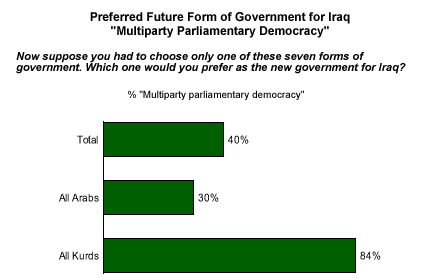
- Of the seven governmental models tested, a multiparty parliamentary democracy is the preferred form of government for a plurality (40%) of all Iraqis, with a system based on the Islamic concept of shura (mutual consultation) the second most widely chosen option (25%). Among Iraq's ethnic Arabs, these same two choices dominate, though the gap between them is statistically insignificant (30% and 28%, respectively). But in Sulaymaniyah, an overwhelming 94% prefer a multiparty parliamentary democracy, while just 4% opt for a system based on shura.
The underlying theme in each of these examples is a markedly greater demand among Iraqis in the Kurdish northeast for a secularist political and juridical model than is typical of Iraqis as a whole. This perspective threatens to put them sharply at odds with their compatriots as Iraq moves to full self-governance and its political system is further transformed, possibly along more Islamist lines.
Ethnicity Per Se?
Of course, many Kurds live outside the areas dominated by the Patriotic Union of Kurdistan and the Kurdistan Democratic Party, and are considerably more "assimilated" into the country's broader social and attitudinal fabric. Indeed, the poll's findings indicate that some of the most interesting contrasts lie not between the perspectives of ethnic Kurds and ethnic Arabs, but between the views of those who live in the self-governing northeast and the views of Kurds living outside that region -- that is, in governorates where they remain very much a minority.
For example, less than half (45%) of all Iraqi Kurds who live outside the self-governing northeast say they favor the separation between mosque and state -- a principle that draws overwhelming support (73%) among those living in Sulaymaniyah.
On the question of whether women ought to be guaranteed the same legal rights as men, the views of Kurds living in the 15 non-Kurdish governorates are much closer to the views of Arab Iraqis than those of their fellow Kurds in the northeast. Half (50%) of this group endorses a guarantee of male/female legal parity, a proportion not markedly higher than the 41% of Arab Iraqis who back this principle, but dramatically lower than the 98% of Sulaymaniyah's residents who do so.
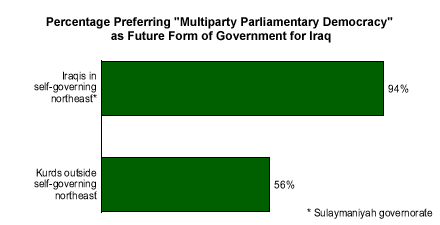
On the issue of their preferred future form of government for Iraq, the views of Kurds outside Iraq's northeast fall squarely between those of Sulaymaniyah's residents and those of their Arab Iraqi compatriots. A majority (56%) of Kurds in non Kurdish-dominated areas desire a multiparty parliamentary democracy, compared with 30% of Iraqi Arabs who opt for this choice and 94% of those in Sulaymaniyah who do so.