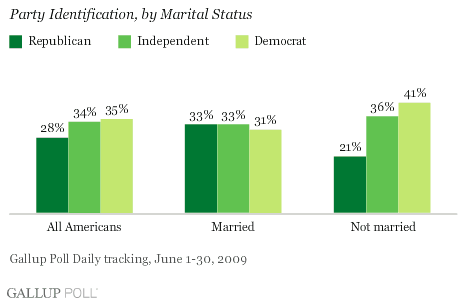
PRINCETON, NJ -- A Gallup analysis of more than 29,000 interviews conducted in June highlights a continuing and significant marriage gap in party identification. The percentage of all Americans who identified as Republican in June was 28%, but is higher at 33% among those who are married, and a lower 21% among unmarried Americans. On the other hand, Democratic identification in June was at 35% overall, but 31% among married Americans, and 41% among those who are not married. This marriage gap in party identification is evident across races as well as age groups.
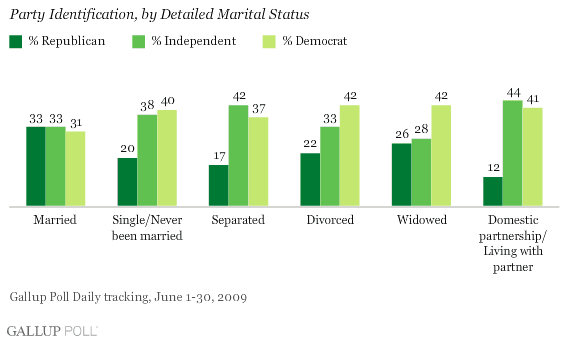
Being "unmarried" in America today encompasses a number of different life situations -- including those who are single and have never married as well as those who are separated, divorced, widowed, and those living in a domestic partnership. The large sample size for this data set allows for a detailed subdivision of unmarried Americans into each of these specific categories.
As can be seen in the accompanying graph, the particular circumstances of being unmarried do not appear to make a great deal of difference in terms of party identification. Democrats have a significant identification advantage over Republicans across each of these segments.
Noteworthy Findings
- The largest Democratic-over-Republican identification advantage is among Americans living with a domestic partner (Gallup's data do not distinguish between those with partners of the same sex and those with partners of the opposite sex). Among those in a domestic partnership, 41% identify as Democrats and just 12% as Republicans.
- Those who are single/never married, separated, and divorced all evidence the same 20-point Democratic advantage.
- The Democratic advantage is a slightly smaller 16 points among those who are widowed.
There are also variations across these segments of unmarried Americans in terms of the percentage who identify as independents. Of note are the quite high 44% of those who live with a domestic partner and 42% of those who are separated who don't claim allegiance to either party.
Race and Age
Marital status is correlated with race, which in turn is associated with party identification. More specifically, nonwhites in America today are less likely than whites to be married, and nonwhites are more likely to identify as Democrats. Thus, it is possible to hypothesize that some of the relationship between marital status and party identification is based on these differences by race. The data, however, show that the relationship between marriage and party identification persists among both whites and nonwhites.
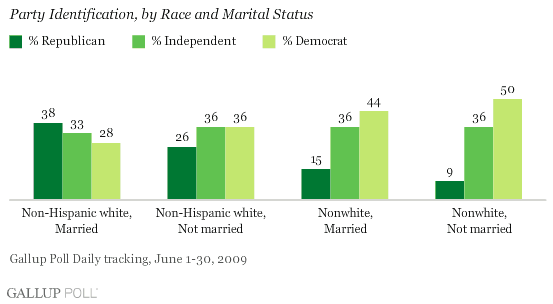
Republicans have a 10-point advantage over Democrats among married whites, and Democrats have a mirror-image 10-point advantage among unmarried whites.
Regardless of their marital status, Democrats do very well among nonwhite Americans. Still, marriage makes a difference. The Democratic advantage over Republicans is 29 points among married nonwhites and a larger 41 points among unmarried nonwhites.
What about age? Younger Americans are less likely than older Americans to be married, and are more likely to identify as Democrats. This leads to the hypothesis that these underlying age patterns could be a significant part of the explanation for the relationship between marriage and party identification. But, as is the case for differences by race, the data show that the marital status-party ID relationship persists across all age groups.
Republicans have a one-point advantage among 18- to 34-year-olds who are married, while Democrats have a large 19-point advantage among those 18-34 who are not married. Similar striking differences are found among those 35-54, and 55+. In each of these age groups, those who are not married are consistently and significantly more likely to be Democrats than those of the same age who are married.
Implications
It is difficult to tease out the precise reasons why those who are married in America today are disproportionally likely to identify with the Republican Party, and why those who are unmarried tilt toward the Democratic Party. Race and age factors may play somewhat of a role in explaining the relationship. But the relationship persists even after controlling for these two demographic variables.
The association between marital status and party identification is part of a broader constellation of values and political variables in American society today that are inter-correlated with one another -- including positions on issues and levels of religiosity. Marriage is a predictor of conservative ideology and conservative positions on social issues, which in turn predict high levels of Republican identification. Being unmarried is a predictor of more liberal ideology and more liberal positions on social issues, which predict higher levels of Democratic identification. Marriage is also associated with religious intensity, including church attendance and importance of religion in one's life. These measures of religion, in turn, are important predictors of party identification. But it is uncertain whether religion, ideology, and party lead to choice of marital status, or whether marital status leads Americans to different ideological, religious, and partisan choices.
Regardless of the precise causal paths involved, however, the data conclusively show that in America today, being married is significantly associated with increased Republican and decreased Democratic identification, while unmarried Americans tilt in the opposite direction.
Survey Methods
Results are based on telephone interviews with 29,351 national adults, aged 18 and older, conducted June 1-30, 2009, as part of Gallup Poll Daily tracking. For results based on the total sample of national adults, one can say with 95% confidence that the maximum margin of sampling error is ±1 percentage points.
Interviews are conducted with respondents on land-line telephones (for respondents with a land-line telephone) and cellular phones (for respondents who are cell-phone only).
In addition to sampling error, question wording and practical difficulties in conducting surveys can introduce error or bias into the findings of public opinion polls.
