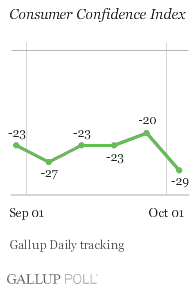
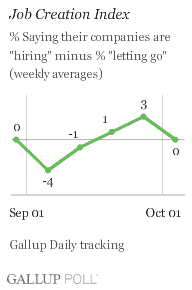
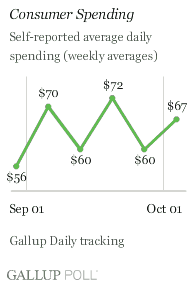
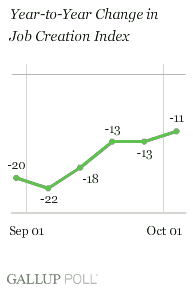
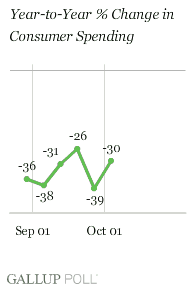
PRINCETON, NJ -- Consumer perceptions of the economy worsened last week as Gallup's Consumer Confidence Index fell by 9 points to -29 and Gallup's Job Creation Index fell 3 points to zero. Even though these are better levels for these economic measures than those posted as last year's financial crisis unfolded, consumer spending continues to reflect the "new normal" being down 30% from the same week a year ago.
What Happened (Week Ending Oct. 4)
- Consumer Confidence took a tumble after three good weeks as Gallup's Consumer Confidence Index worsened to -29 from its highs of the year. Consumer confidence now stands essentially where it stood a month ago. A year ago, as the financial crisis deepened, the Index was at -61. The percentage of Americans saying the economy is "getting better" fell 7 percentage points to 36%, essentially matching its level of a month ago. The percentage saying the economy is "getting worse" fell as well (falling 6 points from a week ago), matching its level of a month ago at 58%. The sharp drop in consumer confidence after enjoying three weeks of new highs reflects the fragile nature of consumer perceptions at this point in time.
-
Job Creation also tumbled as Gallup's Job Creation Index fell to zero from the prior week's high of +3. The percentage of employees saying their companies are hiring is at 26% -- up from 22% a month ago but down from 32% a year ago. The percentage of workers saying their companies are letting people go is also at 26% -- the same as a month ago and 5 points higher than a year ago. This decline in the Job Creation Index suggests the prior week's improvement may once again be more of a blip than a trend as was the case in mid-May.
-
Consumer Spending increased as self-reported daily spending in stores, restaurants, gas stations, and online averaged $67 -- up from the previous week's $60-per-day spending level -- but remaining in the range of recent weeks ($60-$72). Some of this uptick in spending may result from the fact that this is one of those weeks that encompasses a payday for many consumers. Spending continues to reflect the "new normal," remaining down 30% from spending during the same week a year ago.
What to Watch For
Given this is the first two-week decline in the equity market since July, it is not surprising that Gallup's Consumer Confidence Index has taken a tumble. The question in the week ahead is whether this decline is something of a one-week downward blip, or instead, a change in direction of the upward trend of recent weeks. In this regard, the negative news on the job front last week combined with the rash of other economic data suggesting the economic recovery may be slower than many had hoped could mean confidence will trend less positive for some time, particularly if the stock market continues to give up some of its gains.
On Thursday, we will find out more about the job situation as the government reports the new jobless claims numbers, which are likely to show an increase over the 540,000 consensus forecast. Regardless of what the government reports, Gallup's Job Creation Index suggests the job market continues to struggle. Fears that the job market may hold back economic activity going forward may be well-founded.
In this regard, Gallup's behaviorally based spending measure continues to support the idea that there is a "new normal." In turn, this suggests that the prognostication that holiday sales are likely to be flat this year -- even when compared to last year's poor results -- may be optimistic.
Finally, recent negative news on the economy may mean more talk of the government's need to do more for the job market. Although the "stimulus" idea may not be used because of its damaged brand, poor job market conditions may encourage Congress to expand the federal social safety net by extending unemployment insurance and related COBRA health insurance benefits in the weeks ahead -- even the $8,000 new home buyer tax credit seems likely to be extended or even enlarged.
However, actually stimulating job creation is another thing altogether -- a huge challenge. This is something that may get a lot of talk right now -- particularly if the job situation as measured by Gallup's data remains as bleak as in recent months. However, unless the job situation worsens markedly in the next couple of months, it is not likely to get real consideration until next year's elections approach.
Review and export the complete daily trends on these measures: Economic Indexes; Consumer Spending; Economic Outlook; Economic Conditions; Job Market
Learn more about Gallup's economic measures.
Survey Methods
For Gallup Daily tracking, Gallup interviews approximately 1,000 national adults, aged 18 and older, each day. The Gallup consumer perceptions of the economy and consumer spending results are based on random half-samples of approximately 500 national adults, aged 18 and older, each day. The Gallup job creation and job loss results are based on a random half sample of approximately 250 current full- and part-time employees each day. Results from the week of Sept. 28-October 4, 2009, are based on telephone interviews with 3,514 adults for the consumer perceptions and spending questions. For these results, one can say with 95% confidence that the maximum margin of sampling error is ±2 percentage points. Results for the job creation and job loss questions are based on interviews with 1,903 employees, with a maximum margin of error of ±3 percentage points.
Interviews are conducted with respondents on landline telephones (for respondents with a landline telephone) and cellular phones (for respondents who are cell phone only).
In addition to sampling error, question wording and practical difficulties in conducting surveys can introduce error or bias into the findings of public opinion polls.