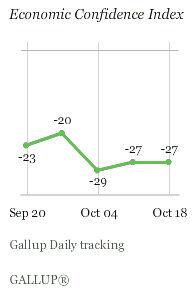
PRINCETON, NJ -- It may seem as though consumers decided to celebrate the Dow Jones Industrial Average's hitting 10,000 by going on a one-week spending spree, but a slightly improved jobs picture may be among the better explanations. Still, Gallup's Economic Confidence Index remained essentially unchanged from the prior week.
What Happened (Week Ending Oct. 18)
-
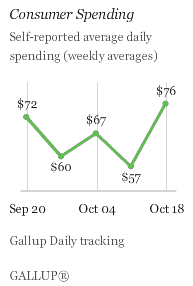
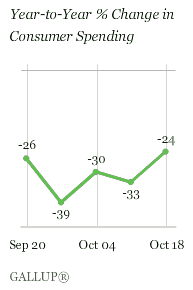
Consumer Spending surged last week, as self-reported daily spending in stores, restaurants, gas stations, and online averaged $76 -- up sharply from $57 per day the previous week, and its highest level since August. Still, this is up only $4 from a month ago and is down 24% from the $100 average of the same week in 2008, even though last year's comparable reflects the onset of the financial crisis that began to unfold last September. Gallup's spending data continue to be volatile on a weekly basis, with shifts most likely in response to paydays and holidays. Further, Gallup's data are not seasonally adjusted, and a similar upward bounce of $15 took place in the same week a year ago, followed by a decline the next week, suggesting that there may be something of a Halloween effect on spending. Regardless, the upturn in consumer spending is good news and could raise holiday spirits if spending can maintain its upward momentum.
-
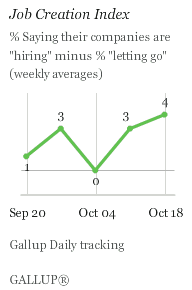
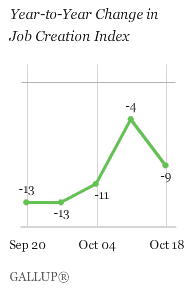
Job Creation improved once more last week, as Gallup's Job Creation Index increased to +4 -- a new 2009 high. The slightly better job conditions were the result of a decline in the percentage of workers saying their companies are letting people go, from 24% to 22% -- about where layoffs were a month ago (23%) but somewhat worse than a year ago (18%). The percentage of employees saying their companies are hiring is at 26% -- up slightly from 24% a month ago but still down from 31% a year ago. There was a similar improvement in job-market conditions during the same week last year even as the financial crisis deepened, suggesting there may be some seasonal effects involved. Still, the Index has been either at zero or in positive territory for the last five weeks, and the continued decline in layoffs is good news for those worried about losing their jobs and the U.S. economy as a whole.
-
Economic Confidence was unchanged last week, as Gallup's Economic Confidence Index remained at -27. Also unchanged were the percentage of Americans saying the economy is "getting better" (38%) and the percentage saying it is "getting worse" (56%). Economic confidence is worse than it was a month ago (-23) but far better than a year ago (-57).
What to Watch For
Consumer spending this week is certainly worth cheering but it may be premature to jump on the bandwagon of those recently suggesting there is a slight improvement taking place in retail sales that may bode well for Christmas sales. While holiday sales could be better than anticipated, Gallup data suggest the spending trend remains relatively flat, and the recent one-week bounce might simply mirror the increase in the same week last year -- particularly in light of the prior week's comparatively low spending. Of course, this could change if last week's increase turns out to be the start of a more positive consumer spending trend -- so consumer spending deserves to be monitored closely in the weeks ahead.
Even more hopeful are the recent job-market trends. Gallup's measurements are trending more positive, as layoffs appear to be slowing, and Gallup's numbers did improve after the days that will be included in this Thursday's jobless claims numbers. Given the Columbus Day holiday and the associated aberrations, it is hard to predict what the government will report on Thursday. However, if current trends continue, jobless claims could break below the magic 500,000 level in the next couple of weeks.
Gallup modeling suggests that the real key to improved consumer spending during the months ahead is the jobs situation. If job-market conditions continue to improve, Christmas sales might end up being better than the well-established dismal expectations that now exist. However, these expectations of weak holiday sales may combine with the business new normal of holding back hiring to mean far fewer people are hired this Christmas. In turn, this could become a vicious new cycle, with less hiring translating into less spending.
The challenge for policymakers is to break this negative feedback cycle -- reversing it, so it works for the economy rather than against it.
Review and export the complete daily trends on these measures: Economic Indexes; Consumer Spending; Economic Outlook; Economic Conditions; Job Market
Learn more about Gallup's economic measures.
Survey Methods
For Gallup Daily tracking, Gallup interviews approximately 1,000 national adults, aged 18 and older, each day. The Gallup consumer perceptions of the economy and consumer spending results are based on random half-samples of approximately 500 national adults, aged 18 and older, each day. The Gallup job creation and job loss results are based on a random half sample of approximately 250 current full- and part-time employees each day. Results from the week of Oct. 12-18, 2009, are based on telephone interviews with 3,492 adults for the consumer perceptions and spending questions. For these results, one can say with 95% confidence that the maximum margin of sampling error is ±2 percentage points. Results for the job creation and job loss questions are based on interviews with 1,969 employees, with a maximum margin of error of ±3 percentage points.
Interviews are conducted with respondents on land-line telephones and cellular phones.
In addition to sampling error, question wording and practical difficulties in conducting surveys can introduce error or bias into the findings of public opinion polls.