PRINCETON, NJ -- Gallup's Economic Confidence Index fell slightly last week from the prior week and now stands well below where it was a month ago. The job situation deteriorated from its 2009 high of the prior week, while consumer spending fell back to its 2009 trend line from its paycheck- and Halloween-inspired high.
What Happened (Week Ending Oct. 25)
-
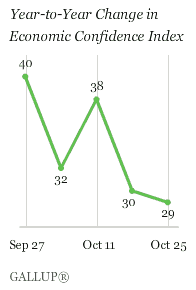
Economic Confidence worsened slightly last week, as Gallup's Economic Confidence Index fell to -29 -- down nine percentage points from where it was just a month ago. The percentages of Americans describing the economy as "getting better" (37%) and as "getting worse" (58%) are not much different from those of the prior week, but are considerably worse than those of the same week last month. "Poor" ratings of the economy are up five points from a month ago to 48%, while "excellent"/"good" ratings are at 11% (vs. 13% a month ago). The August and September gains in economic confidence seem to have dissipated in October.
-
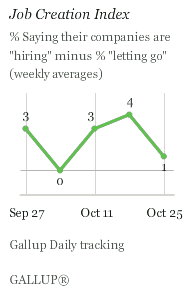
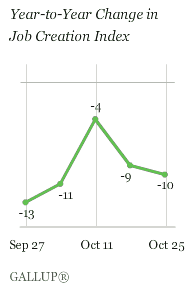
Job Creation also lost ground last week, as Gallup's Job Creation Index fell back to +1 -- down three points from the prior week's 2009 high. The percentage of employees saying their companies are hiring fell back to 24% -- down slightly from 26% the prior week and 27% a month ago. The percentage of workers saying their companies are letting people go was essentially unchanged at 23% from 22% the prior week and 24% a month ago. Right now, layoffs are four points worse than they were during the height of the financial crisis a year ago, while hiring is down six points.
-
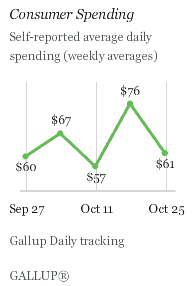
Consumer Spending fell back to its new normal last week, as self-reported daily spending in stores, restaurants, gas stations, and online averaged $61 -- down $15 from the prior week and essentially the same as a month ago. It appears the "paycheck effect" combined with likely Halloween-related spending to create a temporary spending surge. Overall, the current consumer spending trend continues to disappoint: it is down 34% from the $92 average of the same week in 2008, even though last year's comparable reflects conditions that followed the onset of last year's financial crisis.
What to Watch For
Gallup's Economic Confidence Index shows consumer confidence down in October on a month-to-date basis, compared to September. Contrary to the current consensus, the Conference Board's Tuesday release of its Consumer Confidence Index may reflect this finding, although its mail-survey methodology does not allow it to always reflect Gallup's more recent daily findings.
Similarly, Gallup's weekly Economic Confidence measurements show consumer confidence declining in the past week. Contrary to the current consensus estimate, this should also be reflected in a decline in the Reuters/University of Michigan Consumer Sentiment Index that will be released Friday -- although it uses a small sample, making it hard to match Gallup's ability to discern small changes. Regardless, Gallup's measurements suggest consumer confidence has continued to worsen during recent weeks, and that is not likely to be good for the economy.
More important than consumers' overall perceptions of the economy are their perceptions of the job market. Last week's uptick in jobless claims was a surprise. The current consensus is for a slight improvement when the numbers are reported on Thursday, while Gallup's Job Creation Index suggests just the opposite -- a slight uptick. Halloween tends to engender additional hiring of temporary workers. Whether the government's seasonal adjustments will accurately reflect this short-term hiring effect is unclear. Regardless, Gallup's daily monitoring of the job market suggests the unemployment rate is likely to hit 9.9% when reported a week from Friday -- and could possibly hit the psychological threshold of 10%.
Probably the biggest disappointment of the week, however, was the return of consumer spending to the "new normal" trend line. It appears as though consumers are not only spending less but their spending patterns may be becoming more cash-based. In turn, this suggests that Christmas this year may be more cash-based than it has been in a long time. The amount spent on individual Christmas presents could be limited. Timing also could be affected as consumers hunt for bargains when they have cash to spend.
Finally, the Grinch that steals Christmas this year -- as if the outlook isn't bleak enough already -- could be increasing gas prices. Gas prices were declining as Christmas approached last year, but that may not be the case this holiday season.
Regardless, perhaps retailers and consumers alike might benefit from an early start to Christmas this year. Consumers could benefit since the selection of goods will be best early and retailers may be offering attractive prices. Retailers may benefit by getting things off to the best start possible since cash and gas could pose problems for sales as the holidays get closer.
Review and export the complete daily trends on these measures: Economic Indexes; Consumer Spending; Economic Outlook; Economic Conditions; Job Market
Learn more about Gallup's economic measures.
Survey Methods
For Gallup Daily tracking, Gallup interviews approximately 1,000 national adults, aged 18 and older, each day. The Gallup consumer perceptions of the economy and consumer spending results are based on random half-samples of approximately 500 national adults, aged 18 and older, each day. The Gallup job creation and job loss results are based on a random half sample of approximately 250 current full- and part-time employees each day. Results from the week of Oct. 19-25, 2009, are based on telephone interviews with 3,511 adults for the consumer perceptions and spending questions. For these results, one can say with 95% confidence that the maximum margin of sampling error is ±2 percentage points. Results for the job creation and job loss questions are based on interviews with 1,955 employees, with a maximum margin of error of ±3 percentage points.
Interviews are conducted with respondents on land-line telephones and cellular phones.
In addition to sampling error, question wording and practical difficulties in conducting surveys can introduce error or bias into the findings of public opinion polls.