Iraqi women are already using their new political powers to guard against extremism and intolerance in any form, whether it be religious or secular.
-- President George W. Bush, March 12, 2004
Part one of a two-part article on the future of women in Iraq. This article looks at the future of women's roles in Iraqi society and their equality under the law.
Over the course of the coalition's tenure, the desire to improve and safeguard the social contribution, personal efficacy, and legal rights of Iraqi women became an important component of the Coalition Provisional Authority's (CPA) self-defined mission in Iraq. Indeed, for a U.S. presidential administration that had initially derided such concepts as nation-building and interventionist "social engineering," the range of efforts made in this area was remarkable.
At the CPA's insistence, the Transitional Administrative Law -- the interim constitution signed in early March -- includes not only an extensive bill of rights, but also a guarantee that women must hold at least a quarter of the seats in Iraq's elected national parliament (the initial draft had set the minimum proportion at 40%). Soon thereafter, Secretary of State Colin Powell announced a $10 million Iraqi Women's Democracy Initiative, aimed at providing training in "leadership skills, organizing political activities, and other civil actions," and millions more have been allocated for women's groups and business and professional development. The CPA worked closely with Iraqi groups such as the Iraqi Higher Women's Council, and launched partnerships with non-governmental organizations such as the U.S.-Iraq Women's Network.
Such efforts have not been without controversy or direct opposition, however. In late December, the Iraqi Governing Council (IGC) passed a resolution seeking to revoke the country's decades-old personal status laws -- among the most secular and liberal in the region -- and to replace them with sharia-influenced ones that the country's clerics would administer. Because personal status law defines such basic issues as marriage, divorce, child custody, and property inheritance, the effects of such a change would have been dramatic. The resolution was eventually withdrawn on a technicality (the IGC's meeting lacked a quorum), under threat of veto by CPA Administrator L. Paul Bremer.
The security situation has also had a dramatically negative impact. In September, Aquila al-Hashimi, one of three women serving on the IGC, was assassinated. A number of less senior Iraqi women have also been threatened, as have public advocates of women's rights. In March, Fern Holland -- a senior CPA women's rights coordinator who helped draft numerous provisions in the interim constitution -- was machine-gunned to death, along with her Iraqi deputy and a CPA press officer. In late May, a second female IGC member, Salama al-Khafaji, narrowly escaped assassination -- and her son was killed.
Iraq's Future: A More Traditional Role for Women?
What are Iraqis' views on these issues? What role do religious values play in determining their views on women's rights, and to what extent do the views of Iraqi men and women differ?
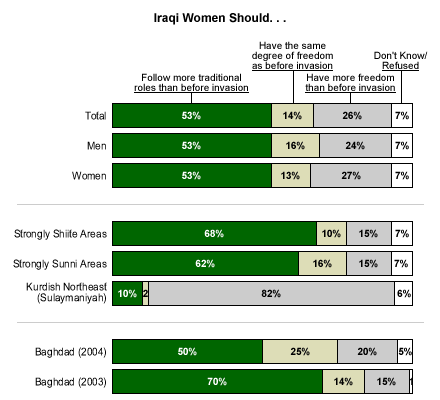
Last summer, the Gallup Poll of Baghdad found that 70% of the capital's residents believed women should follow more traditional roles than they had under the prior (Saddam Hussein) regime -- a contention that male (72%) and female (67%) residents nearly equally endorsed.
This particular manifestation of interest in the re-establishment of traditional values may be easing, however. In Gallup's latest nationwide survey of Iraq, only 53% of all Iraqis -- and just 50% of all Baghdadis -- now say they believe women should adopt a more traditional role than that which they had before. Roughly a quarter of all Iraqis (26%) say they believe women should have more freedom than they did before the coalition invasion, while 14% say their degree of freedom should remain essentially unchanged.
The desire for women to adopt more traditional roles is, of course, strongly linked to religious conservatism. In strongly Shiite areas of the country (68%) -- and in particular, the south central provinces that contain the holy cities of Karbala and Najaf (75%), strong majorities support this posture. By contrast, in largely secular Kurdish Sulaymaniyah, just 10% believe women should follow more traditional roles, while 82% believe women should exercise more personal freedom than before the invasion.
Should Men and Women Be Guaranteed Equal Legal Rights?
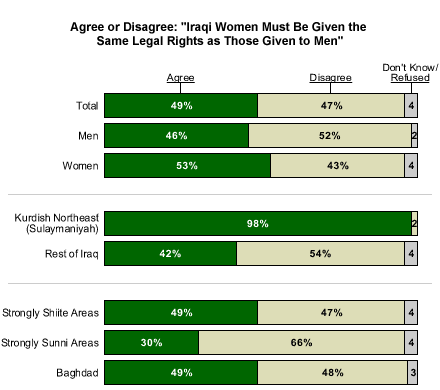
The 2004 Gallup Poll of Iraq also asked Iraqis whether they agreed with the assertion that "Iraqi women must be given the same legal rights as those given to men."
The result? Statistically equal percentages of all Iraqis accepted (49%) and rejected (47%) the basic notion of gender parity in regard to legal rights and privileges -- though women (53%) were admittedly slightly more likely to endorse this notion than were men (46%). In fact, outside the Kurdish northeast (self-governing since 1992), an outright majority (54%) of Iraqis rejected the idea that both sexes should enjoy equal legal protection.
Interestingly, opposition to male-female legal parity is significantly higher in heavily Sunni areas than in areas where Shiites are predominant. In strongly Sunni areas of the country, those opposing a guarantee of equal legal rights for men and women outnumber those in favor by more than 2-to-1 (66% oppose, 30% favor). In the most heavily Shiite areas, however, the distribution of opinion on this issue precisely follows the nationwide pattern (49% favor, 47% oppose).
In addition to internal factors, these findings undoubtedly reflect external theological and social influences as well. While Western observers often tend to think of Shia as the more conservative tradition within Islam, among Iraq's neighbors, it is (Wahhabi-influenced) Sunni Saudi Arabia -- not Shiite Iran -- that enforces far more rigid limits on what social roles, freedoms, and degree of personal mobility are acceptable for women.