PRINCETON, NJ -- Self-reported consumer spending was down more than 20% in each of the last three weeks from last year's depressed weekly comparables. At the same time, Gallup's Economic Confidence and Job Creation Indexes were essentially unchanged.
What Happened (Week Ending Dec. 13)
-
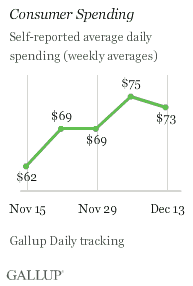
Consumer Spending fell slightly last week, as self-reported daily spending in stores, restaurants, gas stations, and online averaged $73 -- down $2 from the previous week. More importantly, it was down 22% from last year's comparable, when average spending was $94 per day. For the third week in a row, consumer spending has trailed last year's anemic spending levels by more than 20%. While it remains unclear how consumers' spending is being divided between Christmas gifts and other discretionary spending for such things as travel, entertainment, and eating out, consumers are reporting a significant decline in their perceived spending during recent weeks. (This week's consumer spending level may be slightly overstated, as Gallup did not interview on Tuesday and Wednesday last week, days on which spending estimates are typically lower.) Even with this year's much better inventory controls, many retail merchants may be feeling the need to unload goods as Christmas approaches, providing good buying opportunities for consumers with money yet to spend.
-
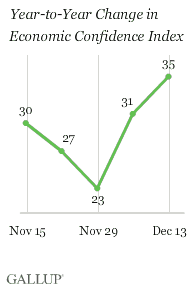
Economic Confidence was essentially unchanged last week. Gallup's Economic Confidence Index was -27, versus -28 the prior week. Consumer assessments of the current economy were not much different, with 46% rating the economy "poor" -- compared to 45% the prior week and 47% two weeks ago. The percentage of Americans rating the economy "excellent" or "good" returned to 11% from 9% the prior week, and is identical to the 11% for all of November. Americans' expectations for the economy going forward were also not much different, with 37% describing the economy as "getting better," versus 38% the prior week and 36% for November. Similarly, 56% said the economy is "getting worse," compared to 58% and 59%, respectively, the previous two weeks. Overall, economic confidence is remains up slightly from its November average (-30).
-
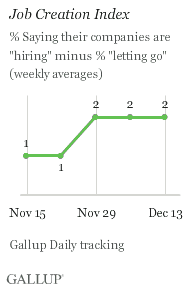
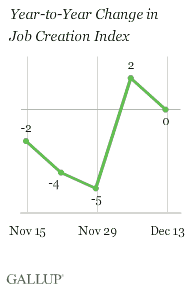
Job Creation was unchanged again last week, as Gallup's Job Creation Index was at +2, the same as the prior two weeks. Last week, 26% of employees said their companies are hiring -- essentially the same as the 24% and 26% of the prior two weeks, respectively -- while 24% said their companies are letting people go, also about the same as the 22% and 24% of the prior two weeks. Job-market conditions have improved from their bleak status of earlier in 2009, and currently match year-ago comparables, but have been essentially unchanged since October.
What to Watch For
Gallup's attitudinal economic data suggest that the Main Street economy continues to lack a lot of merriment this holiday season. Neither economic confidence nor job creation has shown much improvement during recent months, while consumer spending continues to trail significantly behind last year's recession-depressed levels. This seems to comport well with the assertions of Dr. Christina Romer, chair of the president's Council of Economic Advisers, on "Meet the Press" this past weekend that most Americans will continue to feel as though the country is in a recession until the jobs situation improves significantly.
On the other hand, Gallup data contrast with many economists' optimistic reactions to recent government reports suggesting a slight decline in the unemployment rate last month and an uptick in retail sales. For example, White House economic adviser Larry Summers said "everybody agrees that the recession is over" this past weekend on "This Week." He went on to talk about the usual progression from the return of economic growth to increased job growth after some period of time.
These seemingly contradictory descriptions of the current economic situation may continue to be debated when the Federal Open Market Committee meets on Tuesday and Wednesday. If the U.S. economy is beginning to experience a significant recovery, then perhaps it is time for the Fed to begin pulling back on some of its extraordinary efforts to provide economic stimulus. The timing of such a policy shift is made all the more important by what seems to be a total lack of fiscal spending discipline.
As desirable as such a course may be, Gallup's economic data suggest that the real economy as seen on Main Street remains weak and the jobs situation remains dire. In turn, this would argue for no change in Fed policies even at the risk of pulling back the monetary stimulus too late to avoid a variety of negative unintended/undesirable consequences.
Odds are that the Fed will see economic reality more in terms of consumer perceptions as measured by Gallup than by government economic reports. That is, the Fed recognizes that much of what is currently reflected in recent government reports is more illusory than real. And Fed Chairman Bernanke knows that the greater risk in the current financial environment is associated with pulling back on monetary stimulus too soon as opposed to too late.
Review and export the complete daily trends on these measures: Economic Indexes; Consumer Spending; Economic Outlook; Economic Conditions; Job Market
Learn more about Gallup's economic measures.
Survey Methods
For Gallup Daily tracking, Gallup interviews approximately 1,000 national adults, aged 18 and older, each day. The Gallup consumer perceptions of the economy and consumer spending results are based on random half-samples of approximately 500 national adults, aged 18 and older, each day. The Gallup job creation and job loss results are based on a random half sample of approximately 250 current full- and part-time employees each day. Results from the week of Dec. 7-13, 2009, are based on telephone interviews with 2,461 adults for the consumer perceptions and spending questions. For these results, one can say with 95% confidence that the maximum margin of sampling error is ±3 percentage points. Results for the job creation and job loss questions are based on interviews with 1,381 employees, with a maximum margin of error of ±4 percentage points.
Interviews are conducted with respondents on land-line telephones and cellular phones.
In addition to sampling error, question wording and practical difficulties in conducting surveys can introduce error or bias into the findings of public opinion polls.