PRINCETON, NJ -- For the first time in 2009, self-reported consumer spending topped last year's weekly comparables, although by a slim 3%. The higher 2009 figure is largely the result of a sharp decline in spending during the same week a year ago that marked the beginning of the consumer spending slump that extended throughout most of the year. Gallup's Economic Confidence Index showed a slight improvement last week in Americas' evaluations of the national economy. Gallup's Job Creation Index shows job-market conditions have deteriorated in the past several weeks and are now at roughly the same point they were at this time last year.


What Happened (Week Ending Dec. 27)
-
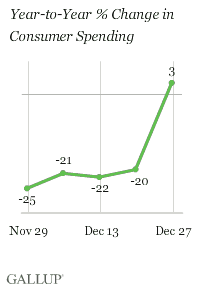
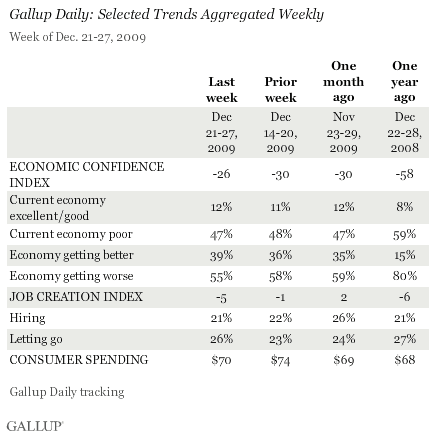
Consumer Spending closed the gap last week compared with spending at the same point a year ago, as self-reported daily spending in stores, restaurants, gas stations, and online averaged $70 -- up 3% from last year's $68-per-day comparable. While the year-over-year spending gap has been declining in recent weeks, this marks the first time in 2009 that weekly spending has matched that of the same week in 2008. Much of the year-over-year improvement results from the way spending eased by 5% from the prior week ($74 versus $70) in 2009, while it plunged 27% in the same week a year ago ($93 versus $68). Consumers have been more cautious about their spending this holiday season than they were a year ago, but so far they seem to have avoided the kind of sharp falloff experienced late last December.
-
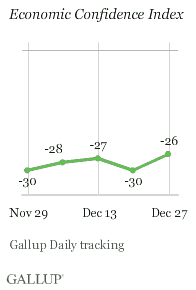
Economic Confidence improved slightly last week, as Gallup's Economic Confidence Index was -26 versus -30 the prior week and a month ago. Current consumer optimism about the state of the U.S. economy remains far better than it was a year ago, when the Index stood at -58. Consumers rate the current economy the same as a month ago with 47% saying it was "poor" and 12% rating it as "excellent" or "good." Americans' expectations for the economy going forward are slightly better now than they were a month ago, with 39% describing the economy as "getting better" versus 35% last month, and 55% saying the economy is "getting worse," compared with 59% one month ago.
-
Job Creation deteriorated considerably last week, as Gallup's Job Creation Index was at -5, worsening from the -1 of the prior week and the +2 of a month ago. Twenty-one percent of employees said their companies are hiring last week, essentially the same as the 22% of the prior week, but down from the 26% of a month ago. At the same time, 26% of employees said their companies are letting people go, which is up from the 23% of the prior week and the 24% of a month ago. Job-market conditions remain depressed and last week showed the same kind of deterioration that was experienced in the same week a year ago.
What to Watch For
Last year, Gallup's behavior-based self-reported consumer discretionary spending fell sharply during the week of Christmas, improved a little during the week before New Year's, and then settled into what was to become at least a temporary spending new normal. Although December 2009's weekly spending levels are some of the highest of the year, they continue to significantly trail those of 2008 during the first three weeks of the month. However, the immediate pre-Christmas drop-off was slight in 2009 leaving spending levels this past week about the same as a year ago. The question going forward is whether consumer spending will be able to continue to exceed the 2009 new normal in 2010.
In this regard, Gallup's Economic Confidence Index suggests consumer sentiment has improved slightly during the holidays and remains much better than it was a year ago. Still, throughout 2009 it seems clear that while economic confidence might be a necessary condition for consumers to increase their spending, it is no longer sufficient to do so as the two have become decoupled.
More importantly, Gallup's Job Creation Index suggests the job situation is deteriorating as 2009 comes to an end. Whether Thursday's jobless claims will reflect these conditions is hard to know given the potential holiday distortions. Regardless, Gallup's job creation modeling suggests the December unemployment rate, reported on Jan. 8, 2010, will increase, moving up to the 10.1% to 10.3% range.
It will be important to monitor these indices as the new year begins. The holiday season is a time of unusual circumstances with official holidays, work closures, and vacations. Additionally, that there is no interviewing on holidays and that Gallup has taken several end-of-year days off from daily interviewing raises the possibility of some unusual patterns in the data at this time of year.
Review and export the complete daily trends on these measures: Economic Indexes; Consumer Spending; Economic Outlook; Economic Conditions; Job Market
Learn more about Gallup's economic measures.
Survey Methods
For Gallup Daily tracking, Gallup interviews approximately 1,000 national adults, aged 18 and older, each day. The Gallup consumer perceptions of the economy and consumer spending results are based on random half-samples of approximately 500 national adults, aged 18 and older, each day. The Gallup job creation and job loss results are based on a random half sample of approximately 250 current full- and part-time employees each day. Results from the week of Dec. 21-27, 2009, are based on telephone interviews with 1,984 adults for the consumer perceptions and spending questions. For these results, one can say with 95% confidence that the maximum margin of sampling error is ±3 percentage points. Results for the job creation and job loss questions are based on interviews with 1,071 employees, with a maximum margin of error of ±4 percentage points.
Interviews are conducted with respondents on landline telephones and cellular phones.
In addition to sampling error, question wording and practical difficulties in conducting surveys can introduce error or bias into the findings of public opinion polls.