PRINCETON, NJ -- Gallup's Job Creation Index suggests that the job situation deteriorated last week with slightly fewer companies hiring while slightly more were letting employees go. Add in the disappointing December jobs report, and it is not surprising that economic confidence also worsened last week. Still, consumer spending continues to be encouraging. Although flat compared with the prior week, it remains slightly above last year's same-week comparables, as upper-income Americans who are less affected by job market conditions are spending a little more now than they were at this time last year.
What Happened (Week Ending Jan. 17)
-
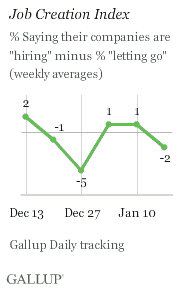
Job Creation as reflected by U.S. workers' reports of their own employer's hiring/firing activities deteriorated last week. Gallup's Job Creation Index was at -2 -- down from the +1 of the prior week. Hiring was down slightly as 23% of employees reported their companies were hiring compared with 24% the prior week. At the same time, slightly more companies (25%) were letting people go compared with the previous week (23%). Right now, job market conditions are essentially no better than they were a month ago (22% hiring and 23% letting go) or a year ago (23% hiring and 26% letting go). Of course, the real job challenge facing the country is most clearly reflected when comparing these numbers with the job market conditions of two years ago when the recession was just getting underway. At that time, 41% of U.S. workers said their company was hiring and 14% said their company was letting workers go.
-
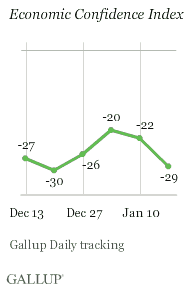
Economic Confidence took a tumble last week as Gallup's Economic Confidence Index worsened to -29 -- 7 points worse than the -22 of the prior week. Economic confidence is essentially where it was last month after showing improvement during each of the past three weeks. Much of the change is because of a dip in Americans' expectations for the future direction of the economy as 37% say the economy is "getting better," down from 41% the prior week, and 58% say it is "getting worse," compared with 53% the previous week. Assessments of current economic conditions also worsened as 47% rate the economy "poor," compared with 44% the previous week, and 11% rate it "excellent" or "good." The decline in economic confidence may be due, at least in part, to a renewed recognition that job market conditions remain weak. Another factor may be continued high gas prices, which are up nearly a dollar from levels a year ago.
-
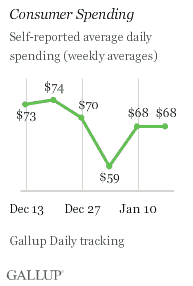
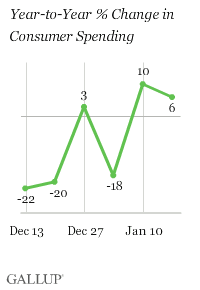
Consumer Spending was unchanged last week with self-reported daily spending in stores, restaurants, gas stations, and online averaging $68 -- the same as during the prior week and up a modest 6% from the same week a year ago. This marks the second time in 2010 that spending has exceeded its year-ago comparable and contrasts sharply with the way in which Gallup's weekly spending estimates were down significantly from 2008 throughout 2009. Consumer spending will continue to enjoy favorable comparables given the January 2009 average of $64 per day that turned out to be something of a "new normal" in spending last year. That spending in early January 2010 that appears to be matching last year's new normal reflects the bottoming out of consumer spending. This is good news for the U.S. economy given current job market conditions.
What to Watch For
So far in early 2010, the good news in Gallup's behavior-based economic data is that self-reported consumer spending this month is likely to match or slightly exceed last year's new normal. This bottoming out of consumer discretionary expenditures may be a modest goal given the technical recovery of the U.S. economy as positive GDP growth reflects. On the other hand, double-digit unemployment -- even two years after the recession began -- might have had consumers continuing to pull back and spending declining even more.
Of course, the bad news involves job-market conditions and the overall lack of new hiring. At this time last year, 23% of employees were saying their companies were hiring, while this year 23% are saying the same thing. The magnitude of the hiring challenge facing the nation is reflected by the fact that that current new hiring is running at about half the 41% rate of hiring in January 2008 as the recession began. Regardless of what jobless claims show Thursday morning -- and Gallup's data suggest a slight increase -- new hiring remains a serious problem for the economy in 2010. In fact, Gallup's job creation model suggests the unemployment rate will increase from its current 10.0% in January.
In this regard, it seems likely that there will soon be new legislative proposals to stimulate job creation in 2010. We may be able to attribute the GOP challenge in the Massachusetts special election to many disparate factors, but one of them is likely the lack of job creation in the U.S. economy. As soon as the issues surrounding the healthcare bill are resolved, a more pronounced pivot to a focus on jobs on the part of Congress and the administration is economically and politically likely, not to mention warranted.
Finally, there was a sharp decline in economic confidence last week. In part, this may have resulted from the current lack of hiring. However, it may also be worthwhile to look back to early 2008 and reconsider the beginning of the recession. Record gas prices at the pump played a significant role in the economic downturn of 2008 before the financial crisis later that year exacerbated it. Today's gas prices remain well above those of a year ago and could go even higher despite the current weak economy. This is something to keep in mind -- and another threat to economic confidence and the sustainability of the new normal -- as the first half of 2010 unfolds.
Review and export the complete daily trends on these measures: Economic Indexes; Consumer Spending; Economic Outlook; Economic Conditions; Job Market
Learn more about Gallup's economic measures.
Survey Methods
For Gallup Daily tracking, Gallup interviews approximately 1,000 national adults, aged 18 and older, each day. The Gallup consumer perceptions of the economy and consumer spending results are based on random half-samples of approximately 500 national adults, aged 18 and older, each day. The Gallup job creation and job loss results are based on a random half sample of approximately 500 current full- and part-time employees each day. Results from the week of Jan. 11-17, 2010, are based on telephone interviews with 3,438 adults for the consumer perceptions and spending questions. For these results, one can say with 95% confidence that the maximum margin of sampling error is ±3 percentage points. Results for the job creation and job loss questions are based on interviews with 4,177 employees, with a maximum margin of error of ±3 percentage points.
Interviews are conducted with respondents on landline telephones and cellular phones.
In addition to sampling error, question wording and practical difficulties in conducting surveys can introduce error or bias into the findings of public opinion polls.