In many European countries, secularization has greatly increased over the last few decades. However, the new European Union is made up of an incredibly diverse group of countries with vastly different histories and cultural norms. Trust in religious institutions among the 25 member countries varies widely, according to the latest Eurobarometer survey* of the 25 member nations of the EU.
In order to belong to an institution, one needs to trust it, and a basic characteristic of secularization is the loss of trust in institutionalized forms of religious life. Furthermore, the level of trust in religious institutions, as measured by the Eurobarometer, gives a general indication of the extent to which people in various parts of Europe are open to identifying with an organized religious community.
Divergent Views on Religious Institutions
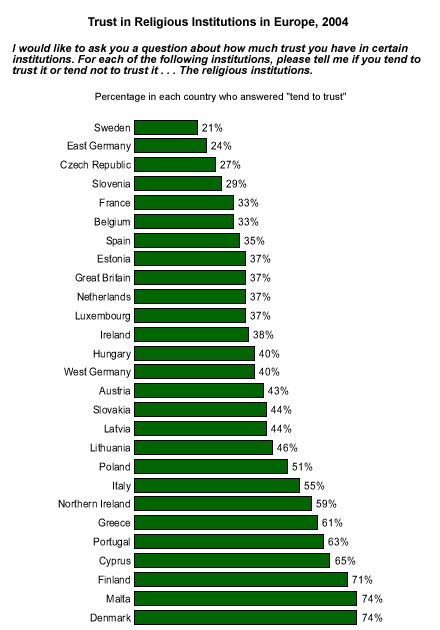
There are no simple explanations for the amazingly diverse views toward religious institutions among the countries in Europe. Consider the opposing views of people in two neighboring countries -- Sweden and Denmark. Both are among the most developed, economically prosperous countries of Europe, and in both countries the dominant religious institution is a Protestant (Lutheran) church. When asked if they tend to trust religious institutions, a scant 21% of Swedes said yes (the lowest of all countries measured), compared with 74% of Danes (the highest percentage measured in any country).
Trust in religious institutions is also high in Finland -- another prosperous Nordic Protestant country -- where 71% of residents trust in religious institutions. The rest of the countries in which more than 60% of the population expresses trust in religious institutions are in southern Europe -- Malta, Cyprus, Portugal, and Greece. With the exception of Greek Orthodox Cyprus and Greece, they are all predominantly Roman Catholic countries. Religious institutions also enjoy the trust of the majority of Poles (51%) and Italians (55%) as well.
Divisions Within Countries
This religious divide exists not only between various European societies, but within some societies as well. In formerly West Germany, 40% express trust in religious institutions, while formerly East Germany -- which was behind the Iron Curtain for many years -- has one of the lowest proportions at 24%. Similarly divergent opinions, no doubt owing to historical divides, exist in the British Isles: 38% of people in Ireland trust religious institutions, as do 37% of those in Great Britain. However, a clear majority of those in Northern Ireland -- 59% -- trust religious institutions.
Old Europe vs. New Europe
There are no easy generalizations when looking at differences between the old and new member countries, either. In the Czech Republic, Slovenia, Estonia, and Hungary -- all former communist countries -- less than 40% of respondents trust religious institutions, comparable to similarly low trust levels in the western European countries of France, Belgium, Spain, Great Britain, the Netherlands, Luxembourg, and Ireland. But three other post-communist new member countries -- Poland, Lithuania, and Latvia -- show somewhat higher levels of trust than the other post-communist countries, at 51%, 46%, and 44%, respectively. Perhaps not surprisingly, the two new member countries that never experienced communism, Cyprus and Malta, have some of the highest trust levels in Europe (65% and 74%, respectively).
A future release will look at religious attendance and religious self-identification in Europe.
*The standard Eurobarometer was established in 1970 as a tool to track the evolution of the citizen opinion of the European integration. Each survey consists of approximately 1,000 face-to-face interviews per Member State (except Germany: 2,000, Luxembourg: 600, United Kingdom 1,300 including 300 in Northern Ireland). Conducted between 2 and 5 times per year, with reports published twice yearly. The fieldwork is coordinated by EORG. First wave of Candidate Countries Eurobarometer was carried out in October 2001 in all the 13 countries applying for membership. One thousand face-to-face interviews are conducted in each country, except for Cyprus and Malta, where the number of interviews conducted are 500 each. The fieldwork is coordinated by Gallup Hungary, and the reports and analysis are written by Gallup based on a contract with the European Commission. The fieldwork for the last wave reported here was conducted in March-April of 2004 and the detailed reports can be found at the European Commission's Web site.
