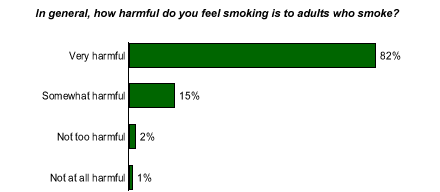
Virtually all American adults know that cigarettes pose a health risk: According to combined Gallup data from 2002 to 2004*, 82% of Americans feel smoking is "very harmful" to adults who smoke, while another 15% say it is "somewhat harmful."
Those percentages are evidence that decades of private and public education and awareness efforts have had some effect. Nevertheless, the Centers for Disease Control and Prevention report that tobacco use remains the leading preventable cause of death in the United States, accounting for about 440,000 deaths each year. Aggregated Gallup data on smoking indicate that 24% of American adults have smoked in the past week, a figure that has held fairly steady for the last decade.
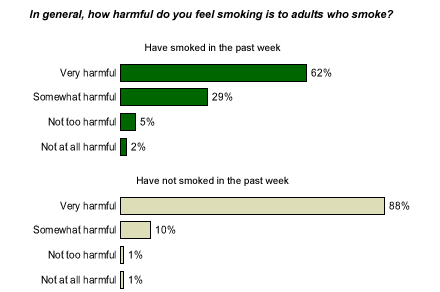
The majority of smokers are obviously well aware that the habit is harmful to them -- but perceptions of how harmful it is to tend to vary between smokers and nonsmokers. Eighty-eight percent of those who haven't smoked in the past week feel smoking is "very harmful," compared with just 62% of those who have.
Who's Hooked?
Still, the fact that three in five smokers say they realize smoking is very harmful speaks to the power of nicotine addiction. Who's most likely to be hooked? There isn't much difference strictly by gender, but age certainly plays a factor. Men are as likely as women to say they've smoked in the past week (26% vs. 23%), and Americans under age 50 are more likely than those over 50 to have done so (27% vs. 19%). The data suggest that older men who smoke are more likely to smoke a pack or more daily than those in other age and gender groups.
Bottom Line
Smoking costs more than $75 billion per year in medical expenses and $80 billion per year in lost productivity. CDC's Healthy People objective is geared toward reducing adult cigarette smoking from a 1998 baseline of 24% to a 2010 target of 12%. They have a long way to go to reach that objective, thought almost all Americans have gotten the message that smoking is dangerous. The implication is that, moving forward, getting more people to quit may require reallocating some of the resources spent on awareness of the risks to developing effective strategies for helping smokers -- especially older males -- overcome what in many cases has proven an insurmountable addiction.
*Results are based on telephone interviews with 3,016 national adults, aged 18 and older, conducted in July 2002, July 2003, and July 2004. For results based on this sample of national adults, the maximum margin of sampling error is ±2 percentage points.
For results based on the sample of 960 men and 1,050 women, the maximum margin of sampling error is ±3 percentage points.
For results based on the sample of 555 men, aged 18 to 49 and 566 women, aged 18 to 49, the maximum margin of sampling error is ±4 percentage points.
For results based on the sample of 809 adults with a high school education or less, the maximum margin of sampling error is ±4 percentage points. For results based on the sample of 1,341 adults with at least some college education, the maximum margin of sampling error is ±3 percentage points.
For results based on the sample of 656 smokers, the maximum margin of sampling error is ±4 percentage points.
For results based on the sample of 333 men who smoke and 323 women who smoke, the maximum margin of sampling error is ±6 percentage points.
For results based on the sample of 220 men, aged 18 to 49 who smoke and 199 women, aged 18 to 49, the maximum margin of sampling error is ±7 percentage points. For results based on the sample of 111 men, aged 50+ who smoke and 124 women, aged 50+, the maximum margin of sampling error is ±10 percentage points.