In 1996, California became the first U.S. state to implement a statewide ban on smoking in all workplaces and restaurants; since then, several other states and numerous local governments have followed suit. In Canada, provincewide smoking bans in New Brunswick and Manitoba go into effect this Friday, with Saskatchewan to follow in January 2005. Great Britain's chief medical officer, Sir Liam Donaldson, has recommended a nationwide smoking ban in all workplaces (including restaurants and bars) -- to the applause of several political leaders and advocacy groups. But British government and industry leaders are still at odds on how to implement smoking bans, and it is currently up to the individual businesses to decide.
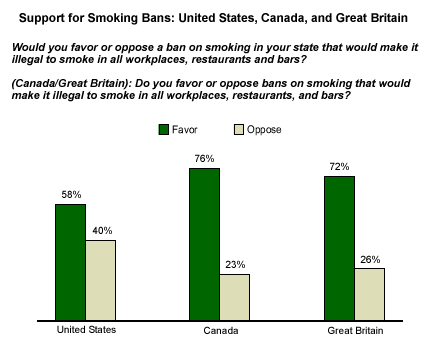
Although these countries are following different paths toward comprehensive smoking bans, there's no question that there is a general trend among Western nations toward broader smoking restrictions. Gallup recently asked adults in the United States, Canada, and Great Britain for their opinions on smoking bans in workplaces, restaurants, and bars*, and uncovered some surprising results. Americans are less likely than those in Canada and Great Britain to support smoking bans, although they are as likely as Canadians and Britons to agree that second-hand smoke is harmful.
Americans Less Likely to Support Smoking Bans
When asked whether they would favor or oppose a ban in their state to make smoking illegal in all workplaces, bars, and restaurants, 58% of Americans say they would favor such a ban, while 40% would oppose it. Britons and Canadians, meanwhile, show much stronger support: About three-fourths of adults in both countries favor bans on smoking in workplaces, restaurants, and bars (76% in Canada, 72% in Great Britain), while only about a quarter oppose such bans (23% in Canada, 26% in Great Britain).
Smokers Weigh In
Interestingly, Americans are no more likely than those in the other two countries to be smokers themselves -- 25% of American adults report smoking cigarettes in the past week, as do 27% of Canadian adults and 29% of British adults.
It's not surprising to find that smokers in all three countries are less likely than nonsmokers to favor bans on smoking in workplaces, bars, and restaurants, but only in America do a majority of smokers oppose smoking bans. Two-thirds (66%) of Americans who've smoked in the past week oppose such bans in their state, compared with 44% of Canadian smokers and 43% of British smokers.
Views on Second-Hand Smoke Consistent
The main argument for smoking bans in bars and restaurants centers around the health risks associated with second-hand smoke (often referred to as "passive smoking" in Great Britain). Anti-smoking advocates argue that nonsmokers who patronize, and work in, establishments that allow smoking are put at risk for cancer and other health problems stemming from inhaled cigarette smoke.
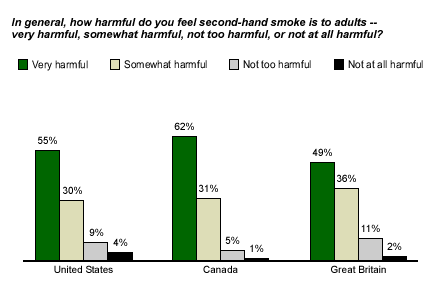
But even though Americans are less likely than Canadians and Britons to favor smoking bans, they're no less likely to believe that second-hand smoke poses health risks. Eighty-five percent of Americans feel that second-hand smoke is "very" or "somewhat" harmful to adults, and an equal percentage of Britons say the same. At 93%, Canadians are slightly more likely than Americans and Britons to see second-hand smoke as harmful.
Do Smokers Feel Discriminated Against?
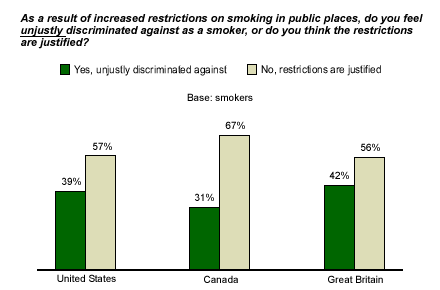
Gallup also asked smokers in all three countries if they feel unjustly discriminated against because of increased restrictions on smoking in public places. Because smokers in the United States are more likely than smokers in Canada and Great Britain to oppose smoking bans, one might assume that American smokers are also more likely to feel unjustly discriminated against.
But that's not the case. Less than a third (31%) of Canadian smokers feel unjustly discriminated against -- the lowest percentage of the three countries. But American smokers and British smokers are about equally likely to feel unjustly discriminated against, at 39% and 42%, respectively. Relatively strong majorities of smokers in each country say they do not feel unjustly discriminated against as a result of increased smoking restrictions.
Bottom Line
The fact that Americans are less enthusiastic about smoking bans than either Canadians or Britons may relate less to their opinions on smoking, and more to their feelings on government regulation in general. Americans tend to believe the government should do less, rather than more, while Britons and Canadians generally take the opposite view.
*Results in the United States are based on telephone interviews with 1,005 national adults, aged 18 and older, conducted July 8-11, 2004. For results based on the total sample of national adults, one can say with 95% confidence that the maximum margin of sampling error is ±3 percentage points. For results based on interviews with 224 smokers, the maximum margin of sampling error is ±7 percentage points. The survey was conducted by Gallup USA.
Results in Canada are based on telephone interviews with 1,005 national adults, aged 18+, conducted Aug. 30-Sept. 6, 2004. For results based on the total sample of national adults, one can say with 95% confidence that the maximum margin of sampling error is ±3 percentage points. For results based on interviews with 284 smokers, the maximum margin of sampling error is ±6 percentage points. The survey was conducted by Gallup Canada.
Results in Great Britain are based on telephone interviews with 1,009 national adults, aged 18 and older, conducted Aug. 25-Sept. 7, 2004. For results based on the total sample of national adults, one can say with 95% confidence that the maximum margin of sampling error is ±5 percentage points. For results based on interviews with 260 smokers, the maximum margin of sampling error is ±7 percentage points. The survey was conducted by Gallup UK.