Americans clearly feel that it's important for today's high school students to be technologically literate and be able to apply what they know -- long before they leave the hallowed halls of learning. However, educators might find it helpful to know which specific aspects of technology Americans are most likely to see as important.
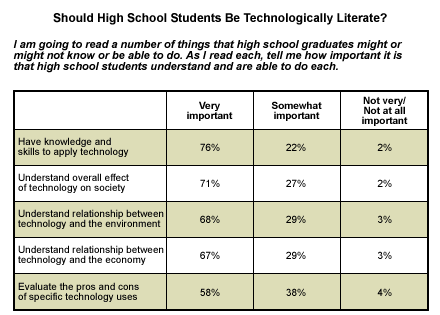
A Gallup survey conducted for the International Technology Education Association* earlier this year presented Americans with a list of five technology-related things that high school graduates might or might not know or be able to do. Then, respondents were asked to rate how important it is that high school students understand and be able to apply each of them.
According to 76% of Americans, it is very important for high school students to have the knowledge and skills needed to apply technology. Seventy-one percent of Americans feel that it's very important for these students to understand the overall effect of technology on society, and more specifically, a majority of respondents believe high school students should understand the relationship between technology and the environment (68%) and technology and the economy (67%). Slightly fewer adults, although still a majority (58%), think it's very important that students be able to evaluate the pros and cons of specific technology uses.
Gender
Women are more likely than men to see most of the technology-related items as very important, with the exception of students being able to evaluate the pros and cons of the uses of specific technology. Differences between men and women are most apparent in their evaluations of the importance of understanding the overall effect of technology on society (78% of women vs. 64% of men find it very important) and understanding technology's relationship with the environment (64% of women vs. 45% of men).
Age and Technology
Age doesn't seem to play a role in the level of importance that Americans assign to students having the knowledge and skills to apply technology. However, older Americans are somewhat more likely than younger Americans to emphasize the importance of several technological relationships. For example, 70% of Americans aged 50 and older feel that understanding the relationship between technology and the economy is very important, compared with 59% of 18- to 29-year-olds. Seventy-one percent of respondents 50 and older think that students should understand the relationship between technology and the environment before graduating from high school, while just 63% of younger adults in the 18 to 29 group feel that way.
Dr. William Dugger Jr., director of technology for ITEA, says knowledge about technology may be behind differences among older and younger adults. "Our studies have shown that younger people have better knowledge about technology, and they are less fearful of it than older people. But because of their longer life experiences, those 50 and over may be more hard-wired to have these complex types of concerns."
Bottom Line
As the ITEA survey illustrates, adults also understand that it's not enough to put computers in the classrooms. Making certain that students are engaged with technology across all disciplines is paramount to their future growth and well-being as they join the global economy.
*These results are based on telephone interviews with a randomly selected national sample of 800 adults, aged 18 and older, conducted March 11-31, 2004. For results based on this sample, one can say with 95% confidence that the maximum error attributable to sampling and other random effects is ±4 percentage points. In addition to sampling error, question wording and practical difficulties in conducting surveys can introduce error or bias into the findings of public opinion polls.