Actor and research activist Christopher Reeve's death last week brought renewed focus to his tireless efforts over the last decade to promote stem cell research. Because stem cells are essentially "blank cells" that can become specialized cells, they can be genetically manipulated and have the potential to regenerate damaged organs or tissue. Scientists see them as a pathway toward cures for spinal cord injuries of the kind Reeve suffered, as well as diabetes, Parkinson's disease, Alzheimer's disease, and other conditions.
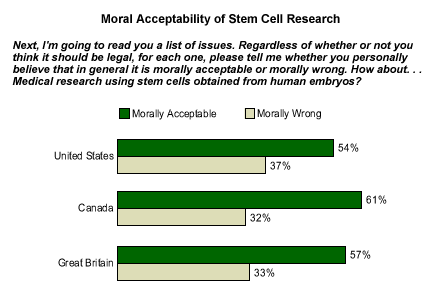
But for many people, the fact that some stem cells come from human embryos -- either frozen embryos resulting from in vitro fertilization procedures or embryos cloned for the sole purpose of research -- is a moral impediment to this research. However, recent Gallup polling in the United States, Canada, and Great Britain*, indicates that majorities in each country agree that using embryonic stem cells for research is morally acceptable. Americans are less likely than Canadians to find it morally acceptable, 54% of U.S. adults say it is morally acceptable, compared with 61% of Canadians who say so. Americans' and Britons' views are more similar; 57% of Britons find it morally acceptable. Roughly a third in each country say it is morally wrong.
Science and Religion
Americans tend to be far more religious than Canadians or Britons -- Americans are nearly twice as likely as Canadians and three times as likely as Britons to attend church weekly. Americans are also far more likely to say that religion is very important in their lives (see "Worlds Apart: Religion in Canada, Britain, U.S." in Related Items).
Given that high level of religiosity, one might expect far fewer Americans to view embryonic stem cell research as morally acceptable than do those in the other two countries. But the gap in opinion on stem cell research is relatively small; much larger gaps are evident between the United States and the other two countries on questions about the moral acceptability of abortion, premarital sex, and same-sex marriage.
The absence of large differences may partly reflect the newness and complexity of the issue -- many people have not yet formed the same entrenched positions that they may have on other moral issues that have been in the public eye longer. (For a closer look at Americans' positions on stem cell research, see "Medicine Meets Morality in Stem Cell Debate" in Related Items.)
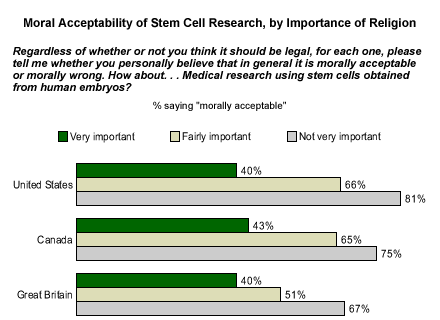
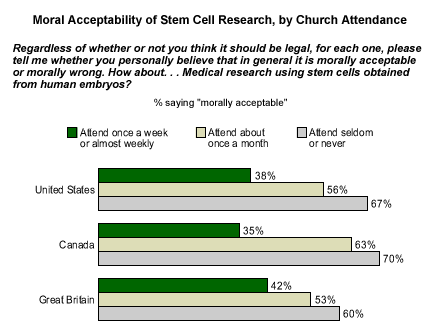
Across all three countries, people with similar levels of religiosity tend to have like-minded views on the topic of embryonic stem cell research. Those who attend church or synagogue weekly or nearly weekly are the least likely to say that stem cell research is morally acceptable -- 38% in the United States, 35% in Canada, and 42% in Great Britain. The same relationship holds true for those who say that religion is very important in their daily lives. For example, 43% of Canadians for whom religion is very important feel embryonic stem cell research is morally acceptable, versus 75% of those who say that religion is not very important in their daily lives.
Bottom Line
While people in all three countries have somewhat similar views about the moral acceptability of embryonic stem cell research, each country has very different governmental regulations dictating the production and use of those stem cells.
The Bush' administration's stance on stem cell research is to fund research on existing stem cells, but not on new stem cell lines. At the opposite end of the spectrum, the British government created the United Kingdom Stem Cell Bank to distribute embryonic stem cell lines free to researchers, although a British ethics committee will carefully monitor their use. Canada's current policy falls somewhere in between that of the United States and Great Britain. Their government will finance research using stem cells from embryos and aborted fetuses, but will not permit cloning stem cells for the purpose of research.
*Results in the United States are based on telephone interviews 1,000 national adults, aged 18 and older, conducted May 2-4, 2004. For results based on the total sample of national adults, one can say with 95% confidence that the maximum margin of sampling error is ±3 percentage points. The survey was conducted by Gallup USA.
Results in Canada are based on telephone interviews with 1,005 national adults, aged 18 and older, conducted Aug. 30-Sept. 6, 2004. For results based on the total sample of national adults, one can say with 95% confidence that the maximum margin of sampling error is ±3 percentage points. The survey was conducted by Gallup Canada.
Results in Great Britain are based on telephone interviews with 1,009 national adults, aged 18 and older, conducted Aug. 25-Sept. 7, 2004. For results based on the total sample of national adults, one can say with 95% confidence that the maximum margin of sampling error is ±5 percentage points. The survey was conducted by Gallup UK.
