This election season, bloggers took political communication to another dimension by making political opinions of every persuasion omnipresent on the Web. Flattering and unflattering names for those on both sides of the political spectrum, previously reserved for private conversation, became public on political blog sites. For example, some bloggers typecast conservatives as "gun-toting churchgoers," most using the description pejoratively, but some bearing the badge with honor. Is there truth behind the label?
It is true that those who attend church regularly tend to be conservative, as do those who own guns. And people who fit both descriptions voted overwhelmingly for George W. Bush this year's presidential election. But an analysis of recent Gallup data shows that churchgoing and gun ownership do not necessarily go together in America.
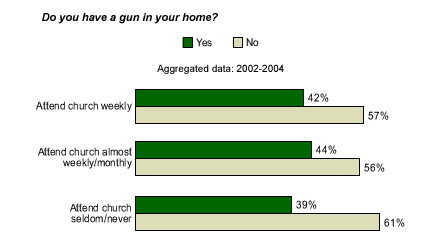
The analysis relied on data from the last three Gallup Crime polls, conducted in October of each year. The data show that American churchgoers are no more likely to own guns than those who rarely or never darken a chapel door. About 4 in 10 people in both groups say they have a gun in the house.
Laws Covering Sale of Firearms
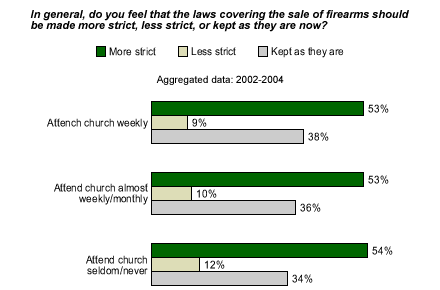
Weekly churchgoers and non-churchgoers are not in dispute over their attitudes toward gun laws, either. Similar majorities of both groups (53% of weekly churchgoers, 54% of non-churchgoers) agree that the laws covering the sale of firearms should be made stricter. About 1 in 10 say that the laws should be made less strict, and approximately a third of each group say the laws should be kept just as they are now. Americans who attend church on a regular basis, but less frequently than every week, also agree with their weekly attending and non-attending counterparts about gun laws.
Ban Handguns?
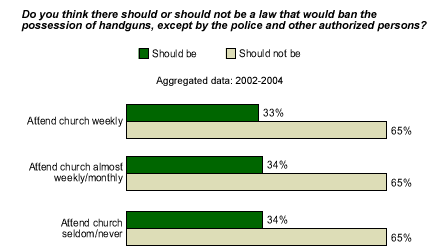
Handguns are not commonly thought of as hunting weapons. They are more often associated with crime, and in that capacity are often kept in the house for self-defense against criminal activity. Even though handguns tend to be more politically controversial than traditional hunting rifles, people who seldom or never attend religious services agree with weekly churchgoers that there should be no law to ban the possession of handguns. Sixty-five percent of people in both groups say there should not be a law banning handguns. About a third of churchgoers (33%) and non-churchgoers (34%) disagree with that premise.
Bottom Line
It is true that in American politics people associate certain behaviors with people of different political persuasions. While there often is some truth to stereotypes (those who attend church and those who own guns tend to be more conservative), the idea that there is a nexus of cultural conservatism that makes churchgoing Americans more apt to own guns doesn't pan out. But that probably won't stop self-proclaimed pundits from using the term again to oversimplify a chunk of the electorate, along with "tree-hugging Volvo drivers," "flag-waving, pick-up-driving good ole' boys," and the ever-popular "blue-state, wine-drinking, academic elitist."
*Results are based on aggregated data from telephone surveys with 3,033 adults, 18 and older, conducted between Oct. 14, 2002 and Oct. 14, 2004. For results based on the total sample of national adults, one can say with 95% confidence that the margin of sampling error is ±2 percentage points.
Actual dates of surveys: Oct. 14-17, 2002; Oct. 6-8, 2003; Oct. 11-14, 2004.
The margin of error for the 920 weekly churchgoers is ±4 percentage points; the margin of error for the 711 nearly weekly/monthly churchgoers is ±4 percentage points; the margin of error for the 1,374 who seldom or never attend church is ±3 percentage points.
