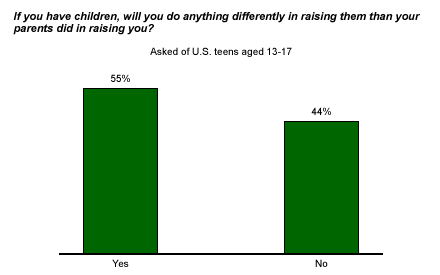
Each generation of young people typically sees itself as fundamentally different from the generation before -- with many vowing never to be like their parents or raise their children "that way." Results from a recent Gallup Youth Survey* indicate that a majority of today's teens intend to keep that oath, but a substantial percentage will follow their parents' game plans when they have children. Slightly more than half (55%) of teens aged 13 to 17 indicate they will do some things differently when raising their own children, while 44% say they want to follow their parents' example and not do anything differently.
More Strict or Less Strict?
What do teens plan to do differently when they are parents themselves? Almost certainly not surprising to most parents, the most common response that teens who would do some things differently give to this open-ended question is to "be less controlling and allow more freedom." Eighteen percent of teens feel that they will cut their own children more slack.
A few responses in teens' own words illustrate that desire for freedom. "I will allow my children more room to make mistakes and the right decisions, " says one 14-year-old girl. Similarly, a 14-year-old boy has the following suggestion: "Give them (children) more freedom and not shelter them, let them make decisions but also make sure they know which ones are the wrong ones." Another 14-year-old girl takes a practical perspective: "Not focus on the smaller things like being really proper, because we don't listen anyway."
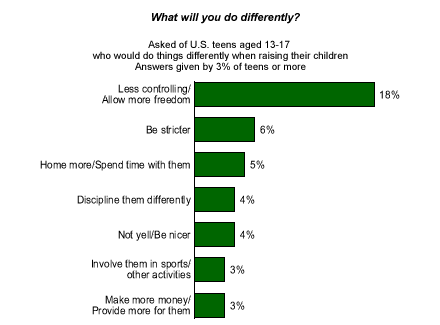
On the other hand, 6% of teens who would raise their children differently would be "stricter" than their own parents are with them. Some teens actually crave more structure and parental involvement in their lives. "My mom did a great job of raising all of us, but she wasn't very strict," says a 13-year-old boy. "I want my kids to know that I'm going to love them even after they mess up, but they are still going to have to be punished for those mistakes." One respondent, a 13-year-old girl, actually says that she will not let her kids watch as much television as she watches.
Teens Want More Time
Five percent say they will do something quite simple with their own children: spend more time with them. One 14-year-old girl says she would "show more affection, spend more time, and congratulate them on their successes, big or small."
Other popular responses include disciplining their kids differently (4%), not yelling/being nicer (4%), involving their kids in sports and other activities (3%), and making more money to provide for their kids (3%).
Finally, in a brief statement that could be the motto for countless adolescents, one 13-year-old boy says he'll do everything differently because he's a different person.
*The Gallup Youth Survey is conducted via an Internet methodology provided by Knowledge Networks, using an online research panel that is designed to be representative of the entire U.S. population. The current questionnaire was completed by 439 respondents, aged 13 to 17, Aug. 8-19, 2004. For results based on the total sample, one can say with 95% confidence that the maximum margin of sampling error is ±5 percentage points.
For results based on 244 teens who said that they would do some things differently than their parents when they raise their own children, the maximum margin of sampling error is ±7 percentage points.