The ranks of Americans without health insurance continued to swell last year, with Census figures showing 45 million Americans were without coverage in 2003 -- an increase of 1.4 million from the previous year. Apart from the inability to cope financially with the skyrocketing costs of catastrophic accidents or illnesses, the uninsured are more prone to neglect regular medical assessments and appropriate preventative care. In turn, this perpetuates a vicious cycle of higher incidents of serious medical issues that ultimately drive healthcare costs higher.
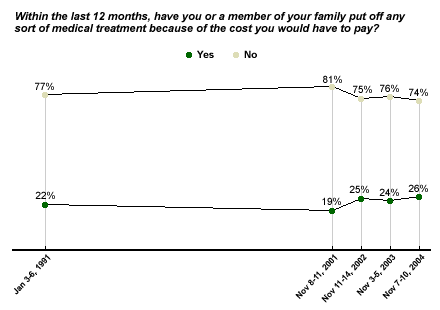
Gallup's 2004 Health poll* further illustrates the seriousness of the problem. Eleven percent of U.S. adults say they do not have any health insurance through Medicare, Medicaid, or private insurers. Slightly more than a quarter (26%) of American adults say that -- within the past year alone -- they have put off seeking medical treatment for themselves or a family member because of the out-of-pocket costs it would incur.
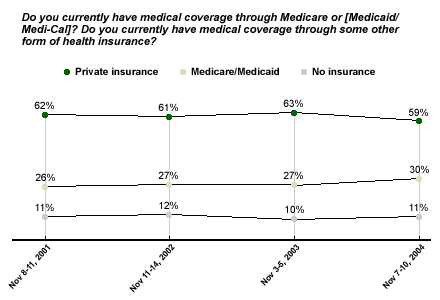
Naturally, those whose incomes don't necessarily force a choice between paying insurance premiums and putting food on the table are more likely to have insurance. People with higher annual incomes are dramatically more likely than are those with lower incomes to have health coverage. Only 3% of Americans with annual household incomes of $75,000 or more say they are not covered, while that number rises to 21% among those earning less than $30,000 annually.
Data compiled by CoverTheUninsured.org, a project of the Robert Wood Johnson Foundation, shows that one-fourth of uninsured Americans live below the federal poverty line. CoverTheUninsured also reports that the likelihood of being uninsured as an adult gradually decreases as age increases, partly because young adults are less likely to have jobs offering health insurance, and because most elderly Americans are covered by Medicare. Foreign-born Americans are nearly three times as likely as U.S.-born Americans to be uninsured. Americans employed in blue-collar jobs, such as agriculture, construction, and transportation, are also disproportionately likely to go without insurance.
Putting Off Healthcare
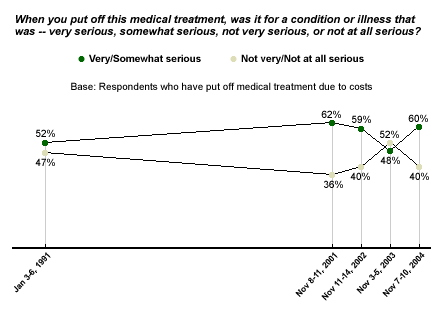
It may be troubling that 26% of Americans say that medical costs kept them from seeking care, but even more alarmingly, 6 in 10 of those who put off treatment say that the condition or illness for which they did not seek care was either "somewhat serious" (44%) or "very serious" (16%). Such delays in care lead not only to higher costs of treatment (when conditions are not caught until they are in more advanced stages), but in the case of serious diseases such as cancer and heart disease, can often mean the difference between life and death.
Gallup's numbers confirm there is a strong link between lack of health insurance and the need to put off medical care, with 54% of those who have no coverage saying that they delayed seeking care in the last year. But although those without health insurance are most likely to avoid seeking medical help, this problem is not restricted to people completely lacking in coverage. More than 2 in 10 (23%) of those with private health insurance say they put off medical care within the last year because of the cost.
Bottom Line
Out-of-pocket costs for medical care and prescription drugs have increased over recent years, and U.S. workers are more likely now than they were three years ago to be asked by their employers to shoulder part of their healthcare costs. Sixty-four percent of adults with private insurance now share the cost of their healthcare, compared with 54% in 2001. When asked about changes in the amount they have to pay for health insurance within the past year, 76% of those who pay all or part of their medical insurance report that the amount has gone up, with 28% saying it has gone up "a lot."
*These results are based on telephone interviews with 1,016 national adults, aged 18 and older, conducted Nov. 7-10, 2004. For results based on the total sample of national adults, one can say with 95% confidence that the margin of sampling error is ±3 percentage points. In addition to sampling error, question wording and practical difficulties in conducting surveys can introduce error or bias into the findings of public opinion polls.
For results based on the sample of 709 adults who are not insured by Medicare or Medicaid, the maximum margin of sampling error is ±4 percentage points.
For results based on the sample of 619 adults who have private health insurance, the maximum margin of sampling error is ±4 percentage points.
For results based on the sample of 509 adults who pay all or part of their health insurance premiums, the maximum margin of sampling error is ±5 percentage points.
For results based on the sample of 245 adults who have put off medical treatment due to cost within the past 12 months, the maximum margin of sampling error is ±7 percentage points.