Emergency department visits tend to be urgent and unplanned, and inpatient visits are usually necessitated by serious injuries or illnesses, with the exception of women who are admitted for childbirth. Among both emergency department patients and inpatients, hospital satisfaction ratings vary significantly according to the patient's payor type -- namely, Medicare patients, Medicaid patients, those with HMOs or PPOs, those using other commercial insurance, and self-payors. But what about outpatient services, where conditions are less likely to be life-threatening and services are more likely to be elective?
The two types of outpatient services for which Gallup measures patient satisfaction -- outpatient surgery and outpatient test and treatment -- show different patterns of variation by payor class. Outpatient surgery scores vary less by payor class than either inpatient or emergency department ratings. Its more consistent satisfaction across payor categories can be explained largely by the overall high level of satisfaction with outpatient surgery (it is the highest rated of the four areas Gallup measures), its more elective nature (patients are more likely to be having outpatient surgeries out of choice, rather than necessity), and that outpatient surgery patients have greater freedom to select their own facilities.
Satisfaction scores for outpatient test and treatment show more variation by payor class. Average scores in four of the six payor categories vary significantly from the mean satisfaction score -- the most variation of any of the four areas.
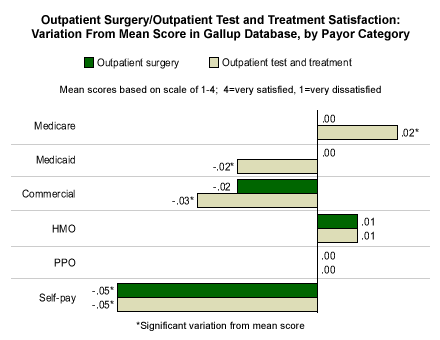
One payor category -- self-paying patients -- gives lower-than-average satisfaction ratings for both outpatient surgery and outpatient test and treatment services. Self-payors, who generally have no insurance and are paying their own way, tend to be the lowest-income patients. Because outpatient surgery procedures are usually planned ahead of time and don't stem from life-threatening conditions, physicians and hospitals can be more selective in the patients they accept. It could be that self-pay patients are less likely than other patients to be able to access outpatient surgery services, and are more negatively influenced by high costs when they are evaluating their experiences. They might also be more likely to forego the most desirable treatments due to cost, and may therefore be less satisfied with the overall effectiveness of the care they received.
Self-pay patients are also least satisfied with outpatient test and treatment services, an area in which Medicaid patients also give below-average satisfaction scores. In fact, outpatient test and treatment is the only area in which Medicaid patients, who also tend to have lower incomes, have significantly lower-than-average satisfaction. Conversely, as with emergency department satisfaction, Medicare patients have higher-than-average satisfaction with outpatient test and treatment. Medicare patients are more likely to be frequent users of outpatient services; that greater familiarity may breed increased patience and confidence.
Bottom Line
Our analysis over the past few weeks of patient satisfaction by payor class in four areas -- inpatient, emergency department, outpatient surgery, and outpatient test and treatment -- has revealed several key findings:
- With the exception of outpatient test and treatment, Medicaid
patients do not have lower-than-average levels of patient
satisfaction. It does not appear that this low-income group feels
discriminated against by the healthcare system overall.
- In general, patient satisfaction is highest among Medicare
patients and lowest among self-pay patients. Satisfaction ratings
by payor category vary most in the emergency department and
outpatient test and treatment.
- Outpatient surgery ratings vary least by payor class, but satisfaction in this area still dips significantly below average among self-pay patients.
The most consistent finding across service areas is the low level of satisfaction among self-pay patients. Many people in this group may be falling through the cracks -- unable to qualify for Medicaid but unable to afford private health insurance. These numbers are one more illustration of the need for repairs to the healthcare safety net and broader access to insurance coverage. It's also possible that these patients, many of whom are "no-pay" patients (showing up for emergency treatment with no ability to pay), are subtly viewed by the medical community as undesirable, and could receive substandard service as a result.
Regardless of the reason, it appears that it doesn't pay to be self-pay when it comes to the quality of healthcare services.