As counselors and spiritual guides, faith community leaders have a significant opportunity in the coming year to help bring together a nation that perceives itself as deeply divided. Much evidence exists to support the idea that this year's presidential election left the country more divided than it has been:
- More votes were cast for John Kerry than any other losing
presidential candidate in history.
- Kerry and George W. Bush both received more votes than any
other presidential candidate -- winner or loser -- ever.
- Bush's job approval rating has been close to 50% (between 46%
and 55%) since the end of January 2004; currently it's at 49%.
Bush's support is considerably higher among Republicans and
considerably lower among Democrats.
- Conservative talk radio hosts describe a 51% majority as proof of a "mandate" for Bush and his policies, while liberal hosts hold forth with election fraud theories.
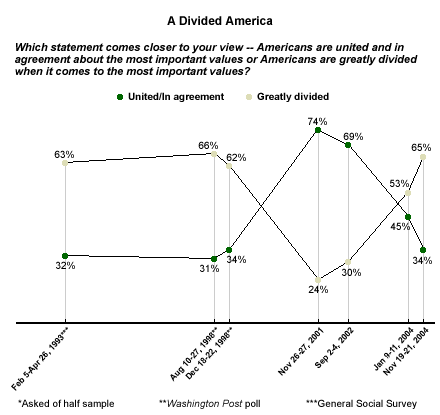
Other Gallup polling* buttresses the argument that America is divided more now than in recent years, but there have been other times when Americans perceived the nation as divided as it is now. A few weeks after the election, 65% of U.S. adults said Americans are greatly divided when it comes to the most important values, while 34% said Americans are united and in agreement. This perception is quite different from perceptions in 2001 and 2002. A few months after the Sept. 11 attacks, only 24% said that Americans were greatly divided. And, shortly before the first anniversary of the Sept. 11 attacks, only 30% said Americans were greatly divided. However, the current perception is not that different from perceptions in 1993 and 1998, when about two-thirds said Americans were greatly divided on important values.
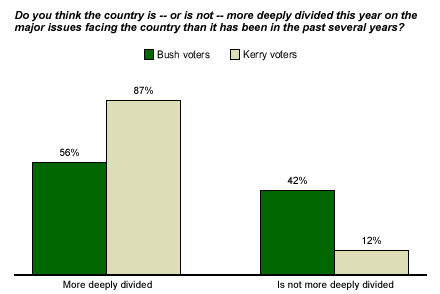
Even if there have been times in the past when they were as divided as they are now, 72% of Americans perceive the country as more deeply divided on major issues now than it has been in the past several years, compared with only 26% who believe that it isn't. Kerry voters are more inclined than Bush voters to believe the country is more divided -- 87% of people who voted for Kerry think America is more divided now than in recent years, while only 12% think it isn't. Bush voters are also more likely to see the country as more divided today, but by a much narrower margin: 56% to 42%. These findings aren't surprising given the intense emotions surrounding this election and the extreme disappointment of those who supported the losing candidate.
Can Faith Communities Make a Difference in Bridging the Divide?
Given this contentious climate, what can leaders of faith communities do to bridge the chasm between "red America" and "blue America," and help bring healing and unity to the country?
- Recognize that most of your members value
tolerance. According to Gallup's Religious Tolerance
Index** 87% of Americans are at least tolerant of other religious
faiths, practicing a "live and let live" attitude toward people
with beliefs different from their own.
- Hold study groups within your congregation to discuss
"hot topics." Congregations should promote an exchange of
ideas on issues about which faithful people disagree. Help your
members see that there is more than one side to many issues, and
disagreement does not mean heresy.
- Promote and participate in interfaith
dialogues. A good example of such an effort can be found
at www.ReachingCommonGround.com, an organization "dedicated to
building bridges between Christians and Jews." Harvard University
student Elizabeth Goldhirsh established an essay contest -- with
$100,000 in prize money -- for college students in memory of her
parents. Nearly 4,000 college students submitted essays on finding
common ground between the two religions, and the 2004 winners were
announced last November.
- Look for common ground. Help your members see
what values we, as Americans, hold in common. Despite the media
focus on what divides us, there is much that unites us.
- Emphasize respect for individuals. Encourage members to look beyond "positions" or "causes" and see people -- unique individuals of sacred worth who happen to hold different opinions.
*Results are based on telephone interviews with approximately 500 national adults, aged 18 and older, conducted Nov. 19-21, 2004. For results based on the total sample of national adults, one can say with 95% confidence that the maximum margin of sampling error is ±5 percentage points.
**Results are based on telephone interviews with 1,000 adult members of a church, synagogue, or other religious faith community, aged 18 and older, and 500 nonmembers, conducted in October and November 2003. For results based on this sample, one can say with 95% confidence that the margin of sampling error is ±2.6 percentage points.