Since the 1960s, Gallup has been asking Americans about which of three institutions they consider to be the biggest threat to the country in the future -- big business, big labor, or big government. This year, like every other year that Gallup has asked the question, big government is perceived as the biggest threat. But that consistent placement at the top of the threat list notwithstanding, public opinion on this question has varied significantly over the years, as the country's political and economic climates have changed.
Currently, 57% of Americans believe big government is the greatest threat to the country in the future, while 27% believe big business is and just 11% see big labor as the most serious threat*. These results are nearly identical to those from 2003.
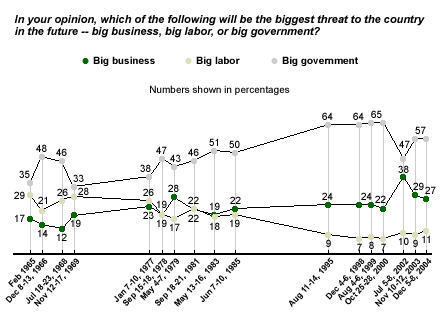
Looking back at results on this question over time reveals some interesting trends.
Big Business
The perceived threat from big business loomed largest in July 2002, when 38% of Americans said big business was the most serious threat to the country's future -- up 16 percentage points from just two years earlier. This increase in the perceived threat from big business was likely spurred by the corporate corruption scandals at companies such as Enron, Tyco, and WorldCom, which dominated news headlines that year. The future threat from big business has now dipped back to 27%, closer to where it stood in the late 1990s.
Big Government
The perceived threat posed by big government swelled to its highest levels in the mid-1990s. Each of the four times Gallup asked this question during President Bill Clinton's Democratic administration, nearly two-thirds of Americans cited big government as the biggest threat to the country's future. During the 1980s, when Republican President Ronald Reagan led the country on a platform of reducing the size of the federal government, roughly half of the public feared big government most. But despite Reagan's emphasis on smaller government, fear of big government was still somewhat higher in the 1980s than in the 1960s and 1970s.
Big Labor
The historical trend on this question reflects the diminishing influence of labor unions in recent decades. The percentage of Americans who believe big labor presents the biggest threat to the country was in the high 20s for most of the 1960s. But that percentage has declined steadily over the years, and has averaged in the single digits since 1995.
A Party Question
In this year's poll, there are no differences among Republicans, Democrats, and independents when it comes to the threat they see from big government. Similar percentages among each political group see big government as the biggest threat. More Republicans than Democrats see big labor as a threat and more Democrats than Republicans see big business as a threat. In the past, Republicans have been more likely to see big government as the greatest threat, but still a majority of all partisan groups agree.
*These results are based on telephone interviews with a randomly selected national sample of 1,003 adults, aged 18 and older, conducted Dec. 5-8, 2004. For results based on these samples, one can say with 95% confidence that the maximum error attributable to sampling and other random effects is ±3 percentage points. In addition to sampling error, question wording and practical difficulties in conducting surveys can introduce error or bias into the findings of public opinion polls.
