Last September, Gallup conducted a survey* that measured how emotionally committed Singaporean employees are to their jobs. The survey shows the percentage of engaged workers is the highest it has been since Gallup began conducting this study in 2001. The percentage of engaged workers now stands at 9%, up from 6% in 2003. The proportion of actively disengaged employees -- those who are disenchanted and disaffected -- is sharply down, from 17% in 2003 to 9% in 2004. That improvement notwithstanding, however, the sizable majority of workers in Singapore -- 82% -- remain in the "not engaged" category, meaning they're putting time, but not energy or passion, into their work.
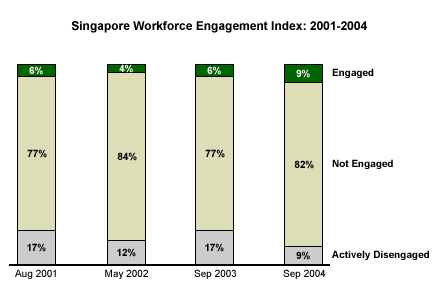
Gallup researchers estimate actively disengaged workers will cost the Singapore economy at least $4 billion (SGD) annually in terms of lost productivity.
Gallup discovered several interesting trends in the 2004 data:
- The size of the company does not seem to influence engagement.
- It doesn't matter much whether employees work in the public or private sector -- engagement levels in the two sectors are similar, and both have increased since last year.
- Engagement levels among white-collar workers are higher than
those among blue-collar workers; furthermore, engagement among
white-collar workers has increased, while the level for blue-collar
workers is unchanged.
- Among white-collar workers, managers and executives are more engaged than those who are not responsible for directing the work of other employees. But among both groups, engagement levels have increased sharply from 2003.
The Role of the Manager
Gallup's research has shown that managers play a key role in increasing employee engagement. Outstanding managers and poor managers coexist in every company, regardless of size. The disengagement present in the Singaporean workforce appears to be related particularly strongly to these manager-related issues:
- Setting expectations -- Just slightly more than a quarter of
employees "strongly agree" that they know what is expected from
them at work (by giving this item a rating of "5" on a scale of 1
to 5).
- Potential utilization -- Only about one in six Singaporean
workers strongly agree that they are in roles that give them the
opportunity to do what they do best every day. This proportion is
especially low among Singaporeans with lower levels of
education.
- Giving feedback -- Only about one in six workers also strongly
agree that they have received progress-related feedback in the past
six months.
- Learning and growing -- Finally, the percentage who strongly
agree that they have had opportunities to learn and grow in the
past year is also only about 1 in 6, though there has been
significant progress here; that number is up from 1 in 10 in 2003.
The increase on this item is one of the main drivers behind the
increase in overall workforce engagement levels.
It may seem paradoxical that, while the number saying they learn and grow at work has increased, formal investments in training appear to have declined in recent years. The survey also found 32% of Singaporean workers say they attended a company-arranged training program in the last six months, down from 37% in 2003 and 45% in 2002. Public-sector employees, those working in managerial positions, and those in larger organizations are more likely than other workers to have attended a training program.
But the quantity of formal training itself does not seem to significantly impact engagement -- the disengagement level among workers who have been through training is not very different from that among those who have not been through training. The goals of training initiatives can make a difference. Three of every four workers who said they had been through a training program indicated the program was intended to fix areas in which workers are already weak. Gallup research reveals that training is most beneficial when it is carried out to enhance a strength, not to remedy a weakness.
- Sense of caring and respect -- Only about one in seven respondents strongly agree that their manager or someone at work cares about them. And one in eight strongly agree that their opinions count in the workplace.
The article's conclusion will discuss the perceptions that Singaporeans have about the future of the economy and their own jobs and the role that engagement plays in creating positive perceptions about both the macro and micro environment.
*This study was conducted as part of a nationwide poll on perceptions about work life in Singapore that was conducted in the first two weeks of September. The study was conducted among 1,010 Singaporean citizens and permanent residents between the ages of 18 and 54 who are currently employed full or part time, using a random location quota sample. Interviewing was conducted between the period of Sept. 1, 2004, and Sept. 16, 2004. For results based on this sample, one can say with 95% confidence that the maximum error attributable to sampling and other random effects is ±3 percentage points. In addition to sampling error, question wording and practical difficulties in conducting surveys can introduce error or bias into the findings of public opinion polls.