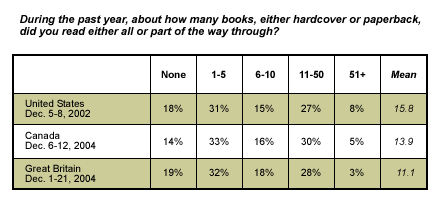
How many books a year grace the nightstands of Americans, Canadians, and Britons? Though Great Britain may boast a rich literary tradition that includes the likes of William Shakespeare, Charles Dickens, and Jane Austen, the average Briton read fewer books in the last year than the average American or Canadian. Recent Gallup polling in Canada and Great Britain* indicates that on average, Britons read 11 books in the past year, while Canadians averaged 14 books. By comparison, a December 2002 poll** found Americans saying they read even more -- an average of 16 books in the prior year.
To the disappointment of librarians and schoolteachers everywhere, close to a fifth of residents in each country said they did not read any books at all in the past year. More than 70% of people in each country fall into the 1 to 50-book range, with a few booklovers in each country (8% of Americans, 5% of Canadians, and 3% of Britons) reading more than 50 books.
Who Reads Most?
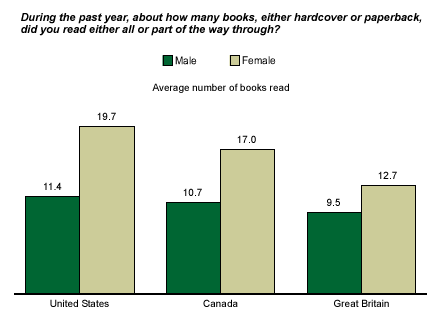
Particularly in the United States and Canada, women tend to read more than men. The difference is about eight books in the prior 12 months between American men and women and approximately six books between Canadian men and women.
Laura Prystanski, a 32-year-old Canadian writer from Ontario who worked for more than 10 years in the public library system and reads about 35 books a year, says her mother was the biggest reader between her parents. "If 'nose in a book' is a genetic condition, I definitely inherited it from her. I'm very grateful."
In commenting on why he reads only about three to four books a year, Kevin Lo, a 33-year-old Canadian from Toronto, explains, "I find myself to be easily distracted to other activities, such as riding my bike, hanging out with friends, fixing my car, etc. I do my reading mostly in times of commute, airplane rides, and before sleep."
The data reflect the idea that reading may become more appealing with age. Older respondents -- particularly those older than 60 -- tend to read more than their younger counterparts do. That may suggest that those in retirement have the time to read more and take advantage of it. All three countries show that book readership is related to the amount of formal education they have had. People who have postsecondary educations read more than those who don't.
Danielle Bouchard, a 23-year-old Londoner, says, "I can't imagine many Brits reading in their leisure time, apart from the weekend papers. Especially at my age as leisure time is generally spent socializing with others, going to the cinema and watching telly -- so there is little time to read, apart from on the commute to and from work when you don't have such options."
The competition reading faces from so many other entertainment options for young people's time poses a frustrating challenge for parents who feel it is important.
"Despite the fact that my kids [a 17-year-old son and 20-year-old daughter] were read to a lot, they are not avid readers," says Vivian Gufarotti, a 52-year-old librarian from upstate New York who reads about three books a month. "They do occasionally read for pleasure and I'm crossing my fingers that they will still grow to be readers."
Passionate Readers
To book devotees like Prystanski and Gufarotti, the residents of each country who haven't picked up a book lately are missing out on a vital part of life. "To me, reading is as important as breathing," Prystanski says. "Developmentally, it instills a grammatical intuition of a language that can't be taught. It opens minds to thoughts they might have been closed to, and teaches people that there are worlds and views beyond the narrow scope of their lives."
"I love beautifully crafted fiction that teaches me something about another culture or time in history, challenges my beliefs, or stirs me emotionally." Gufarotti says. "I like to feel that the act of reading has somehow altered me (hopefully for the better); that I am not quite the same person I was before I read the book."
*Results in Canada are based on telephone interviews with 1,004 national adults, aged 18 and older, conducted Dec. 6-12, 2004. For results based on the total sample of national adults, one can say with 95% confidence that the maximum margin of sampling error is ±3 percentage points. The survey was conducted by Gallup Canada.
Results in Great Britain are based on telephone interviews with 1,009 national adults, aged 18 and older, conducted Dec. 1-21, 2004. For results based on the total sample of national adults, one can say with 95% confidence that the maximum margin of sampling error is ±5 percentage points. The survey was conducted by Gallup UK.
**Results in the United States are based on telephone interviews with 1,001 national adults, aged 18 and older, conducted Dec. 5-8, 2002. For results based on the total sample of national adults, one can say with 95% confidence that the maximum margin of sampling error is ±3 percentage points.