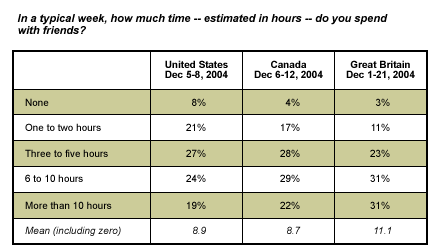
Perhaps part of the reason the Beatles got by so famously with a little help from their friends was that they were British. Recent Gallup polling in the United States, Canada, and Great Britain* shows residents of Great Britain say they typically spend about 11.1 hours per week with friends. Americans and Canadians, on the other hand, typically spend fewer than nine hours a week with friends (8.9 and 8.7 hours, respectively).
Research shows that social relationships have a positive impact on other aspects of life. Psychologists such as Martin Seligman and Edward Diener, who study positive emotions, have found that close friends and family is a key predictor of well-being -- all extremely happy people have them, without exception. "Interestingly, we also find the reverse -- that happy people have more friends, and that people put into a good mood are more sociable," says Diener. "There is a very strong relation then between having close, caring people in one's life and happiness."
Gallup's employee engagement research has shown that close personal relationships are important in the workplace as well; specifically, having a best friend at work leads to many positive outcomes both for the employees and employer.
Gender and Age Differences
In all three countries, men spend slightly more time with friends than do women. This is particularly true among American men, who spend on average about 10 hours a week with friends, while women clock only about 7 1/2 hours. In Canada and Great Britain, there is only about one hour's difference in average "friend time" between men and women.
When it comes to age, respondents in the youngest age category, 18 to 29, average spending the most time with friends, while those in the 30 to 49 age range average spending the least. People between the ages of 30 and 49 presumably tend to be more involved in raising a family or building a career, and may therefore have less time for socializing with friends. According to Diener, people develop strategies for maximizing the time they do have for friendships as they grow older. "Other psychologists have shown that older people tend to narrow their friendships, and social relationships -- they become more selective. They just don't want to spend time with people they do not like or enjoy."
Number of Friends
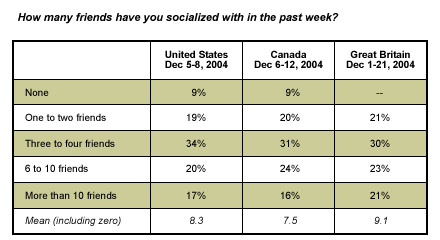
On average, residents of each country say they socialized with between seven (7.5 in Canada) and nine friends in the past week. About a third of people in each country socialized with three to four friends in the past week. In friendly Great Britain, one in five of respondents say they socialized with more than 10 friends.
Quality Over Quantity
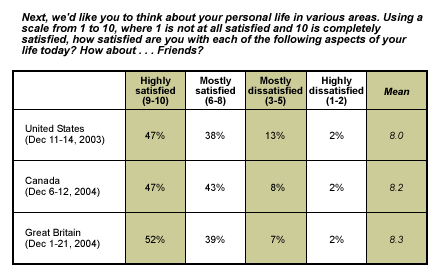
But despite some differences in time spent with friends and number of friends, the vast majority of residents of all three countries are either highly satisfied or mostly satisfied with their friends. In Great Britain and Canada, only about 1 in 10 people say they are dissatisfied with their friends; this percentage rises only slightly to 15% among Americans.
*Results in the United States are based on telephone interviews with 1,003 national adults, aged 18 and older, conducted Dec. 5-8, 2004; and 1,011 national adults, aged 18 and older, conducted Dec. 11-14, 2003. For results based on the total sample of national adults, one can say with 95% confidence that the maximum margin of sampling error is ±3 percentage points. The survey was conducted by Gallup USA.
Results in Canada are based on telephone interviews with 1,004 national adults, aged 18 and older, conducted Dec. 6-12, 2004. For results based on the total sample of national adults, one can say with 95% confidence that the maximum margin of sampling error is ±3 percentage points. The survey was conducted by Gallup Canada.
Results in Great Britain are based on telephone interviews with 1,009 national adults, aged 18 and older, conducted Dec. 1-21, 2004. For results based on the total sample of national adults, one can say with 95% confidence that the maximum margin of sampling error is ±5 percentage points. The survey was conducted by Gallup UK.
