How best to prepare kids for the future is a major concern for many Americans. Education quality is a perennial fixture on Gallup's "most important problem" list. Earlier this month, just 40% of Americans said they were satisfied with the quality of public education in the country.
A new Gallup survey* provides fresh data on a set of questions addressing Americans' opinions about public education priorities. Respondents were presented with a list of attributes and asked to rate: a) the importance of each attribute to a school's success, and b) how likely each attribute is to be present in the respondent's local schools.
Here are the items, along with the percentage of respondents who gave each item a rating of "5" for "great importance":
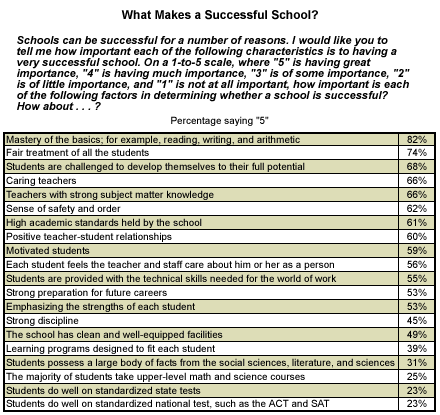
"Mastery of the basics" appears as one of the most important -- if not the most important -- items on the list, reflecting the perception that there is a minimum standard of fundamental knowledge that all students must gain in order to function well in society. The driving concern underlying No Child Left Behind (NCLB) education reform is that too many students aren't meeting that threshold.
However, Americans aren't nearly as concerned about students achieving above-average scores on standardized tests -- either the national tests like the SAT used primarily for college admissions, or state tests such as those mandated by NCLB. These two items are least likely to be rated extremely important, suggesting a disconnect in Americans' minds between academic achievement and the primary tools used to assess achievement on a large scale.
Mapping Out Opportunities
The following graph plots the perceived importance of the various attributes on the list against perceptions of how likely each attribute is to actually be in a respondent's local schools. The farther to the right an item is, the higher its importance rating; the higher it is on the graph, the more likely respondents are to think it is happening.
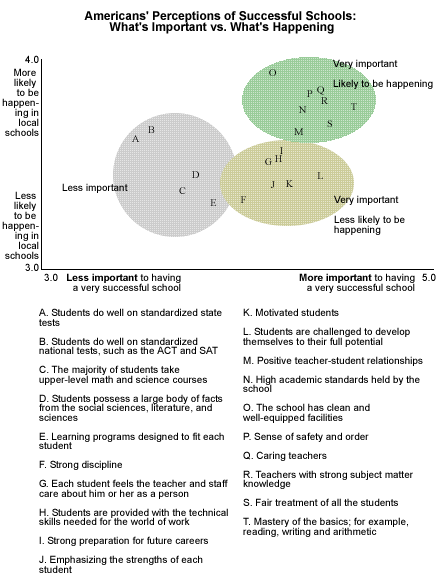
First, the good news: "Mastery of the basics" and "high academic standards" are both relatively high on the graph, suggesting most Americans feel students are being supplied with a solid academic curriculum. Also comparatively high are items relating to basic needs ("clean, well-equipped facilities," "sense of safety and order") and basic teacher quality ("caring teachers," "teachers with strong subject matter knowledge," and "positive student-teacher relationships").
Of greater concern to education reformers may be the items in the lower-right section of the graph -- those that rated high in importance but low on implementation. "Motivated students," "emphasizing the strengths of each student," and "students are challenged to develop themselves to their full potential" all fall into this area, suggesting Americans feel that keeping students engaged in their educations is one of the biggest challenges facing schools today.
The second part of this series will examine the public's opinions about the overall goals of the education system in 21st-century America.
*Results are based on telephone interviews with 1,019 national adults, aged 18 and older, conducted Nov. 3-29, 2004. For results based on the total sample of national adults, one can say with 95% confidence that the maximum margin of sampling error is ±3 percentage points.