The amount of schooling Chinese receive has risen sharply in the past two generations, and continues to rise. Since 1986, China has had a nine-year compulsory education policy, requiring six years of primary school and three years of secondary school -- the effects of which are not yet reflected across all sectors of adult society.
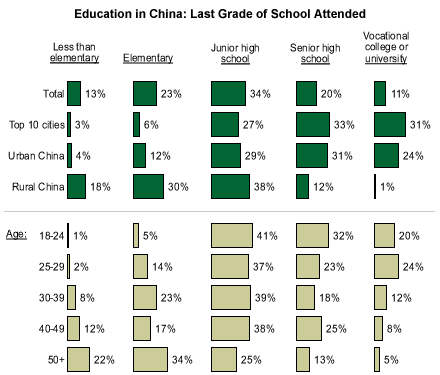
Nationwide, slightly more than a third (36%) of the adults interviewed for the latest Gallup Poll of China say their educations did not continue beyond elementary school. In rural China, however, nearly half of all adults (48%) fall into this category. Another third (34%) of China's adults report their educations ended with the completion of junior high school, while one in five (20%) attended through high school. Roughly a tenth (11%) of Chinese adults have attended university or technical college, though this percentage rises to 31% among residents of the country's 10 largest cities.
The cross-generational differences in educational attainment are stark. While a mere 6% of Chinese between the ages of 18 and 24 say their own educations continued no farther than the completion of elementary school, this is true for 56% of those aged 50 and older. Similarly, while more than half of 18- to 24-year-olds have attended either high school (32%) or university/technical college (20%), only about a fifth of those aged 50 and older have done so (13% attended high school, 5% attended college).
Obviously, China's earlier generations failed to receive educational opportunities like those accorded to today's youth -- but it's also worth noting that this deprivation is particularly acute among older women. Among women aged 60 and older, 44% did not even complete elementary school. Among men in this same age group, only 13% failed to complete elementary school.
Gender inequality in access to higher education now appears to have vanished. Nationwide, 23% of women aged 18 to 29 have attended university or technical college -- statistically the same as men in this age group (22%).
Muted Satisfaction With Own Education
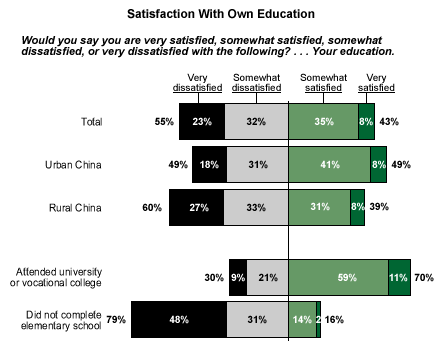
The positive effects of the relatively recent mandate to establish years of compulsory schooling have yet to work their way throughout society -- which is reflected in the relatively poor ratings many adult Chinese give to their own educations. As noted in "China's Citizens Optimistic, Yet Not Entirely Satisfied" (see Related Items), only 43% of Chinese are either very (8%) or somewhat (35%) satisfied with their own educations, while 55% describe themselves as either somewhat (32%) or very (23%) dissatisfied. Rural residents, who generally have less access to advanced schooling, are significantly less likely to say they are very or somewhat satisfied with their own educations (39%) than are their urban counterparts (49%).
Not surprisingly, the level of satisfaction with one's education corresponds closely to the actual level of education attained. Those fortunate enough to have attended either university or technical college are dramatically more likely to be satisfied with their educations (70%) than are those who did not complete elementary school (16%).
Strong Satisfaction With the Education Children Are Receiving
Whatever their misgivings about their own educations, Chinese parents are likely to be satisfied with the education their children are now receiving. This no doubt reflects that today's children have far greater access to extended schooling than did their parents. It may also reflect recent attempts to improve the quality of Chinese teaching. The National School Reform, introduced in 2003, aims to increase teacher interaction with students and encourage greater classroom participation and discussion -- features not traditionally characteristic of Chinese education.
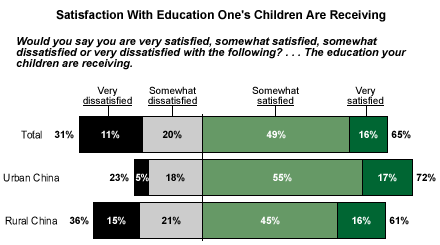
Among Chinese with school-aged children, roughly two-thirds (65%) are satisfied with the education their children now receive (16% very satisfied, 49% somewhat satisfied), while just 31% say they are either somewhat (20%) or very (11%) dissatisfied in this regard.
Among urban residents with school-aged children, 72% are satisfied with their children's education -- a share nearly half again as high as the percentage of urban parents expressing satisfaction with their own educations (49%). In rural China, three-fifths (61%) of residents with school-aged children are pleased with their children's schooling -- sharply higher than the 39% of rural parents who take this view regarding the educations they personally received.
Admissions Competition Spurs Private Schools and Tutoring
Standardized exams are now a prerequisite for acceptance to academic-track secondary schools, as well as to universities and technical colleges. In light of the huge dividends such admission pays for their children's future, a growing number of young Chinese families now pay to send their children to private classes held after normal school hours and on Saturdays -- a development mirroring that of Japan's famed "cram schools."
For those in academic-track secondary schools, the ultimate objective of this additional effort is the national college entrance examination, held each year. An outstanding score on this examination is a prerequisite for admission to the country's best colleges and universities, of which Tsinghua University, Peking University, Fudan University, and Shanghai Jiao Tong University are among the highest rated.
Chuanping Zhang, Paul Ni, Yushi Guo, and Lini Yu contributed valuable insights to this report.