No parents want their children to adopt habits that pose serious health risks, such as excessive drinking, smoking, or using illicit drugs. But the fact is many children will experiment with each of these substances, with some non-trivial percentage eventually becoming regular users or abusers.
According to the most recent Gallup Youth Survey*, 17% of teenagers (aged 13 to 17) are willing to admit they have occasion to use alcohol, 13% say they had tried marijuana, and 5% say they had smoked cigarettes in the past week. These rates represent different frequencies of use, but probably reflect the use patterns that are most troubling to parents: occasional drinking, experimentation with drugs, and regular use of tobacco.
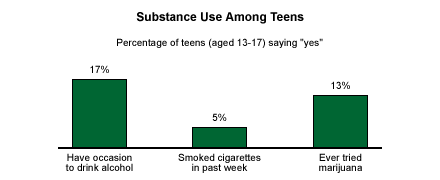
The rates of drinking and experimentation with marijuana, at least, are high enough that all parents would be wise to take an active role in discouraging their children from getting involved in these behaviors. But the data show some teens are more likely to fall prey to temptation than others.
Substance Use by Age, Family Status, and Church Attendance
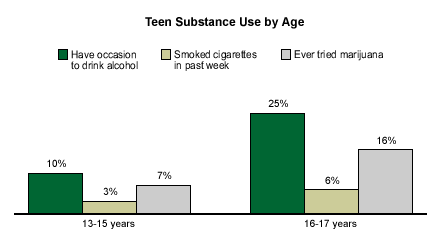
First of all, drinking, smoking, and marijuana use are more prevalent among older teens than younger teens. The rates of use are at least double among 16- and 17-year-olds, compared with those aged 13 to 15. So, come about 10th grade, parents should really start to worry.
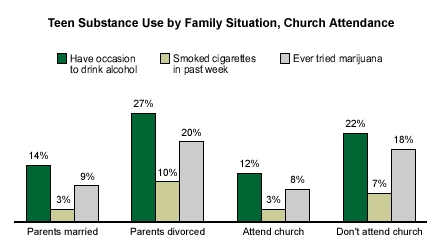
Household structure is another important factor. Teens whose parents are divorced are about twice as likely as those whose parents are married to report these behaviors.
Being active in one's religious faith is also correlated with lower rates of risky behavior. Teens who attended church or synagogue in the last week (an indicator of regular attendance) are about half as likely to drink, smoke cigarettes, or experiment with marijuana as those who didn't attend. However, whether this is because of the influence of religion or the influence of family is unclear. Church attendance is much higher among teens whose parents are married (53%) than among those whose parents are divorced (38%). Most likely the two factors -- family and church attendance -- work in tandem to positively influence teens.
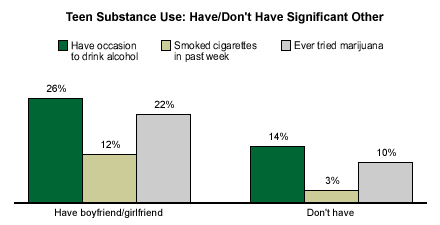
A third factor, which is not highly related to the marital structure of the household or teens' religious attendance (or even to age), is having a boyfriend or girlfriend. Teens involved in these relationships are about twice as likely to drink and have tried marijuana, and are much more likely to smoke, than are those who have no boyfriend or girlfriend.
Substance Use by Class Standing and Gender
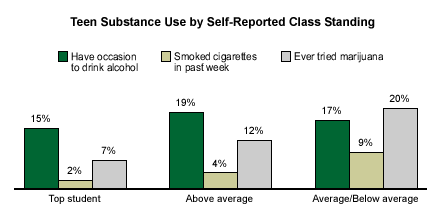
Being a good student is associated with lower rates of cigarette smoking and trying marijuana, but it is no barrier to the influence of alcohol. Fifteen percent of teens who describe themselves as top students say they have occasion to drink, compared with 17% of those who are average or below average in school.
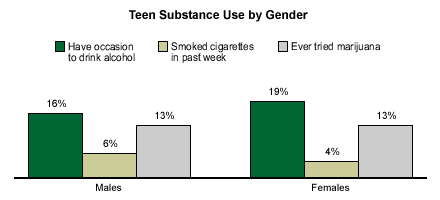
Gender does not seem to be important in relation to these risky behaviors. Male and female teens exhibit equal tendencies to drink, smoke, and try marijuana.
Bottom Line
Some parents may try to lull themselves into a false sense of security about their children's association with risky behaviors. Others may have exaggerated fears about the chances their kids could wind up in rehab before they get to college. In either case, information about the true pattern of substance abuse among teens is probably helpful.
The Gallup data confirm the importance of stable families to warding off peer pressure. Religious faith, whether alone or in tandem with a nuclear family, may also help. At the same time, the data suggest that, while "going steady" may have been a wholesome venture for the merry band of high school students on Happy Days, it can perhaps hasten one's sense of maturity -- or at least be associated with an inflated sense of maturity. And wanting to feel "grown up," according to some research, is the real driving force behind the attraction of these risky activities.
*These results are based on telephone interviews with a randomly selected national sample of 1,028 teenagers in the Gallup Poll Panel of households, aged 13 to 17, conducted Jan. 17 to Feb. 6, 2005. For results based on this sample, one can say with 95% confidence that the maximum error attributable to sampling and other random effects is ±3 percentage points. In addition to sampling error, question wording and practical difficulties in conducting surveys can introduce error or bias into the findings of public opinion polls.