Americans' views of several countries around the world vary significantly depending on their party affiliation. Recent Gallup polling shows that Republicans and Democrats differ most in their ratings of nations in which the United States has taken military action following the Sept. 11, 2001, terrorist attacks, and in ratings of some of the countries that have supported or opposed U.S. military action in Iraq.
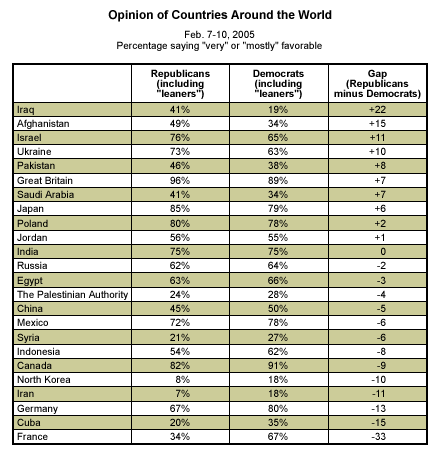
Gallup's Feb. 7-10 poll* shows that Republicans are much more likely than Democrats to rate Iraq and Afghanistan favorably, while Democrats are more favorable than Republicans toward France and Germany. Democrats are also more positive than Republicans about Iran and North Korea -- two nations, along with Iraq, that President George W. Bush described as part of the "axis of evil" in his 2002 State of the Union address.
Overall Results
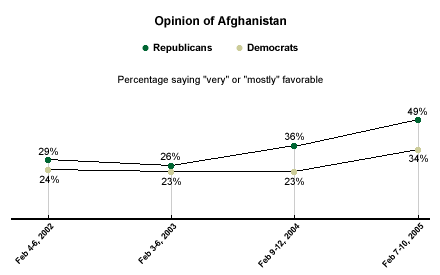
Republicans, including independents who lean toward the Republican Party, are most likely to differ from Democrats, including Democratic leaners, in their favorable views of Iraq (41% vs. 19%) and Afghanistan (49% vs. 34%). Republicans also view the following nations more favorably than Democrats do: Israel, Ukraine, Pakistan, Great Britain, Saudi Arabia, and Japan.
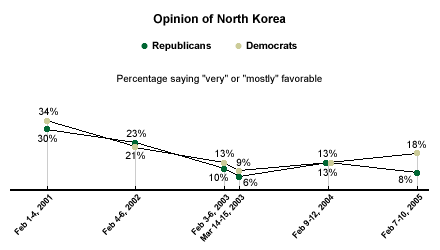
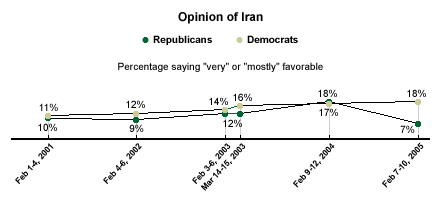
Democrats, meanwhile, are more likely than Republicans to favorably rate France (67% vs. 34%), Cuba (35% vs. 20%), Germany (80% vs. 67%), Iran (18% vs. 7%), and North Korea (18% vs. 8%). Views of Canada, Indonesia, Syria, Mexico, and China also are more favorable among Democrats than Republicans.
Republicans and Democrats show essentially no difference in their ratings of six other nations -- Poland, Jordan, India, Russia, Egypt, and the Palestinian Authority.
For the most part, these favorability gaps are small enough that the majority of Republicans and Democrats are, nevertheless, in agreement in their views of each country. The major exception to this is France: 67% of Democrats view this country favorably, while 34% of Republicans view it favorably.
Partisan Views of Nations Changed With Start of Iraq War
Republicans' and Democrats' opinions of several nations shifted as the United States made its case for going to war in Iraq in early 2003.
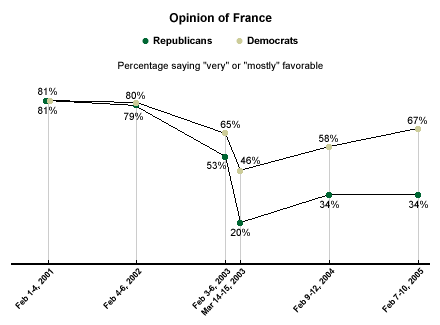
- France. Republicans and Democrats showed essentially no difference in their views of France in 2001 and 2002. However, favorable views of France dropped substantially among both groups in early 2003, but much more so among Republicans than Democrats. Among Democrats, France's favorable ratings reached a low of 46% in mid-March 2003, while ratings dropped all the way to 20% among Republicans. Since that time, ratings of France have improved among both groups, but Democrats are now twice as likely as Republicans to rate that country positively.
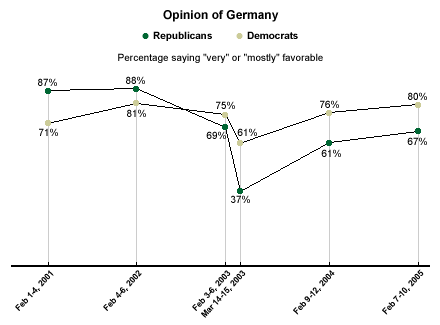
- Germany. Republicans rated Germany more favorably than Democrats did in 2001 and 2002. But, Republicans' favorable ratings of Germany plummeted to 37% about a week before the start of the Iraq war. The favorable ratings also dropped among Democrats at that time, but only to 61%. Since 2003, ratings of Germany have rebounded among both Republicans and Democrats, but Republicans continue to view Germany less favorably than Democrats do.
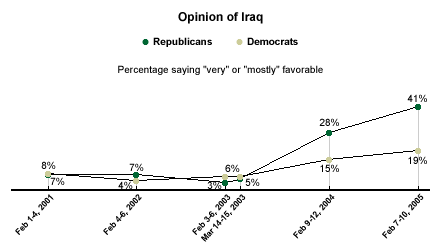
- Iraq. Few Americans rated Iraq favorably prior to the start of the Iraq war. Fewer than 1 in 10 Republicans and Democrats rated Iraq favorably from 2001 to 2003. Last year, the favorable ratings of Iraq surged among both Republicans and Democrats, with a 23-point increase from March 2003 to February 2004 among Republicans and a 9-point increase among Democrats. The latest poll finds another jump in Republicans' favorable ratings of Iraq, from 28% to 41%, but essentially no change in Democrats' views of the country.
- Afghanistan. In 2002 and 2003, Gallup found only slight variations in ratings of Afghanistan among Republicans and Democrats. Favorable ratings of Afghanistan increased among Republicans in 2004, from 26% to 36%, while they remained unchanged among Democrats last year. In 2005, ratings increased among both groups, with nearly half of Republicans rating the country favorably and only about a third of Democrats doing so.
- North Korea. Republicans and Democrats have shown essentially no difference in their views of North Korea until this year, when 18% of Democrats rated the country favorably, compared with only 8% of Republicans.
- Iran. As Gallup found with North Korea, there have only been slight partisan variations in ratings of Iran from 2001 through 2004. The current poll, however, finds an 11-point gap between Republicans and Democrats, with Democrats rating Iran more favorably than Republicans do.
Bottom Line
Republicans and Democrats differ in their views of many countries around the world. Over the past two years, Democrats have grown relatively more favorable toward nations that opposed the war in Iraq, while Republicans have grown relatively more positive about nations the United States has invaded since the 9/11 terrorist attacks.
This year, Gallup also found partisan differences emerging in views of North Korea and Iran.
*Results are based on telephone interviews with 1,008 national adults, aged 18 and older, conducted Feb. 7-10, 2005. For results based on the total sample of national adults, one can say with 95% confidence that the maximum margin of sampling error is ±3 percentage points. In addition to sampling error, question wording and practical difficulties in conducting surveys can introduce error or bias into the findings of public opinion polls.
