When Gallup asks Americans on an open-ended basis about top problems facing the county, the economy is always at or near the top of the list, while environmental concerns seldom break the top five issues mentioned. For most people, economic conditions are more top-of-mind than environmental concerns -- and therefore they carry more political weight. "People vote their pocketbooks," the saying goes, not "people vote their air quality."
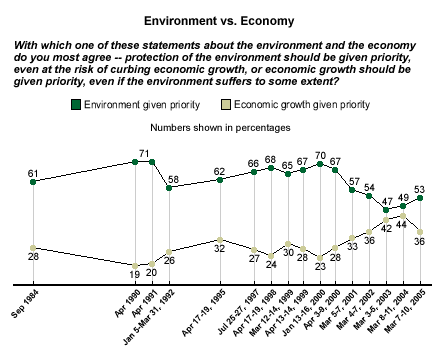
But civic leaders, political strategists, and environmentalists should take note of one Gallup Poll question in which the environment consistently trumps the economy in the public's mind. When presented with an explicit choice about which should be given priority -- protecting the environment or economic growth -- a majority of Americans select protecting the environment. With a few recent exceptions, a clear majority of Americans have chosen the environment over the economy on this question since Gallup began asking it more than 20 years ago.
According to Gallup's March 2005 environment poll*, slightly more than half of Americans (53%) say protecting the environment should be given priority "even at the risk of curbing economic growth," while a third (36%) prioritize economic growth "even if the environment suffers to some extent." Eleven percent say both should be given equal priority or have no opinion. These most recent results represent a tilt back toward the environment from the past two years, when less than half of Americans favored the environment over the economy.
The existing data on this question suggest that preference for the environment is stronger when the economy is good, which might explain the dip below 50% in pro-environment responses in the past few years and the high 70% pro-environment score in 2000. That has not always been the case, though, as the recent resurgence of the environmental movement in the early 1990s also found strong pro-environment sentiment, at the same time the economy was in recession (although the pro-environment responses declined considerably in 1992).
Age and Politics Influence Environmental Attitudes
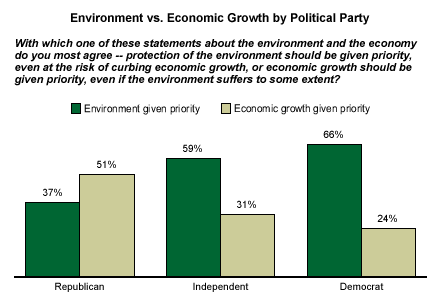
The public's willingness to place environmental protection above economic growth is far from universal -- there is significant variance by age and political affiliation, for example. Republicans and older Americans are less likely to prioritize the environment.
Thirty-seven percent of Republicans say they favor environmental protection over economic growth, while 51% would put economic growth ahead of the environment. A majority of independents (59%) place environmental protection first, while just 3 in 10 (31%) pick growing the economy. Among Democrats, two-thirds (66%) choose protecting the environment as the higher priority, while 24% choose economic growth.
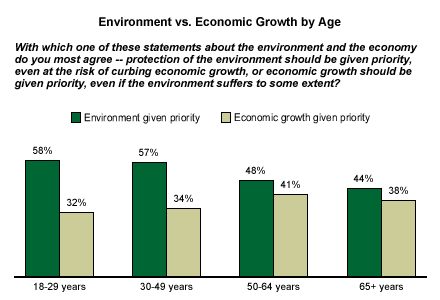
Older Americans are significantly less likely than younger Americans to choose the environment as their top priority. A majority of 18- to 29-year-olds (58%) and 30- to 49-year-olds (57%) pick protecting the environment over economic growth. Among 50- to 64-year-olds, 48% prioritize protecting the environment. Just 44% of Americans aged 65 and older place the environment ahead of the economy.
Green by Region?
The West Coast (especially California) is often stereotyped as the nation's hotbed of environmental activism. But when looking at the results by geographic region, the Midwest actually has the highest percentage of Americans who choose the environment (60%), followed by the South (55%), the East (50%), and then the West (45%). The 2004 environment poll showed similar results by region. It could be that the regions with the most dependence on farming are also most willing to prioritize environmental protection over economic growth. After all, farmers were the first environmentalists and agribusiness leaders know the value of land and resource conservation.
*These results are based on telephone interviews with a randomly selected national sample of 1,004 adults, aged 18 and older, conducted March 7-10, 2005, respectively. For results based on these samples, one can say with 95% confidence that the maximum error attributable to sampling and other random effects is ±3 percentage points. In addition to sampling error, question wording and practical difficulties in conducting surveys can introduce error or bias into the findings of public opinion polls.
