Are hospitals actively working to improve inpatient satisfaction? For almost all hospitals the answer is a definite "yes" -- and for many, patient satisfaction is a key indicator of hospital success. When patient feedback from the Hospital Consumer Assessment of Health Plans (HCAHPS) survey is reported to the public next year, the pressure will definitely be on to improve the patient experience.
At many hospitals, efforts to improve inpatient satisfaction focus almost exclusively on nursing staff performance. A cursory analysis of inpatient satisfaction data would typically suggest this focus is correct -- that nursing-related measures are the key drivers of inpatient satisfaction.
But this focus misses a key influence on inpatient satisfaction. Nursing's primary effect on the patient experience kicks in only after the patient actually arrives in the inpatient care unit. For many such units, more than half of the admitted patients are referred from the emergency department. And interestingly enough, patients admitted through the emergency department give significantly lower inpatient satisfaction ratings than those admitted directly.
Role of the Emergency Department in Inpatient Satisfaction
We examined aggregated inpatient satisfaction ratings for more than 140,000 discharges in 2004. For all of Gallup's core questions, with the exception of food service ratings, ratings of inpatient services were significantly lower among emergency department admissions. The largest difference appears in a question addressing patients' perceptions of quality: Emergency department admissions score 0.12 lower than direct admissions in their belief the hospital is the best at treating their medical conditions.
On a four-point scale, 6 of 20 operational core questions show a substantial variance of 0.06 or more between direct admissions and emergency department admissions. The greatest disparity is apparent in patients' perceptions of hospital processes.
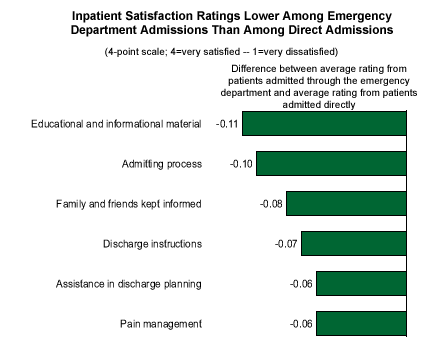
These results indicate the ratings gap can't simply be attributed to time spent waiting in the emergency department for an inpatient bed. Although that's surely a factor in satisfaction with the admitting process, it doesn't account for gaps in patient and family communication, the discharge process, or pain management. Certainly, emergency department admissions can have unique issues that make discharge planning more difficult. And yes, a backlog of patients waiting in an emergency department neither staffed nor structured for longer-term patient care can stretch pain management capabilities.
But these strike me as incomplete explanations. Hospitals should be able to narrow this ratings gap by improving coordination and communication in the emergency department-inpatient admission process.
What Are Hospitals Doing to Improve?
Best-practice hospitals are developing innovative strategies to deal with these issues. For example, some have expanded the idea behind bedside registration, which has vastly improved patient satisfaction with emergency department waiting time, to emergency department inpatient admissions. During extended holding periods, an experienced inpatient nurse gathers all the information necessary for inpatient admission. The nurse may also support care for such patients being held in the emergency department. When a bed is available and the patient is admitted, the nurse accompanies the patient to the inpatient unit, briefs and turns the patient over to the responsible unit nurse.
Like bedside registration in the emergency department itself, this process improves the hospital's perceived efficiency. The personal contact with an experienced inpatient nurse also improves communication with the patient and family. This strategy has typically been applied only when emergency department holds have been awaiting inpatient beds for extended periods -- but there's no reason it could not be applied to all admissions whose condition is not immediately life-threatening.
Bottom Line
Focusing solely on nursing and the nursing unit to improve inpatient satisfaction ignores issues significantly depressing satisfaction for more than half of the patients in many inpatient units. The problem is not simply a failing of the emergency department or the inpatient unit. It is an issue of the integration between the two entities. Neither the emergency department nor the inpatient unit can solve this problem alone. For hospitals serious about improving inpatient satisfaction, a joint emergency department-inpatient committee to study and guide implementation strategies for improving consistency and communication is important to success.