GALLUP NEWS SERVICE
The doctor keeps talking, talking but his eyes keep darting, darting to my fist -- wondering if I'll give him a crisp blue-colored bill.
-- Anton Chekhov, The Cherry Orchard, 1904
PRINCETON, NJ -- Has the move to a more market-oriented economy in Russia begun to clean up the culture of bribery and graft that characterized the country during Chekhov's time and throughout the Soviet era? Gallup World Poll data indicate that three in four Russians would say no, that there is actually more corruption in Russian society now than there was prior to the collapse of the Soviet Union in 1991. Analysts have noted that the only difference is that there is now more money in the system, so that previously informal patronage relationships are now more likely to involve cash exchanges.
Because of that shift, many transactions that would be considered bribes by European or North American standards are often not labeled as such by Russians if they don't actually involve money changing hands. Gallup's survey made it clear that the questions being asked concerned not only money, but also gifts or mutually rendered services and favors. Even so, it's likely that the results for Russia underestimate the true prevalence of what those in developed Western societies would consider bribery.
Nevertheless, according to the data, 21% of those questioned admitted to having personally given a bribe in the last 12 months. Among Moscow residents, the number is far higher, at 40%. By comparison, the incidence of bribery in St. Petersburg, Russia's northern capital and the city where the G8 leaders met not long ago, is close to the national average, at 19%.
Shades of Gray
With so many having had personal experience with bribery, Russians have taken a nuanced view of its morality and role in society. In cases where the issue significantly affects human well-being -- for example, in matters of health and the lives of loved ones -- they are resignedly ready to give recompense-seekers their last penny.
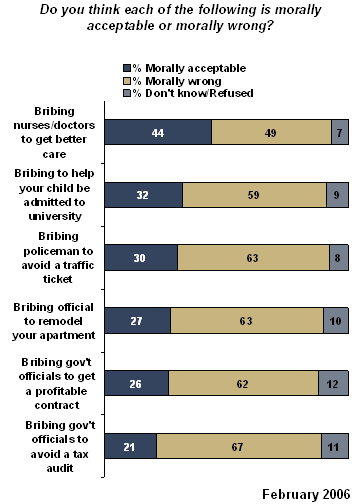
Of those surveyed, 44% consider it morally acceptable to bribe "nurses or doctors in order to get better care in the hospital." Fifty-seven percent of those who have admitted to giving a bribe in the past 12 months confirmed that they have personally "unofficially paid" a nurse or a physician to provide care.
About one-third of those surveyed (32%) say they consider it morally acceptable to give a bribe in order to have a child admitted to a college/university. Among Russians aged 15 to 24 (those most likely to be in college or considering college), 42% consider such bribes to be morally acceptable.
Russian business entrepreneurs are perhaps more likely to have to give bribes than anyone else (in Russia, a bribe given in the course of business is termed "otkat" -- literally, "kickback"). According to the INDEM Foundation, four years ago, the average sum of enticements that government officials demanded from business owners was $10,000; today, the chance to set up and develop one's own business costs about $135,000.
Willingness to engage in bribery is common among Russians who own businesses -- Gallup's data reveal that 47% of respondents who say they are business owners also say they have given bribes in the last 12 months. As the graph indicates, Russians who have thought about starting their own businesses are significantly more likely than those who have never thought about starting a business to consider each type of bribe listed as morally acceptable. Thirty-two percent of those who have ever thought about starting their own businesses say they have given bribes in the last 12 months (versus the overall figure of 21% for the entire population).
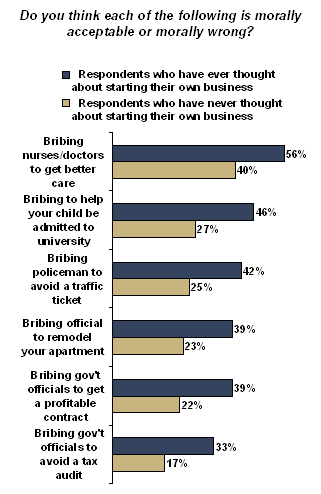
Finally, the idea that bribery has attained a veneer of legitimacy is reflected in that the percentage of government employees who admit to having given bribes is no less than the corresponding percentage among all Russians. Government employees are also just as likely as other respondents to say they consider bribes to be morally acceptable.
Culture of Corruption?
That there is a relatively large proportion of Russians who view various forms of bribery as morally acceptable bespeaks the entrenched nature of the practice. Many Russians may view bribery as a victimless crime, simply because it has for so long been part of the way things are done. But since Mikhail Gorbachev's glasnost reforms of the late 1980s, a growing body of literature has documented how bribery undercuts the rule of law, slows democratic reforms, and ensures that those without the means to pay bribes will not have the means to improve their quality of life.
Perhaps most troubling is the idea that Russian culture has grown more corrupt since the fall of the Soviet Union, not less. Young Russians are even more accepting of bribery than are those who can clearly remember the Soviet era: For every type of bribe listed, the younger the respondent, the more likely he or she is to feel it is morally acceptable.
Survey Methods
Results are based on face-to-face interviews conducted in February 2006 with a randomly selected national sample of 2,011 Russian adults, aged 15 and older. For results based on these samples, one can say with 95% confidence that the maximum error attributable to sampling and other random effects is ±2.4 percentage points. In addition to sampling error, question wording and practical difficulties in conducting surveys can introduce error or bias into the findings of public opinion polls.
