GALLUP NEWS SERVICE
PRINCETON, NJ -- It would hardly be shocking if, presented with a substantial jackpot of money, either Oprah Winfrey or Bill Gates were to donate it all to charity or a specific cause. The personal wealth and philanthropy of these individuals are legendary. But what about the rest of us? Devising ways to spend a financial windfall is a daydreamer's delight, but it turns out the nature of the decisions somewhat depends on the amount of money involved.
In the latest Gallup Panel survey, conducted Nov. 27-29, half of respondents were asked what their first act would be if they were suddenly handed a $1 million inheritance or prize; the other half were asked about receiving $100 million.
In either case, the two primary types of responses involve meeting practical household expenses and giving to others -- the only difference is the degree to which each type of response is mentioned, depending on whether $1 million or $100 million is available. Splurging on luxury or other personal items is far down on both lists. A handful of Americans would start by paying the taxes owed or taking some other precautionary action, such as consulting with a lawyer or an accountant.
Million-Dollar Windfall Stirs Financial Responsibility
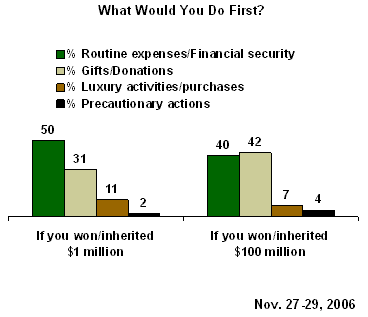
At the million-dollar level, half of Americans (50%) would first do something sensible for their households, such as clear their debts, buy a house, pay off a mortgage, invest or save money, or put some money toward college expenses. Only about a third (31%) would first make a donation to charity or use the money to help a friend or family member. However, that level of generosity still exceeds the 11% who would rush out and indulge a personal desire, such as buying a new car, taking a trip, or quitting their job. A handful of Americans (2%) think extremely practically on this subject, saying their first act would be to contact a financial or legal consultant or pay the taxes owed.
More specifically, 19% would pay off bills and 15% would either buy a house or pay off their mortgage, while 16% would make sure friends and family members are financially cared for and 13% would make a religious or charitable donation. Just 3% would first buy a new car, take a trip, or use the money for entertainment.
If you suddenly won or inherited ONE MILLION dollars, what would be the first thing you would do with it?
|
|
2006 |
|
Routine expenses/Financial security |
% |
|
Pay off all bills/debts |
19 |
|
Buy a house/Pay off mortgage/house improvements |
15 |
|
Put in the bank for saving/investing |
13 |
|
Pay/Invest in education of myself and others |
3 |
|
|
|
|
Gifts/Donations |
|
|
Make sure friends/family members are financially |
16 |
|
Donate to charities/churches/those in need |
13 |
|
Give it away/Share it |
2 |
|
|
|
|
Luxury activities/purchases |
|
|
Spend it on entertainment, toys, etc. |
3 |
|
Buy a new vehicle |
3 |
|
Take a trip/Travel |
3 |
|
Buy land/property |
1 |
|
Quit my job/retire |
1 |
|
|
|
|
Precautionary actions |
|
|
Contact a financial consultant/tax adviser |
1 |
|
Pay the taxes |
1 |
$100 Million Windfall Inspires More Philanthropy
By contrast, at the $100 million level, the average American is a bit more inclined to act like a tycoon. Forty-two percent say they would first use the money to help others in some way -- compared with 31% of those asked about a $1 million prize. Just 40% of those with $100 million to spend -- contrasted with 50% of those with $1 million -- would first put it toward practical household expenses. At the $100 million level, 7% would start by indulging themselves and 4% would think first of protecting themselves in some way, either by paying the taxes owed or consulting an adviser.
In terms of specific responses, 20% would make a donation to charity or a church and 17% would seek to help friends or family, while 18% would pay off their bills, 10% would save or invest it, and 8% would buy a house or pay off their mortgage. Only 1% to 2% would make any of several specific personal or luxury purchases.
If you suddenly won or inherited ONE HUNDRED MILLION dollars, what would be the first thing you would do with it?
|
|
2006 |
|
% |
|
|
Gifts/Donations |
|
|
Donate to charities/churches/those in need |
20 |
|
Make sure friends/family members taken care of |
17 |
|
Give it away/Share it |
5 |
|
|
|
|
Routine expenses/Financial security |
|
|
Pay off all my debts/bills |
18 |
|
Put in the bank for saving/investing |
10 |
|
Buy a house/Pay off mortgage/house improvements |
8 |
|
Pay/Invest in education of myself/others |
4 |
|
|
|
|
Luxury activities/purchases |
|
|
Buy a new vehicle |
2 |
|
Take a trip/Travel |
2 |
|
Spend it on entertainment, toys, etc. |
1 |
|
Buy land/property |
1 |
|
Quit job/retire |
1 |
|
|
|
|
Precautionary actions |
|
|
Contact a financial consultant/tax adviser |
2 |
|
Pay the taxes |
1 |
|
Contact a lawyer |
1 |
Benevolence Increases With Age
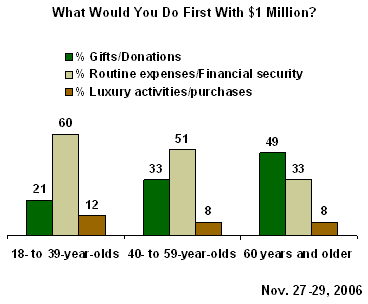
Gallup finds little difference in the spending proclivities of men and women on these questions. However, the impulse to be generous appears to increase with age -- probably in part because older Americans are less likely to have mortgages or large household expenses. Given $1 million, only 21% of those aged 18 to 39 would first give a charitable donation or gift of any kind. This increases to 33% among those aged 40 to 59 and to 49% among those 60 and older. Young people are, conversely, much more inclined to use the money for practical life expenses, including buying a house, paying off debts, or putting it into savings.
This is not to say that, given a financial windfall, younger adults would not use it to make charitable donations, but they are generally unlikely to make charitable giving their first act.
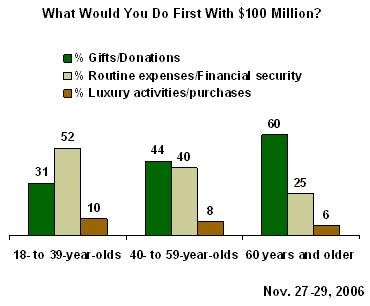
The same generational pattern is seen among those asked what they would do with $100 million.
Survey Methods
Results for this panel study are based on telephone interviews with 1,003 national adults, aged 18 and older, conducted Nov. 27-29, 2006. Respondents were randomly drawn from Gallup's nationally representative household panel, which was originally recruited through random selection methods. For results based on the total sample of national adults, one can say with 95% confidence that the maximum margin of sampling error is ±3 percentage points.
For results based on the 507 national adults in the Form A half-sample and 496 national adults in the Form B half-sample, the maximum margins of sampling error are ±5 percentage points.
In addition to sampling error, question wording and practical difficulties in conducting surveys can introduce error or bias into the findings of public opinion polls.
23. If you suddenly won or inherited ONE MILLION dollars, what would be the first thing you would do with it? [OPEN-ENDED]
BASED ON 507 NATIONAL ADULTS IN FORM A
|
|
2006 |
|
% |
|
|
Pay off all bills/debts |
19 |
|
Make sure friends/family members are financially |
16 |
|
Buy a house/Pay off mortgage/house improvements |
15 |
|
Donate to charities/churches/those in need |
13 |
|
Put in the bank for saving/investing |
13 |
|
Spend it on entertainment, toys, etc. |
3 |
|
Buy a new vehicle |
3 |
|
Pay/Invest in education of myself and others |
3 |
|
Take a trip/Travel |
3 |
|
Give it away/Share it |
2 |
|
Pay the taxes |
1 |
|
Buy land/property |
1 |
|
Contact a financial consultant/tax adviser |
1 |
|
Quit my job/retire |
1 |
|
Contact a lawyer |
* |
|
|
|
|
Other |
4 |
|
Nothing |
* |
|
No opinion |
2 |
|
|
|
|
* Less than 0.5% |
|
24. If you suddenly won or inherited ONE HUNDRED MILLION dollars, what would be the first thing you would do with it? [OPEN-ENDED]
BASED ON 496 NATIONAL ADULTS IN FORM B
|
|
2006 |
|
% |
|
|
Donate to charities/churches/those in need |
20 |
|
Pay off all my debts/bills |
18 |
|
Make sure friends/family members taken care of |
17 |
|
Put in the bank for saving/investing |
10 |
|
Buy a house/Pay off mortgage/house improvements |
8 |
|
Give it away/Share it |
5 |
|
Pay/Invest in education of myself/others |
4 |
|
Buy a new vehicle |
2 |
|
Contact a financial consultant/tax adviser |
2 |
|
Take a trip/Travel |
2 |
|
Spend it on entertainment, toys, etc. |
1 |
|
Buy land/property |
1 |
|
Pay the taxes |
1 |
|
Quit job/retire |
1 |
|
Contact a lawyer |
1 |
|
|
|
|
Other |
4 |
|
No opinion |
1 |